

260
P. Torruella et al.
11.1.1.2 Weighted Back-Projection (WBP)
This technique consists in the reconstruction of the original object from the projections in direct space [10]. To that end, the back-projection bodies are built, smearing
the projected images back in the original projection angles. WBP has been extensively
used for single tilt axis experiments (mainly in medical and biological applications
[11, 12]). Not only it can be analytically resolved but it is also equivalent to Fourier
methods. Besides, some of the artefacts intrinsically associated to WBP, due to the
discrete nature of the experiments, are easily removed by applying a combination
of ramp and low-pass filters. However, WBP performance is far from that of the
iterative methods listed below.
11.1.1.3 Algebraic Reconstruction Techniques (ART)
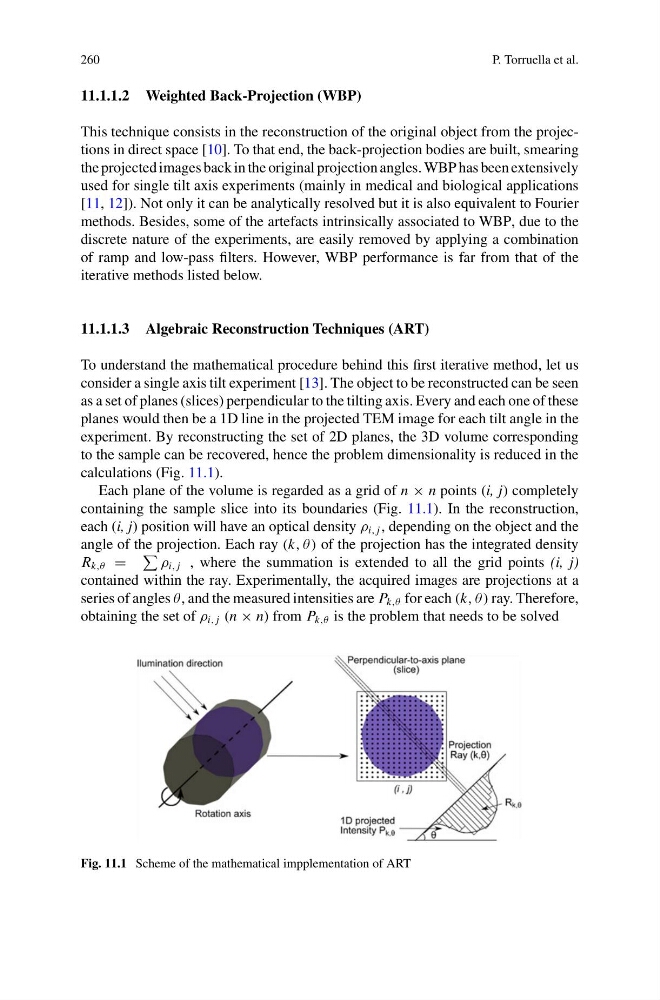
To understand the mathematical procedure behind this first iterative method, let us
consider a single axis tilt experiment [13]. The object to be reconstructed can be seen
as a set of planes (slices) perpendicular to the tilting axis. Every and each one of these
planes would then be a 1D line in the projected TEM image for each tilt angle in the
experiment. By reconstructing the set of 2D planes, the 3D volume corresponding
to the sample can be recovered, hence the problem dimensionality is reduced in the
calculations (Fig. 11.1).
Each plane of the volume is regarded as a grid of n × n points (i, j) completely
containing the sample slice into its boundaries (Fig. 11.1). In the reconstruction,
each (i, j) position will have an optical density ρ i, j , depending on the object and the
angle of the projection. Each ray (k, θ) of the projection has the integrated density
R k,θ =
ρ i, j , where the summation is extended to all the grid points (i, j)
contained within the ray. Experimentally, the acquired images are projections at a
series of angles θ , and the measured intensities are P k,θ for each (k, θ) ray. Therefore,
obtaining the set of ρ i, j (n × n) from P k,θ is the problem that needs to be solved
Fig. 11.1 Scheme of the mathematical impplementation of ART
P. Torruella et al.
11.1.1.2 Weighted Back-Projection (WBP)
This technique consists in the reconstruction of the original object from the projections in direct space [10]. To that end, the back-projection bodies are built, smearing
the projected images back in the original projection angles. WBP has been extensively
used for single tilt axis experiments (mainly in medical and biological applications
[11, 12]). Not only it can be analytically resolved but it is also equivalent to Fourier
methods. Besides, some of the artefacts intrinsically associated to WBP, due to the
discrete nature of the experiments, are easily removed by applying a combination
of ramp and low-pass filters. However, WBP performance is far from that of the
iterative methods listed below.
11.1.1.3 Algebraic Reconstruction Techniques (ART)
To understand the mathematical procedure behind this first iterative method, let us
consider a single axis tilt experiment [13]. The object to be reconstructed can be seen
as a set of planes (slices) perpendicular to the tilting axis. Every and each one of these
planes would then be a 1D line in the projected TEM image for each tilt angle in the
experiment. By reconstructing the set of 2D planes, the 3D volume corresponding
to the sample can be recovered, hence the problem dimensionality is reduced in the
calculations (Fig. 11.1).
Each plane of the volume is regarded as a grid of n × n points (i, j) completely
containing the sample slice into its boundaries (Fig. 11.1). In the reconstruction,
each (i, j) position will have an optical density ρ i, j , depending on the object and the
angle of the projection. Each ray (k, θ) of the projection has the integrated density
R k,θ =
ρ i, j , where the summation is extended to all the grid points (i, j)
contained within the ray. Experimentally, the acquired images are projections at a
series of angles θ , and the measured intensities are P k,θ for each (k, θ) ray. Therefore,
obtaining the set of ρ i, j (n × n) from P k,θ is the problem that needs to be solved
Fig. 11.1 Scheme of the mathematical impplementation of ART