

10 Measuring Atomic Magnetic Moments in Magnetic Nanostructures …
247
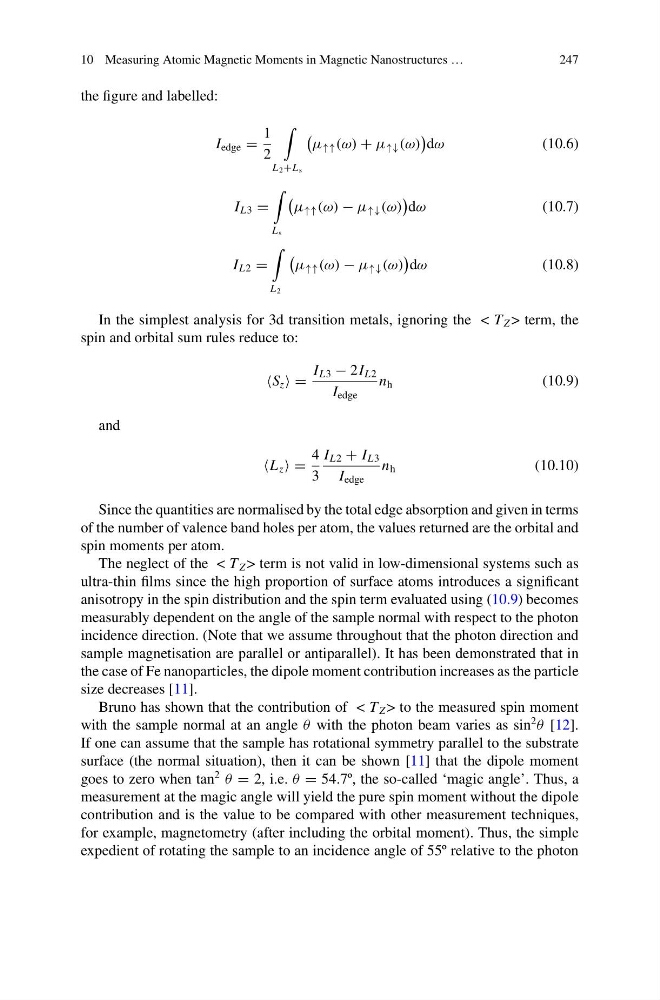
the figure and labelled:
I edge =
1
2
L 2 +L s
μ ↑↑ (ω) + μ ↑↓ (ω)
dω
(10.6)
I L3 =
L s
μ ↑↑ (ω) − μ ↑↓ (ω)
dω
(10.7)
I L2 =
L 2
μ ↑↑ (ω) − μ ↑↓ (ω)
dω
(10.8)
In the simplest analysis for 3d transition metals, ignoring the < T Z > term, the
spin and orbital sum rules reduce to:
S z =
I L3 − 2I L2
I edge
n h
(10.9)
and
L z =
4
3
I L2 + I L3
I edge
n h
(10.10)
Since the quantities are normalised by the total edge absorption and given in terms
of the number of valence band holes per atom, the values returned are the orbital and
spin moments per atom.
The neglect of the < T Z > term is not valid in low-dimensional systems such as
ultra-thin films since the high proportion of surface atoms introduces a significant
anisotropy in the spin distribution and the spin term evaluated using (10.9) becomes
measurably dependent on the angle of the sample normal with respect to the photon
incidence direction. (Note that we assume throughout that the photon direction and
sample magnetisation are parallel or antiparallel). It has been demonstrated that in
the case of Fe nanoparticles, the dipole moment contribution increases as the particle
size decreases [11].
Bruno has shown that the contribution of < T Z > to the measured spin moment
with the sample normal at an angle θ with the photon beam varies as sin
2
θ [12].
If one can assume that the sample has rotational symmetry parallel to the substrate
surface (the normal situation), then it can be shown [11] that the dipole moment
goes to zero when tan
2
θ = 2, i.e. θ = 54.7º, the so-called ‘magic angle’. Thus, a
measurement at the magic angle will yield the pure spin moment without the dipole
contribution and is the value to be compared with other measurement techniques,
for example, magnetometry (after including the orbital moment). Thus, the simple
expedient of rotating the sample to an incidence angle of 55º relative to the photon
247
the figure and labelled:
I edge =
1
2
L 2 +L s
μ ↑↑ (ω) + μ ↑↓ (ω)
dω
(10.6)
I L3 =
L s
μ ↑↑ (ω) − μ ↑↓ (ω)
dω
(10.7)
I L2 =
L 2
μ ↑↑ (ω) − μ ↑↓ (ω)
dω
(10.8)
In the simplest analysis for 3d transition metals, ignoring the < T Z > term, the
spin and orbital sum rules reduce to:
S z =
I L3 − 2I L2
I edge
n h
(10.9)
and
L z =
4
3
I L2 + I L3
I edge
n h
(10.10)
Since the quantities are normalised by the total edge absorption and given in terms
of the number of valence band holes per atom, the values returned are the orbital and
spin moments per atom.
The neglect of the < T Z > term is not valid in low-dimensional systems such as
ultra-thin films since the high proportion of surface atoms introduces a significant
anisotropy in the spin distribution and the spin term evaluated using (10.9) becomes
measurably dependent on the angle of the sample normal with respect to the photon
incidence direction. (Note that we assume throughout that the photon direction and
sample magnetisation are parallel or antiparallel). It has been demonstrated that in
the case of Fe nanoparticles, the dipole moment contribution increases as the particle
size decreases [11].
Bruno has shown that the contribution of < T Z > to the measured spin moment
with the sample normal at an angle θ with the photon beam varies as sin
2
θ [12].
If one can assume that the sample has rotational symmetry parallel to the substrate
surface (the normal situation), then it can be shown [11] that the dipole moment
goes to zero when tan
2
θ = 2, i.e. θ = 54.7º, the so-called ‘magic angle’. Thus, a
measurement at the magic angle will yield the pure spin moment without the dipole
contribution and is the value to be compared with other measurement techniques,
for example, magnetometry (after including the orbital moment). Thus, the simple
expedient of rotating the sample to an incidence angle of 55º relative to the photon