

8 Magnetic Self-Assembling of Spherical Co Nanoparticles …
211
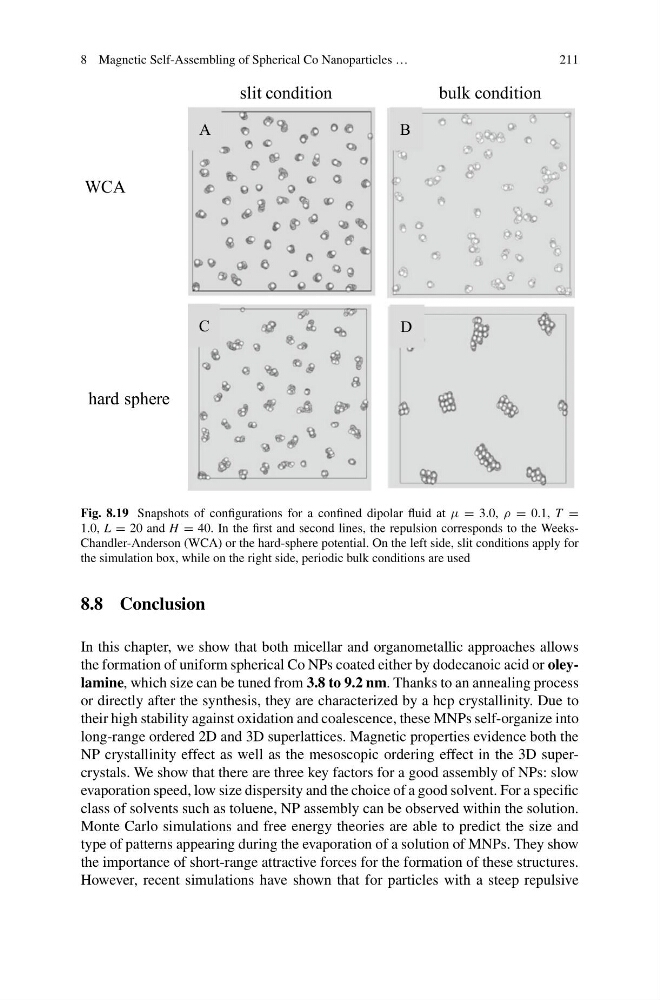
Fig. 8.19 Snapshots of configurations for a confined dipolar fluid at μ = 3.0, ρ = 0.1, T =
1.0, L = 20 and H = 40. In the first and second lines, the repulsion corresponds to the WeeksChandler-Anderson (WCA) or the hard-sphere potential. On the left side, slit conditions apply for
the simulation box, while on the right side, periodic bulk conditions are used
8.8 Conclusion
In this chapter, we show that both micellar and organometallic approaches allows
the formation of uniform spherical Co NPs coated either by dodecanoic acid or oleylamine, which size can be tuned from 3.8 to 9.2 nm. Thanks to an annealing process
or directly after the synthesis, they are characterized by a hcp crystallinity. Due to
their high stability against oxidation and coalescence, these MNPs self-organize into
long-range ordered 2D and 3D superlattices. Magnetic properties evidence both the
NP crystallinity effect as well as the mesoscopic ordering effect in the 3D supercrystals. We show that there are three key factors for a good assembly of NPs: slow
evaporation speed, low size dispersity and the choice of a good solvent. For a specific
class of solvents such as toluene, NP assembly can be observed within the solution.
Monte Carlo simulations and free energy theories are able to predict the size and
type of patterns appearing during the evaporation of a solution of MNPs. They show
the importance of short-range attractive forces for the formation of these structures.
However, recent simulations have shown that for particles with a steep repulsive
211
Fig. 8.19 Snapshots of configurations for a confined dipolar fluid at μ = 3.0, ρ = 0.1, T =
1.0, L = 20 and H = 40. In the first and second lines, the repulsion corresponds to the WeeksChandler-Anderson (WCA) or the hard-sphere potential. On the left side, slit conditions apply for
the simulation box, while on the right side, periodic bulk conditions are used
8.8 Conclusion
In this chapter, we show that both micellar and organometallic approaches allows
the formation of uniform spherical Co NPs coated either by dodecanoic acid or oleylamine, which size can be tuned from 3.8 to 9.2 nm. Thanks to an annealing process
or directly after the synthesis, they are characterized by a hcp crystallinity. Due to
their high stability against oxidation and coalescence, these MNPs self-organize into
long-range ordered 2D and 3D superlattices. Magnetic properties evidence both the
NP crystallinity effect as well as the mesoscopic ordering effect in the 3D supercrystals. We show that there are three key factors for a good assembly of NPs: slow
evaporation speed, low size dispersity and the choice of a good solvent. For a specific
class of solvents such as toluene, NP assembly can be observed within the solution.
Monte Carlo simulations and free energy theories are able to predict the size and
type of patterns appearing during the evaporation of a solution of MNPs. They show
the importance of short-range attractive forces for the formation of these structures.
However, recent simulations have shown that for particles with a steep repulsive