

210
J. Richardi et al.
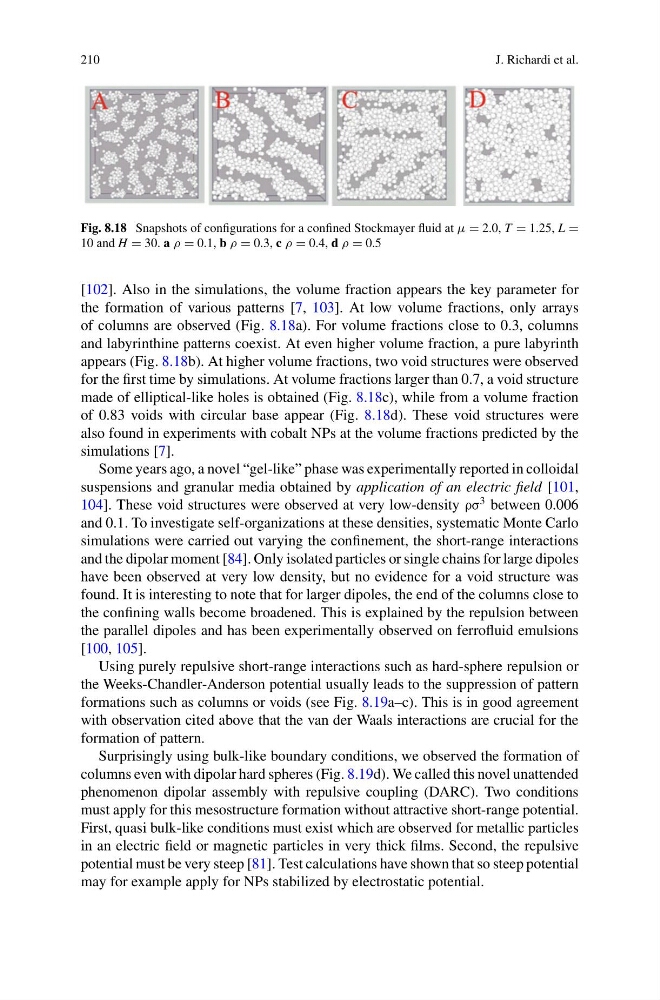
Fig. 8.18 Snapshots of configurations for a confined Stockmayer fluid at μ = 2.0, T = 1.25, L =
10 and H = 30. a ρ = 0.1, b ρ = 0.3, c ρ = 0.4, d ρ = 0.5
[102]. Also in the simulations, the volume fraction appears the key parameter for
the formation of various patterns [7, 103]. At low volume fractions, only arrays
of columns are observed (Fig. 8.18a). For volume fractions close to 0.3, columns
and labyrinthine patterns coexist. At even higher volume fraction, a pure labyrinth
appears (Fig. 8.18b). At higher volume fractions, two void structures were observed
for the first time by simulations. At volume fractions larger than 0.7, a void structure
made of elliptical-like holes is obtained (Fig. 8.18c), while from a volume fraction
of 0.83 voids with circular base appear (Fig. 8.18d). These void structures were
also found in experiments with cobalt NPs at the volume fractions predicted by the
simulations [7].
Some years ago, a novel “gel-like” phase was experimentally reported in colloidal
suspensions and granular media obtained by application of an electric field [101,
104]. These void structures were observed at very low-density ρσ
3 between 0.006
and 0.1. To investigate self-organizations at these densities, systematic Monte Carlo
simulations were carried out varying the confinement, the short-range interactions
and the dipolar moment [84]. Only isolated particles or single chains for large dipoles
have been observed at very low density, but no evidence for a void structure was
found. It is interesting to note that for larger dipoles, the end of the columns close to
the confining walls become broadened. This is explained by the repulsion between
the parallel dipoles and has been experimentally observed on ferrofluid emulsions
[100, 105].
Using purely repulsive short-range interactions such as hard-sphere repulsion or
the Weeks-Chandler-Anderson potential usually leads to the suppression of pattern
formations such as columns or voids (see Fig. 8.19a–c). This is in good agreement
with observation cited above that the van der Waals interactions are crucial for the
formation of pattern.
Surprisingly using bulk-like boundary conditions, we observed the formation of
columns even with dipolar hard spheres (Fig. 8.19d). We called this novel unattended
phenomenon dipolar assembly with repulsive coupling (DARC). Two conditions
must apply for this mesostructure formation without attractive short-range potential.
First, quasi bulk-like conditions must exist which are observed for metallic particles
in an electric field or magnetic particles in very thick films. Second, the repulsive
potential must be very steep [81]. Test calculations have shown that so steep potential
may for example apply for NPs stabilized by electrostatic potential.
J. Richardi et al.
Fig. 8.18 Snapshots of configurations for a confined Stockmayer fluid at μ = 2.0, T = 1.25, L =
10 and H = 30. a ρ = 0.1, b ρ = 0.3, c ρ = 0.4, d ρ = 0.5
[102]. Also in the simulations, the volume fraction appears the key parameter for
the formation of various patterns [7, 103]. At low volume fractions, only arrays
of columns are observed (Fig. 8.18a). For volume fractions close to 0.3, columns
and labyrinthine patterns coexist. At even higher volume fraction, a pure labyrinth
appears (Fig. 8.18b). At higher volume fractions, two void structures were observed
for the first time by simulations. At volume fractions larger than 0.7, a void structure
made of elliptical-like holes is obtained (Fig. 8.18c), while from a volume fraction
of 0.83 voids with circular base appear (Fig. 8.18d). These void structures were
also found in experiments with cobalt NPs at the volume fractions predicted by the
simulations [7].
Some years ago, a novel “gel-like” phase was experimentally reported in colloidal
suspensions and granular media obtained by application of an electric field [101,
104]. These void structures were observed at very low-density ρσ
3 between 0.006
and 0.1. To investigate self-organizations at these densities, systematic Monte Carlo
simulations were carried out varying the confinement, the short-range interactions
and the dipolar moment [84]. Only isolated particles or single chains for large dipoles
have been observed at very low density, but no evidence for a void structure was
found. It is interesting to note that for larger dipoles, the end of the columns close to
the confining walls become broadened. This is explained by the repulsion between
the parallel dipoles and has been experimentally observed on ferrofluid emulsions
[100, 105].
Using purely repulsive short-range interactions such as hard-sphere repulsion or
the Weeks-Chandler-Anderson potential usually leads to the suppression of pattern
formations such as columns or voids (see Fig. 8.19a–c). This is in good agreement
with observation cited above that the van der Waals interactions are crucial for the
formation of pattern.
Surprisingly using bulk-like boundary conditions, we observed the formation of
columns even with dipolar hard spheres (Fig. 8.19d). We called this novel unattended
phenomenon dipolar assembly with repulsive coupling (DARC). Two conditions
must apply for this mesostructure formation without attractive short-range potential.
First, quasi bulk-like conditions must exist which are observed for metallic particles
in an electric field or magnetic particles in very thick films. Second, the repulsive
potential must be very steep [81]. Test calculations have shown that so steep potential
may for example apply for NPs stabilized by electrostatic potential.