

8 Magnetic Self-Assembling of Spherical Co Nanoparticles …
203
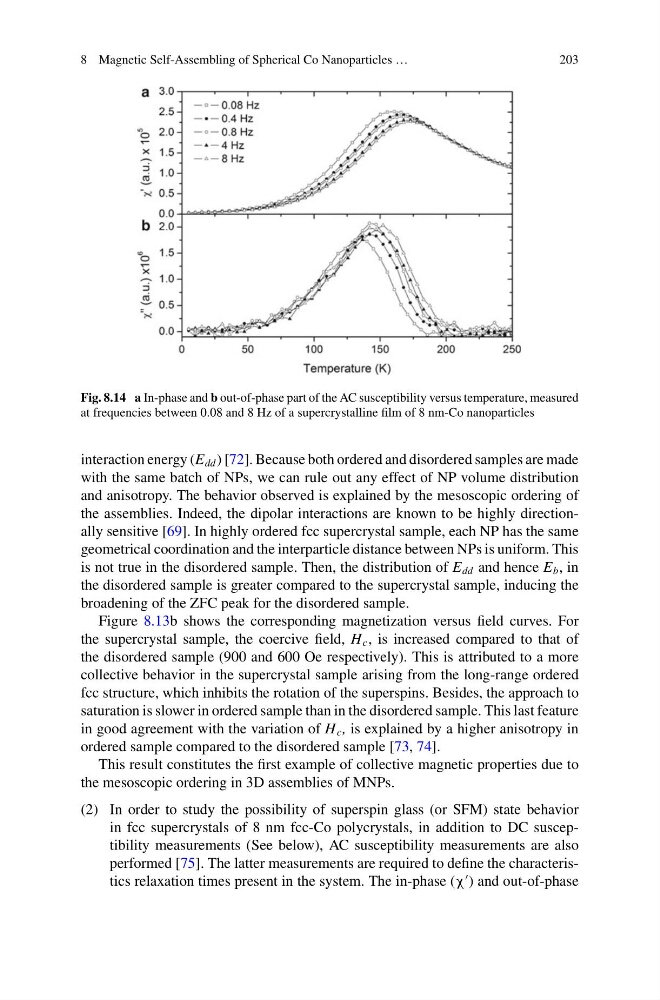
Fig. 8.14 a In-phase and b out-of-phase part of the AC susceptibility versus temperature, measured
at frequencies between 0.08 and 8 Hz of a supercrystalline film of 8 nm-Co nanoparticles
interaction energy (E dd ) [72]. Because both ordered and disordered samples are made
with the same batch of NPs, we can rule out any effect of NP volume distribution
and anisotropy. The behavior observed is explained by the mesoscopic ordering of
the assemblies. Indeed, the dipolar interactions are known to be highly directionally sensitive [69]. In highly ordered fcc supercrystal sample, each NP has the same
geometrical coordination and the interparticle distance between NPs is uniform. This
is not true in the disordered sample. Then, the distribution of E dd and hence E b , in
the disordered sample is greater compared to the supercrystal sample, inducing the
broadening of the ZFC peak for the disordered sample.
Figure 8.13b shows the corresponding magnetization versus field curves. For
the supercrystal sample, the coercive field, H c , is increased compared to that of
the disordered sample (900 and 600 Oe respectively). This is attributed to a more
collective behavior in the supercrystal sample arising from the long-range ordered
fcc structure, which inhibits the rotation of the superspins. Besides, the approach to
saturation is slower in ordered sample than in the disordered sample. This last feature
in good agreement with the variation of H c , is explained by a higher anisotropy in
ordered sample compared to the disordered sample [73, 74].
This result constitutes the first example of collective magnetic properties due to
the mesoscopic ordering in 3D assemblies of MNPs.
(2) In order to study the possibility of superspin glass (or SFM) state behavior
in fcc supercrystals of 8 nm fcc-Co polycrystals, in addition to DC susceptibility measurements (See below), AC susceptibility measurements are also
performed [75]. The latter measurements are required to define the characteristics relaxation times present in the system. The in-phase (χ
) and out-of-phase
203
Fig. 8.14 a In-phase and b out-of-phase part of the AC susceptibility versus temperature, measured
at frequencies between 0.08 and 8 Hz of a supercrystalline film of 8 nm-Co nanoparticles
interaction energy (E dd ) [72]. Because both ordered and disordered samples are made
with the same batch of NPs, we can rule out any effect of NP volume distribution
and anisotropy. The behavior observed is explained by the mesoscopic ordering of
the assemblies. Indeed, the dipolar interactions are known to be highly directionally sensitive [69]. In highly ordered fcc supercrystal sample, each NP has the same
geometrical coordination and the interparticle distance between NPs is uniform. This
is not true in the disordered sample. Then, the distribution of E dd and hence E b , in
the disordered sample is greater compared to the supercrystal sample, inducing the
broadening of the ZFC peak for the disordered sample.
Figure 8.13b shows the corresponding magnetization versus field curves. For
the supercrystal sample, the coercive field, H c , is increased compared to that of
the disordered sample (900 and 600 Oe respectively). This is attributed to a more
collective behavior in the supercrystal sample arising from the long-range ordered
fcc structure, which inhibits the rotation of the superspins. Besides, the approach to
saturation is slower in ordered sample than in the disordered sample. This last feature
in good agreement with the variation of H c , is explained by a higher anisotropy in
ordered sample compared to the disordered sample [73, 74].
This result constitutes the first example of collective magnetic properties due to
the mesoscopic ordering in 3D assemblies of MNPs.
(2) In order to study the possibility of superspin glass (or SFM) state behavior
in fcc supercrystals of 8 nm fcc-Co polycrystals, in addition to DC susceptibility measurements (See below), AC susceptibility measurements are also
performed [75]. The latter measurements are required to define the characteristics relaxation times present in the system. The in-phase (χ
) and out-of-phase