

194
J. Richardi et al.
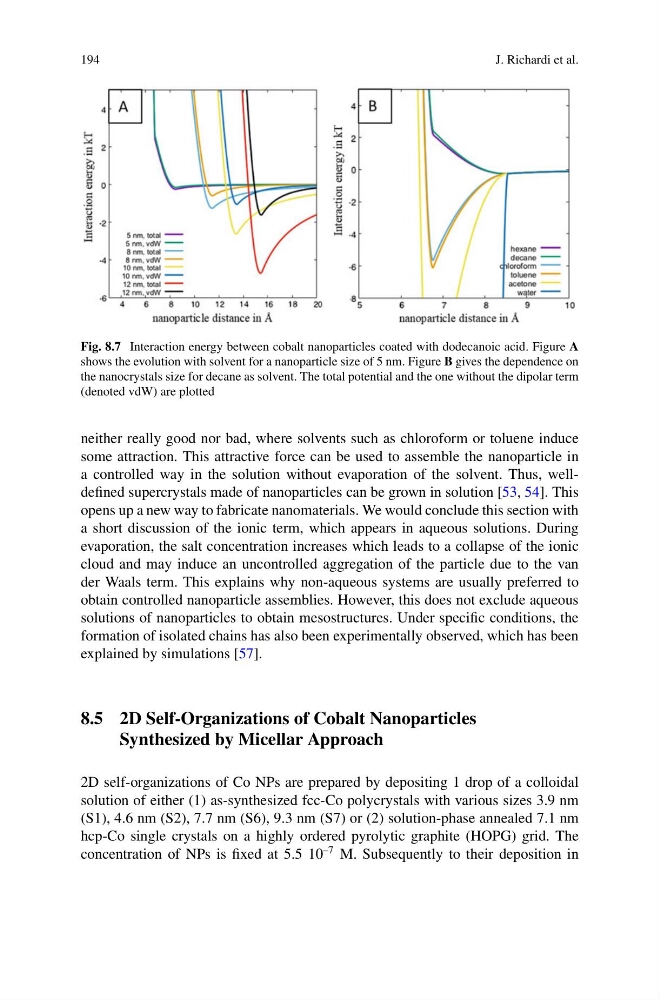
Fig. 8.7 Interaction energy between cobalt nanoparticles coated with dodecanoic acid. Figure A
shows the evolution with solvent for a nanoparticle size of 5 nm. Figure B gives the dependence on
the nanocrystals size for decane as solvent. The total potential and the one without the dipolar term
(denoted vdW) are plotted
neither really good nor bad, where solvents such as chloroform or toluene induce
some attraction. This attractive force can be used to assemble the nanoparticle in
a controlled way in the solution without evaporation of the solvent. Thus, welldefined supercrystals made of nanoparticles can be grown in solution [53, 54]. This
opens up a new way to fabricate nanomaterials. We would conclude this section with
a short discussion of the ionic term, which appears in aqueous solutions. During
evaporation, the salt concentration increases which leads to a collapse of the ionic
cloud and may induce an uncontrolled aggregation of the particle due to the van
der Waals term. This explains why non-aqueous systems are usually preferred to
obtain controlled nanoparticle assemblies. However, this does not exclude aqueous
solutions of nanoparticles to obtain mesostructures. Under specific conditions, the
formation of isolated chains has also been experimentally observed, which has been
explained by simulations [57].
8.5 2D Self-Organizations of Cobalt Nanoparticles
Synthesized by Micellar Approach
2D self-organizations of Co NPs are prepared by depositing 1 drop of a colloidal
solution of either (1) as-synthesized fcc-Co polycrystals with various sizes 3.9 nm
(S1), 4.6 nm (S2), 7.7 nm (S6), 9.3 nm (S7) or (2) solution-phase annealed 7.1 nm
hcp-Co single crystals on a highly ordered pyrolytic graphite (HOPG) grid. The
concentration of NPs is fixed at 5.5 10
–7 M. Subsequently to their deposition in
J. Richardi et al.
Fig. 8.7 Interaction energy between cobalt nanoparticles coated with dodecanoic acid. Figure A
shows the evolution with solvent for a nanoparticle size of 5 nm. Figure B gives the dependence on
the nanocrystals size for decane as solvent. The total potential and the one without the dipolar term
(denoted vdW) are plotted
neither really good nor bad, where solvents such as chloroform or toluene induce
some attraction. This attractive force can be used to assemble the nanoparticle in
a controlled way in the solution without evaporation of the solvent. Thus, welldefined supercrystals made of nanoparticles can be grown in solution [53, 54]. This
opens up a new way to fabricate nanomaterials. We would conclude this section with
a short discussion of the ionic term, which appears in aqueous solutions. During
evaporation, the salt concentration increases which leads to a collapse of the ionic
cloud and may induce an uncontrolled aggregation of the particle due to the van
der Waals term. This explains why non-aqueous systems are usually preferred to
obtain controlled nanoparticle assemblies. However, this does not exclude aqueous
solutions of nanoparticles to obtain mesostructures. Under specific conditions, the
formation of isolated chains has also been experimentally observed, which has been
explained by simulations [57].
8.5 2D Self-Organizations of Cobalt Nanoparticles
Synthesized by Micellar Approach
2D self-organizations of Co NPs are prepared by depositing 1 drop of a colloidal
solution of either (1) as-synthesized fcc-Co polycrystals with various sizes 3.9 nm
(S1), 4.6 nm (S2), 7.7 nm (S6), 9.3 nm (S7) or (2) solution-phase annealed 7.1 nm
hcp-Co single crystals on a highly ordered pyrolytic graphite (HOPG) grid. The
concentration of NPs is fixed at 5.5 10
–7 M. Subsequently to their deposition in