

8 Magnetic Self-Assembling of Spherical Co Nanoparticles …
193
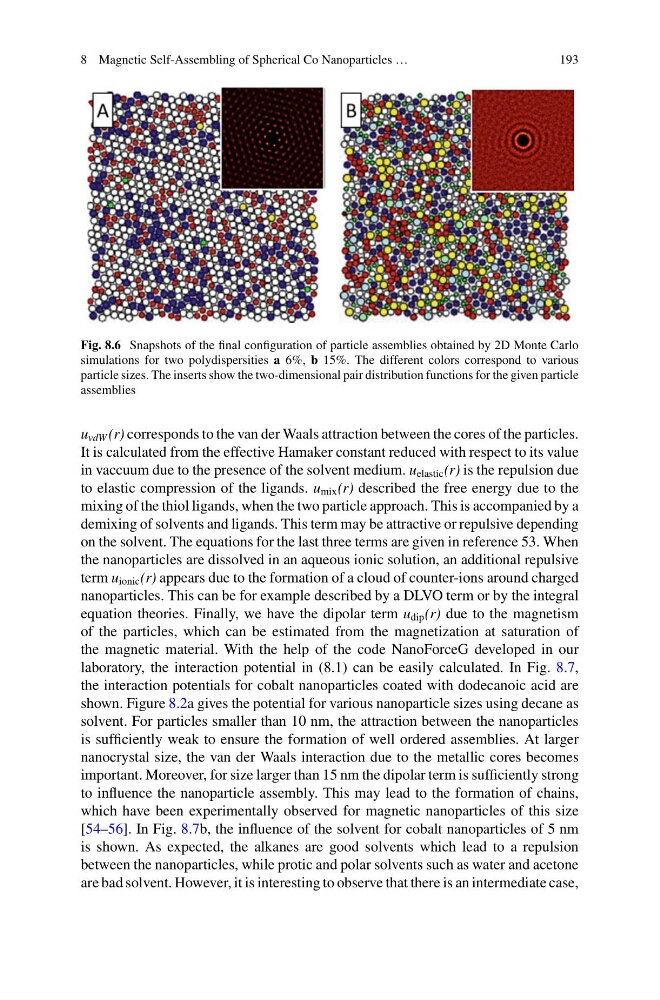
Fig. 8.6 Snapshots of the final configuration of particle assemblies obtained by 2D Monte Carlo
simulations for two polydispersities a 6%, b 15%. The different colors correspond to various
particle sizes. The inserts show the two-dimensional pair distribution functions for the given particle
assemblies
u vdW (r) corresponds to the van der Waals attraction between the cores of the particles.
It is calculated from the effective Hamaker constant reduced with respect to its value
in vaccuum due to the presence of the solvent medium. u elastic (r) is the repulsion due
to elastic compression of the ligands. u mix (r) described the free energy due to the
mixing of the thiol ligands, when the two particle approach. This is accompanied by a
demixing of solvents and ligands. This term may be attractive or repulsive depending
on the solvent. The equations for the last three terms are given in reference 53. When
the nanoparticles are dissolved in an aqueous ionic solution, an additional repulsive
term u ionic (r) appears due to the formation of a cloud of counter-ions around charged
nanoparticles. This can be for example described by a DLVO term or by the integral
equation theories. Finally, we have the dipolar term u dip (r) due to the magnetism
of the particles, which can be estimated from the magnetization at saturation of
the magnetic material. With the help of the code NanoForceG developed in our
laboratory, the interaction potential in (8.1) can be easily calculated. In Fig. 8.7,
the interaction potentials for cobalt nanoparticles coated with dodecanoic acid are
shown. Figure 8.2a gives the potential for various nanoparticle sizes using decane as
solvent. For particles smaller than 10 nm, the attraction between the nanoparticles
is sufficiently weak to ensure the formation of well ordered assemblies. At larger
nanocrystal size, the van der Waals interaction due to the metallic cores becomes
important. Moreover, for size larger than 15 nm the dipolar term is sufficiently strong
to influence the nanoparticle assembly. This may lead to the formation of chains,
which have been experimentally observed for magnetic nanoparticles of this size
[54–56]. In Fig. 8.7b, the influence of the solvent for cobalt nanoparticles of 5 nm
is shown. As expected, the alkanes are good solvents which lead to a repulsion
between the nanoparticles, while protic and polar solvents such as water and acetone
are bad solvent. However, it is interesting to observe that there is an intermediate case,
193
Fig. 8.6 Snapshots of the final configuration of particle assemblies obtained by 2D Monte Carlo
simulations for two polydispersities a 6%, b 15%. The different colors correspond to various
particle sizes. The inserts show the two-dimensional pair distribution functions for the given particle
assemblies
u vdW (r) corresponds to the van der Waals attraction between the cores of the particles.
It is calculated from the effective Hamaker constant reduced with respect to its value
in vaccuum due to the presence of the solvent medium. u elastic (r) is the repulsion due
to elastic compression of the ligands. u mix (r) described the free energy due to the
mixing of the thiol ligands, when the two particle approach. This is accompanied by a
demixing of solvents and ligands. This term may be attractive or repulsive depending
on the solvent. The equations for the last three terms are given in reference 53. When
the nanoparticles are dissolved in an aqueous ionic solution, an additional repulsive
term u ionic (r) appears due to the formation of a cloud of counter-ions around charged
nanoparticles. This can be for example described by a DLVO term or by the integral
equation theories. Finally, we have the dipolar term u dip (r) due to the magnetism
of the particles, which can be estimated from the magnetization at saturation of
the magnetic material. With the help of the code NanoForceG developed in our
laboratory, the interaction potential in (8.1) can be easily calculated. In Fig. 8.7,
the interaction potentials for cobalt nanoparticles coated with dodecanoic acid are
shown. Figure 8.2a gives the potential for various nanoparticle sizes using decane as
solvent. For particles smaller than 10 nm, the attraction between the nanoparticles
is sufficiently weak to ensure the formation of well ordered assemblies. At larger
nanocrystal size, the van der Waals interaction due to the metallic cores becomes
important. Moreover, for size larger than 15 nm the dipolar term is sufficiently strong
to influence the nanoparticle assembly. This may lead to the formation of chains,
which have been experimentally observed for magnetic nanoparticles of this size
[54–56]. In Fig. 8.7b, the influence of the solvent for cobalt nanoparticles of 5 nm
is shown. As expected, the alkanes are good solvents which lead to a repulsion
between the nanoparticles, while protic and polar solvents such as water and acetone
are bad solvent. However, it is interesting to observe that there is an intermediate case,