

162
M. L. Fdez-Gubieda et al.
membrane is similar to that of the cytoplasmic membrane. However, the inserted proteins are special functional proteins involved the synthesis of the magnetic core [25].
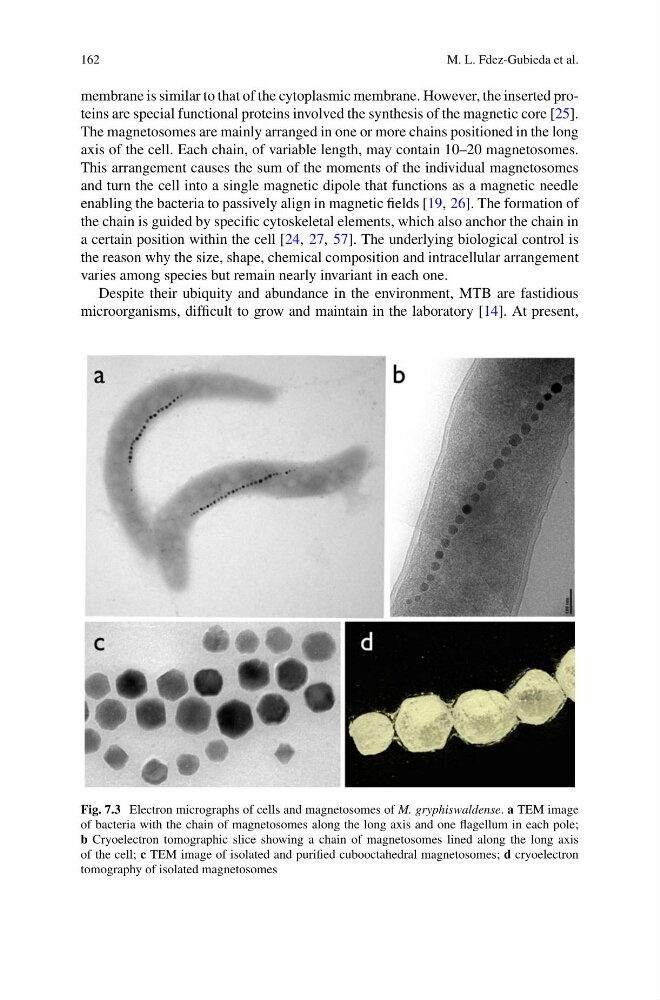
The magnetosomes are mainly arranged in one or more chains positioned in the long
axis of the cell. Each chain, of variable length, may contain 10–20 magnetosomes.
This arrangement causes the sum of the moments of the individual magnetosomes
and turn the cell into a single magnetic dipole that functions as a magnetic needle
enabling the bacteria to passively align in magnetic fields [19, 26]. The formation of
the chain is guided by specific cytoskeletal elements, which also anchor the chain in
a certain position within the cell [24, 27, 57]. The underlying biological control is
the reason why the size, shape, chemical composition and intracellular arrangement
varies among species but remain nearly invariant in each one.
Despite their ubiquity and abundance in the environment, MTB are fastidious
microorganisms, difficult to grow and maintain in the laboratory [14]. At present,
Fig. 7.3 Electron micrographs of cells and magnetosomes of M. gryphiswaldense. a TEM image
of bacteria with the chain of magnetosomes along the long axis and one flagellum in each pole;
b Cryoelectron tomographic slice showing a chain of magnetosomes lined along the long axis
of the cell; c TEM image of isolated and purified cubooctahedral magnetosomes; d cryoelectron
tomography of isolated magnetosomes
M. L. Fdez-Gubieda et al.
membrane is similar to that of the cytoplasmic membrane. However, the inserted proteins are special functional proteins involved the synthesis of the magnetic core [25].
The magnetosomes are mainly arranged in one or more chains positioned in the long
axis of the cell. Each chain, of variable length, may contain 10–20 magnetosomes.
This arrangement causes the sum of the moments of the individual magnetosomes
and turn the cell into a single magnetic dipole that functions as a magnetic needle
enabling the bacteria to passively align in magnetic fields [19, 26]. The formation of
the chain is guided by specific cytoskeletal elements, which also anchor the chain in
a certain position within the cell [24, 27, 57]. The underlying biological control is
the reason why the size, shape, chemical composition and intracellular arrangement
varies among species but remain nearly invariant in each one.
Despite their ubiquity and abundance in the environment, MTB are fastidious
microorganisms, difficult to grow and maintain in the laboratory [14]. At present,
Fig. 7.3 Electron micrographs of cells and magnetosomes of M. gryphiswaldense. a TEM image
of bacteria with the chain of magnetosomes along the long axis and one flagellum in each pole;
b Cryoelectron tomographic slice showing a chain of magnetosomes lined along the long axis
of the cell; c TEM image of isolated and purified cubooctahedral magnetosomes; d cryoelectron
tomography of isolated magnetosomes