

6 Hollow Magnetic Nanoparticles
151
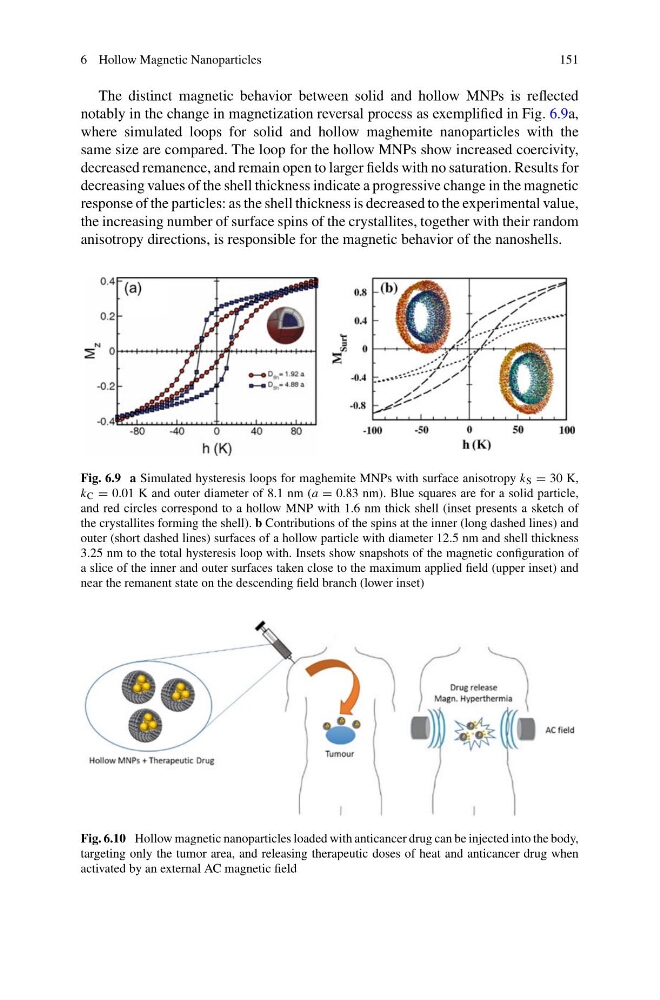
The distinct magnetic behavior between solid and hollow MNPs is reflected
notably in the change in magnetization reversal process as exemplified in Fig. 6.9a,
where simulated loops for solid and hollow maghemite nanoparticles with the
same size are compared. The loop for the hollow MNPs show increased coercivity,
decreased remanence, and remain open to larger fields with no saturation. Results for
decreasing values of the shell thickness indicate a progressive change in the magnetic
response of the particles: as the shell thickness is decreased to the experimental value,
the increasing number of surface spins of the crystallites, together with their random
anisotropy directions, is responsible for the magnetic behavior of the nanoshells.
Fig. 6.9 a Simulated hysteresis loops for maghemite MNPs with surface anisotropy k S = 30 K,
k C = 0.01 K and outer diameter of 8.1 nm (a = 0.83 nm). Blue squares are for a solid particle,
and red circles correspond to a hollow MNP with 1.6 nm thick shell (inset presents a sketch of
the crystallites forming the shell). b Contributions of the spins at the inner (long dashed lines) and
outer (short dashed lines) surfaces of a hollow particle with diameter 12.5 nm and shell thickness
3.25 nm to the total hysteresis loop with. Insets show snapshots of the magnetic configuration of
a slice of the inner and outer surfaces taken close to the maximum applied field (upper inset) and
near the remanent state on the descending field branch (lower inset)
Fig. 6.10 Hollow magnetic nanoparticles loaded with anticancer drug can be injected into the body,
targeting only the tumor area, and releasing therapeutic doses of heat and anticancer drug when
activated by an external AC magnetic field
151
The distinct magnetic behavior between solid and hollow MNPs is reflected
notably in the change in magnetization reversal process as exemplified in Fig. 6.9a,
where simulated loops for solid and hollow maghemite nanoparticles with the
same size are compared. The loop for the hollow MNPs show increased coercivity,
decreased remanence, and remain open to larger fields with no saturation. Results for
decreasing values of the shell thickness indicate a progressive change in the magnetic
response of the particles: as the shell thickness is decreased to the experimental value,
the increasing number of surface spins of the crystallites, together with their random
anisotropy directions, is responsible for the magnetic behavior of the nanoshells.
Fig. 6.9 a Simulated hysteresis loops for maghemite MNPs with surface anisotropy k S = 30 K,
k C = 0.01 K and outer diameter of 8.1 nm (a = 0.83 nm). Blue squares are for a solid particle,
and red circles correspond to a hollow MNP with 1.6 nm thick shell (inset presents a sketch of
the crystallites forming the shell). b Contributions of the spins at the inner (long dashed lines) and
outer (short dashed lines) surfaces of a hollow particle with diameter 12.5 nm and shell thickness
3.25 nm to the total hysteresis loop with. Insets show snapshots of the magnetic configuration of
a slice of the inner and outer surfaces taken close to the maximum applied field (upper inset) and
near the remanent state on the descending field branch (lower inset)
Fig. 6.10 Hollow magnetic nanoparticles loaded with anticancer drug can be injected into the body,
targeting only the tumor area, and releasing therapeutic doses of heat and anticancer drug when
activated by an external AC magnetic field