

150
H. Khurshid et al.
in local anisotropy directions or values of microscopic parameters characterizing a
particular material.
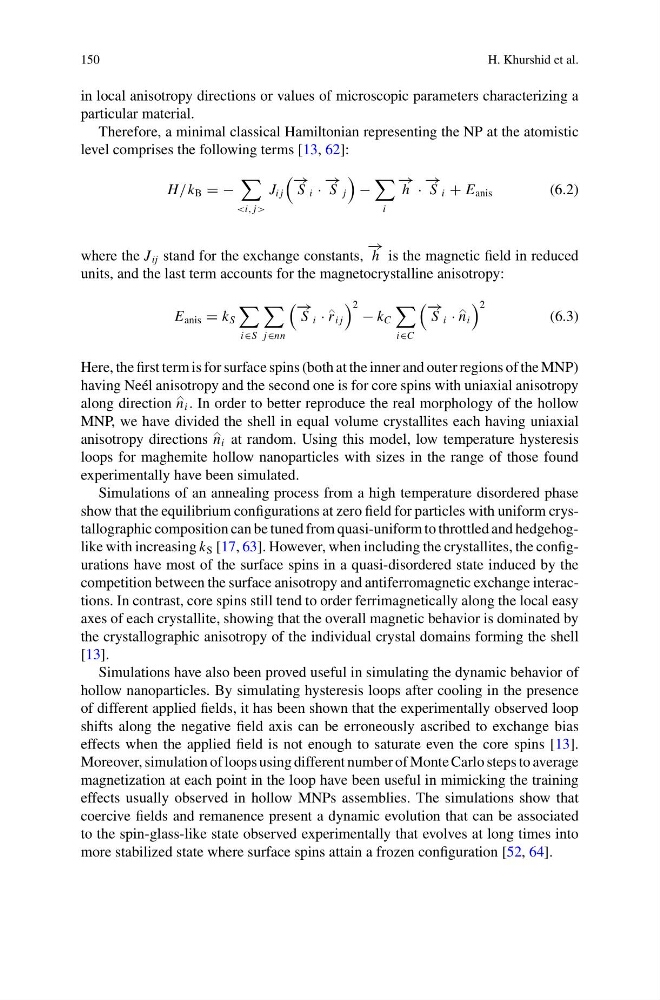
Therefore, a minimal classical Hamiltonian representing the NP at the atomistic
level comprises the following terms [13, 62]:
H/k B = −
J i j
− →
S i ·
− →
S j
−
i
− →
h ·
− →
S i + E anis
(6.2)
where the J ij stand for the exchange constants,
− →
h is the magnetic field in reduced
units, and the last term accounts for the magnetocrystalline anisotropy:
E anis = k S
i∈S
j∈nn
− →
S i · r
i j
2 − k C
i∈C
− →
S i · n
i
2
(6.3)
Here, the first term is for surface spins (both at the inner and outer regions of the MNP)
having Neél anisotropy and the second one is for core spins with uniaxial anisotropy
along direction n
i . In order to better reproduce the real morphology of the hollow
MNP, we have divided the shell in equal volume crystallites each having uniaxial
anisotropy directions n
i at random. Using this model, low temperature hysteresis
loops for maghemite hollow nanoparticles with sizes in the range of those found
experimentally have been simulated.
Simulations of an annealing process from a high temperature disordered phase
show that the equilibrium configurations at zero field for particles with uniform crystallographic composition can be tuned from quasi-uniform to throttled and hedgehoglike with increasing k S [17, 63]. However, when including the crystallites, the configurations have most of the surface spins in a quasi-disordered state induced by the
competition between the surface anisotropy and antiferromagnetic exchange interactions. In contrast, core spins still tend to order ferrimagnetically along the local easy
axes of each crystallite, showing that the overall magnetic behavior is dominated by
the crystallographic anisotropy of the individual crystal domains forming the shell
[13].
Simulations have also been proved useful in simulating the dynamic behavior of
hollow nanoparticles. By simulating hysteresis loops after cooling in the presence
of different applied fields, it has been shown that the experimentally observed loop
shifts along the negative field axis can be erroneously ascribed to exchange bias
effects when the applied field is not enough to saturate even the core spins [13].
Moreover, simulation of loops using different number of Monte Carlo steps to average
magnetization at each point in the loop have been useful in mimicking the training
effects usually observed in hollow MNPs assemblies. The simulations show that
coercive fields and remanence present a dynamic evolution that can be associated
to the spin-glass-like state observed experimentally that evolves at long times into
more stabilized state where surface spins attain a frozen configuration [52, 64].
H. Khurshid et al.
in local anisotropy directions or values of microscopic parameters characterizing a
particular material.
Therefore, a minimal classical Hamiltonian representing the NP at the atomistic
level comprises the following terms [13, 62]:
H/k B = −
J i j
− →
S i ·
− →
S j
−
i
− →
h ·
− →
S i + E anis
(6.2)
where the J ij stand for the exchange constants,
− →
h is the magnetic field in reduced
units, and the last term accounts for the magnetocrystalline anisotropy:
E anis = k S
i∈S
j∈nn
− →
S i · r
i j
2 − k C
i∈C
− →
S i · n
i
2
(6.3)
Here, the first term is for surface spins (both at the inner and outer regions of the MNP)
having Neél anisotropy and the second one is for core spins with uniaxial anisotropy
along direction n
i . In order to better reproduce the real morphology of the hollow
MNP, we have divided the shell in equal volume crystallites each having uniaxial
anisotropy directions n
i at random. Using this model, low temperature hysteresis
loops for maghemite hollow nanoparticles with sizes in the range of those found
experimentally have been simulated.
Simulations of an annealing process from a high temperature disordered phase
show that the equilibrium configurations at zero field for particles with uniform crystallographic composition can be tuned from quasi-uniform to throttled and hedgehoglike with increasing k S [17, 63]. However, when including the crystallites, the configurations have most of the surface spins in a quasi-disordered state induced by the
competition between the surface anisotropy and antiferromagnetic exchange interactions. In contrast, core spins still tend to order ferrimagnetically along the local easy
axes of each crystallite, showing that the overall magnetic behavior is dominated by
the crystallographic anisotropy of the individual crystal domains forming the shell
[13].
Simulations have also been proved useful in simulating the dynamic behavior of
hollow nanoparticles. By simulating hysteresis loops after cooling in the presence
of different applied fields, it has been shown that the experimentally observed loop
shifts along the negative field axis can be erroneously ascribed to exchange bias
effects when the applied field is not enough to saturate even the core spins [13].
Moreover, simulation of loops using different number of Monte Carlo steps to average
magnetization at each point in the loop have been useful in mimicking the training
effects usually observed in hollow MNPs assemblies. The simulations show that
coercive fields and remanence present a dynamic evolution that can be associated
to the spin-glass-like state observed experimentally that evolves at long times into
more stabilized state where surface spins attain a frozen configuration [52, 64].