

4 Core/Shell Bimagnetic Nanoparticles
97
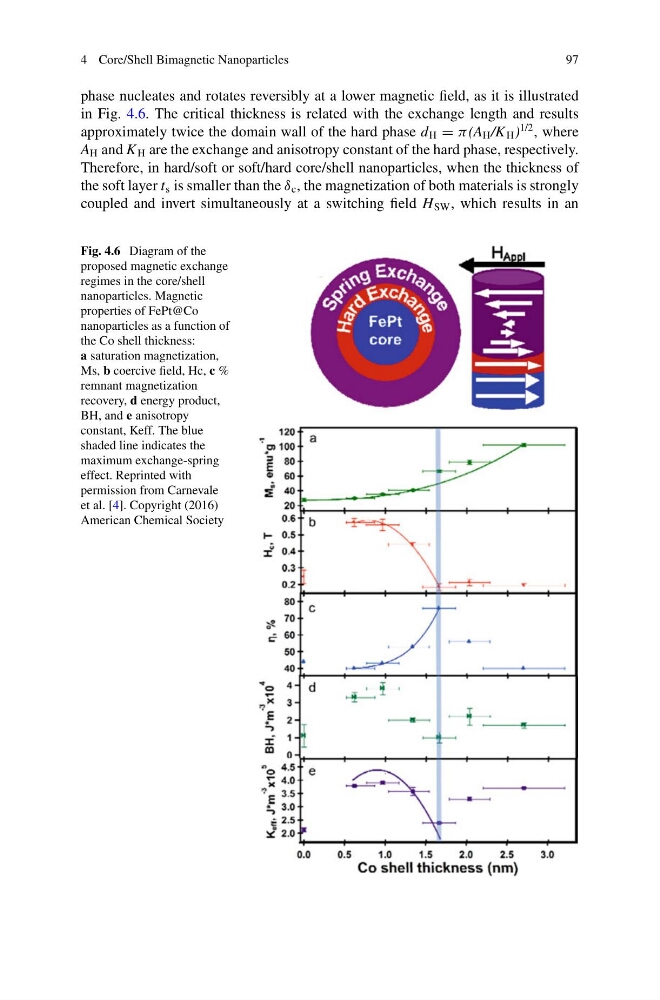
phase nucleates and rotates reversibly at a lower magnetic field, as it is illustrated
in Fig. 4.6. The critical thickness is related with the exchange length and results
approximately twice the domain wall of the hard phase d H = π (A H /K H )
1/2 , where
A H and K H are the exchange and anisotropy constant of the hard phase, respectively.
Therefore, in hard/soft or soft/hard core/shell nanoparticles, when the thickness of
the soft layer t s is smaller than the δ c , the magnetization of both materials is strongly
coupled and invert simultaneously at a switching field H SW , which results in an
Fig. 4.6 Diagram of the
proposed magnetic exchange
regimes in the core/shell
nanoparticles. Magnetic
properties of FePt@Co
nanoparticles as a function of
the Co shell thickness:
a saturation magnetization,
Ms, b coercive field, Hc, c %
remnant magnetization
recovery, d energy product,
BH, and e anisotropy
constant, Keff. The blue
shaded line indicates the
maximum exchange-spring
effect. Reprinted with
permission from Carnevale
et al. [4]. Copyright (2016)
American Chemical Society
97
phase nucleates and rotates reversibly at a lower magnetic field, as it is illustrated
in Fig. 4.6. The critical thickness is related with the exchange length and results
approximately twice the domain wall of the hard phase d H = π (A H /K H )
1/2 , where
A H and K H are the exchange and anisotropy constant of the hard phase, respectively.
Therefore, in hard/soft or soft/hard core/shell nanoparticles, when the thickness of
the soft layer t s is smaller than the δ c , the magnetization of both materials is strongly
coupled and invert simultaneously at a switching field H SW , which results in an
Fig. 4.6 Diagram of the
proposed magnetic exchange
regimes in the core/shell
nanoparticles. Magnetic
properties of FePt@Co
nanoparticles as a function of
the Co shell thickness:
a saturation magnetization,
Ms, b coercive field, Hc, c %
remnant magnetization
recovery, d energy product,
BH, and e anisotropy
constant, Keff. The blue
shaded line indicates the
maximum exchange-spring
effect. Reprinted with
permission from Carnevale
et al. [4]. Copyright (2016)
American Chemical Society