

96
E. L. Winkler and R. D. Zysler
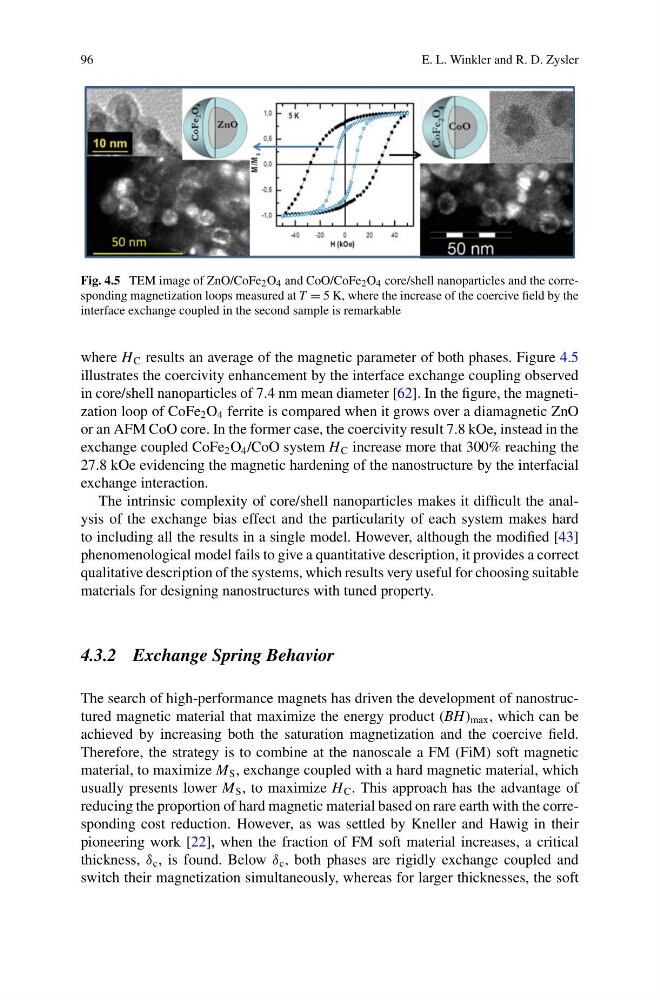
Fig. 4.5 TEM image of ZnO/CoFe 2 O 4 and CoO/CoFe 2 O 4 core/shell nanoparticles and the corresponding magnetization loops measured at T = 5 K, where the increase of the coercive field by the
interface exchange coupled in the second sample is remarkable
where H C results an average of the magnetic parameter of both phases. Figure 4.5
illustrates the coercivity enhancement by the interface exchange coupling observed
in core/shell nanoparticles of 7.4 nm mean diameter [62]. In the figure, the magnetization loop of CoFe 2 O 4 ferrite is compared when it grows over a diamagnetic ZnO
or an AFM CoO core. In the former case, the coercivity result 7.8 kOe, instead in the
exchange coupled CoFe 2 O 4 /CoO system H C increase more that 300% reaching the
27.8 kOe evidencing the magnetic hardening of the nanostructure by the interfacial
exchange interaction.
The intrinsic complexity of core/shell nanoparticles makes it difficult the analysis of the exchange bias effect and the particularity of each system makes hard
to including all the results in a single model. However, although the modified [43]
phenomenological model fails to give a quantitative description, it provides a correct
qualitative description of the systems, which results very useful for choosing suitable
materials for designing nanostructures with tuned property.
4.3.2 Exchange Spring Behavior
The search of high-performance magnets has driven the development of nanostructured magnetic material that maximize the energy product (BH) max , which can be
achieved by increasing both the saturation magnetization and the coercive field.
Therefore, the strategy is to combine at the nanoscale a FM (FiM) soft magnetic
material, to maximize M S , exchange coupled with a hard magnetic material, which
usually presents lower M S , to maximize H C . This approach has the advantage of
reducing the proportion of hard magnetic material based on rare earth with the corresponding cost reduction. However, as was settled by Kneller and Hawig in their
pioneering work [22], when the fraction of FM soft material increases, a critical
thickness, δ c , is found. Below δ c , both phases are rigidly exchange coupled and
switch their magnetization simultaneously, whereas for larger thicknesses, the soft
E. L. Winkler and R. D. Zysler
Fig. 4.5 TEM image of ZnO/CoFe 2 O 4 and CoO/CoFe 2 O 4 core/shell nanoparticles and the corresponding magnetization loops measured at T = 5 K, where the increase of the coercive field by the
interface exchange coupled in the second sample is remarkable
where H C results an average of the magnetic parameter of both phases. Figure 4.5
illustrates the coercivity enhancement by the interface exchange coupling observed
in core/shell nanoparticles of 7.4 nm mean diameter [62]. In the figure, the magnetization loop of CoFe 2 O 4 ferrite is compared when it grows over a diamagnetic ZnO
or an AFM CoO core. In the former case, the coercivity result 7.8 kOe, instead in the
exchange coupled CoFe 2 O 4 /CoO system H C increase more that 300% reaching the
27.8 kOe evidencing the magnetic hardening of the nanostructure by the interfacial
exchange interaction.
The intrinsic complexity of core/shell nanoparticles makes it difficult the analysis of the exchange bias effect and the particularity of each system makes hard
to including all the results in a single model. However, although the modified [43]
phenomenological model fails to give a quantitative description, it provides a correct
qualitative description of the systems, which results very useful for choosing suitable
materials for designing nanostructures with tuned property.
4.3.2 Exchange Spring Behavior
The search of high-performance magnets has driven the development of nanostructured magnetic material that maximize the energy product (BH) max , which can be
achieved by increasing both the saturation magnetization and the coercive field.
Therefore, the strategy is to combine at the nanoscale a FM (FiM) soft magnetic
material, to maximize M S , exchange coupled with a hard magnetic material, which
usually presents lower M S , to maximize H C . This approach has the advantage of
reducing the proportion of hard magnetic material based on rare earth with the corresponding cost reduction. However, as was settled by Kneller and Hawig in their
pioneering work [22], when the fraction of FM soft material increases, a critical
thickness, δ c , is found. Below δ c , both phases are rigidly exchange coupled and
switch their magnetization simultaneously, whereas for larger thicknesses, the soft