

4 Core/Shell Bimagnetic Nanoparticles
91
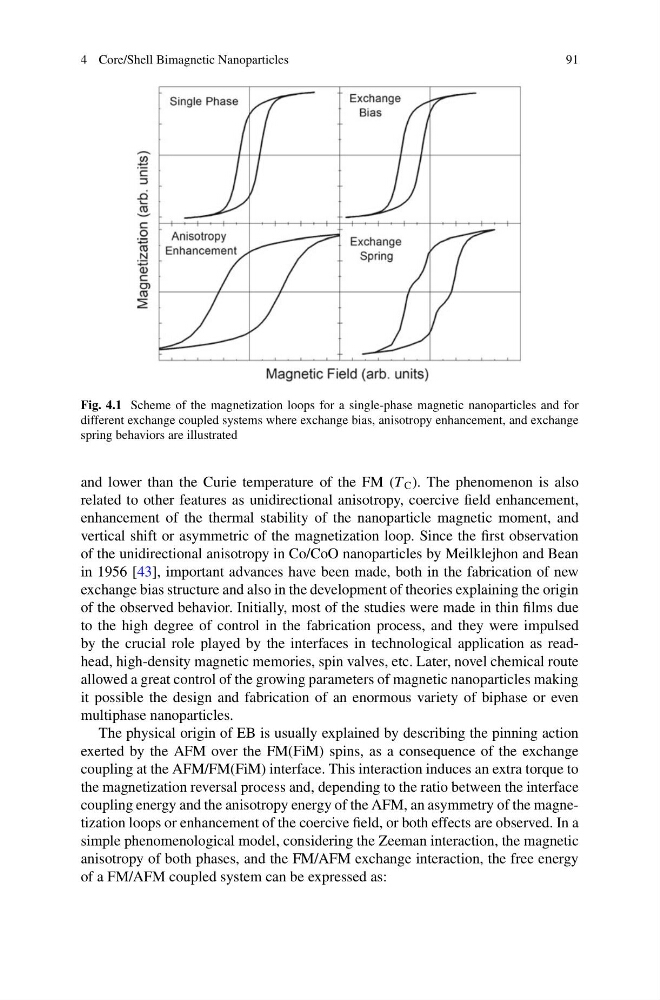
Fig. 4.1 Scheme of the magnetization loops for a single-phase magnetic nanoparticles and for
different exchange coupled systems where exchange bias, anisotropy enhancement, and exchange
spring behaviors are illustrated
and lower than the Curie temperature of the FM (T C ). The phenomenon is also
related to other features as unidirectional anisotropy, coercive field enhancement,
enhancement of the thermal stability of the nanoparticle magnetic moment, and
vertical shift or asymmetric of the magnetization loop. Since the first observation
of the unidirectional anisotropy in Co/CoO nanoparticles by Meilklejhon and Bean
in 1956 [43], important advances have been made, both in the fabrication of new
exchange bias structure and also in the development of theories explaining the origin
of the observed behavior. Initially, most of the studies were made in thin films due
to the high degree of control in the fabrication process, and they were impulsed
by the crucial role played by the interfaces in technological application as readhead, high-density magnetic memories, spin valves, etc. Later, novel chemical route
allowed a great control of the growing parameters of magnetic nanoparticles making
it possible the design and fabrication of an enormous variety of biphase or even
multiphase nanoparticles.
The physical origin of EB is usually explained by describing the pinning action
exerted by the AFM over the FM(FiM) spins, as a consequence of the exchange
coupling at the AFM/FM(FiM) interface. This interaction induces an extra torque to
the magnetization reversal process and, depending to the ratio between the interface
coupling energy and the anisotropy energy of the AFM, an asymmetry of the magnetization loops or enhancement of the coercive field, or both effects are observed. In a
simple phenomenological model, considering the Zeeman interaction, the magnetic
anisotropy of both phases, and the FM/AFM exchange interaction, the free energy
of a FM/AFM coupled system can be expressed as:
91
Fig. 4.1 Scheme of the magnetization loops for a single-phase magnetic nanoparticles and for
different exchange coupled systems where exchange bias, anisotropy enhancement, and exchange
spring behaviors are illustrated
and lower than the Curie temperature of the FM (T C ). The phenomenon is also
related to other features as unidirectional anisotropy, coercive field enhancement,
enhancement of the thermal stability of the nanoparticle magnetic moment, and
vertical shift or asymmetric of the magnetization loop. Since the first observation
of the unidirectional anisotropy in Co/CoO nanoparticles by Meilklejhon and Bean
in 1956 [43], important advances have been made, both in the fabrication of new
exchange bias structure and also in the development of theories explaining the origin
of the observed behavior. Initially, most of the studies were made in thin films due
to the high degree of control in the fabrication process, and they were impulsed
by the crucial role played by the interfaces in technological application as readhead, high-density magnetic memories, spin valves, etc. Later, novel chemical route
allowed a great control of the growing parameters of magnetic nanoparticles making
it possible the design and fabrication of an enormous variety of biphase or even
multiphase nanoparticles.
The physical origin of EB is usually explained by describing the pinning action
exerted by the AFM over the FM(FiM) spins, as a consequence of the exchange
coupling at the AFM/FM(FiM) interface. This interaction induces an extra torque to
the magnetization reversal process and, depending to the ratio between the interface
coupling energy and the anisotropy energy of the AFM, an asymmetry of the magnetization loops or enhancement of the coercive field, or both effects are observed. In a
simple phenomenological model, considering the Zeeman interaction, the magnetic
anisotropy of both phases, and the FM/AFM exchange interaction, the free energy
of a FM/AFM coupled system can be expressed as: