

76
2 Critical Mass, Efficiency, and Yield
1.00
1.25
1.50
1.75
2.00
2.25
0.5
1.0
1.5
2.0
2.5
R(thresh) / d(core)
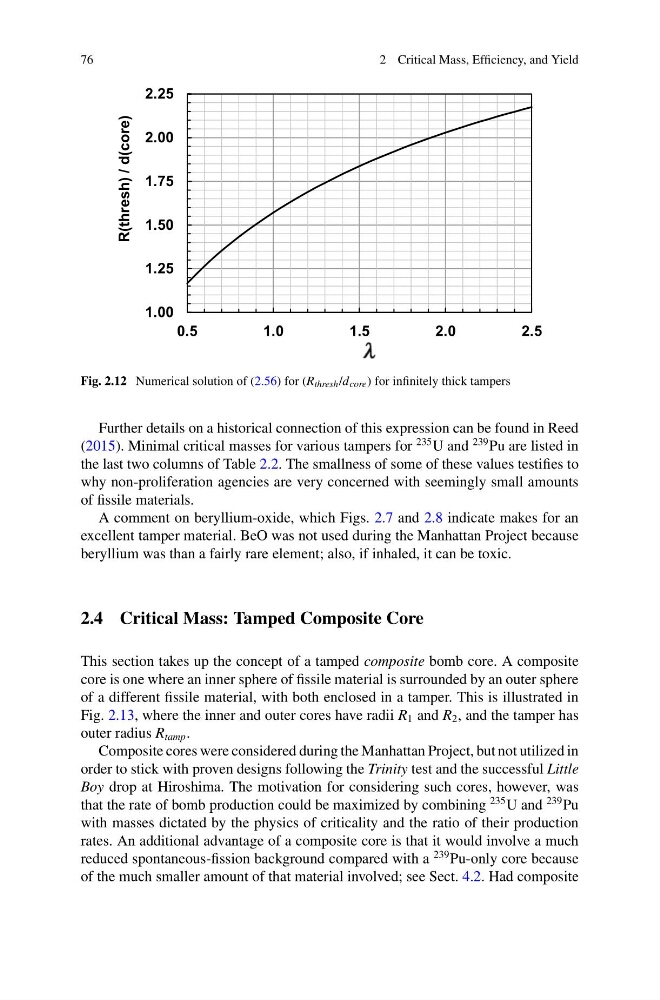
Fig. 2.12 Numerical solution of (2.56) for (R thresh /d core ) for infinitely thick tampers
Further details on a historical connection of this expression can be found in Reed
(2015). Minimal critical masses for various tampers for
235 U and
239 Pu are listed in
the last two columns of Table 2.2. The smallness of some of these values testifies to
why non-proliferation agencies are very concerned with seemingly small amounts
of fissile materials.
A comment on beryllium-oxide, which Figs. 2.7 and 2.8 indicate makes for an
excellent tamper material. BeO was not used during the Manhattan Project because
beryllium was than a fairly rare element; also, if inhaled, it can be toxic.
2.4 Critical Mass: Tamped Composite Core
This section takes up the concept of a tamped composite bomb core. A composite
core is one where an inner sphere of fissile material is surrounded by an outer sphere
of a different fissile material, with both enclosed in a tamper. This is illustrated in
Fig. 2.13, where the inner and outer cores have radii R 1 and R 2 , and the tamper has
outer radius R tamp .
Composite cores were considered during the Manhattan Project, but not utilized in
order to stick with proven designs following the Trinity test and the successful Little
Boy drop at Hiroshima. The motivation for considering such cores, however, was
that the rate of bomb production could be maximized by combining
235 U and
239 Pu
with masses dictated by the physics of criticality and the ratio of their production
rates. An additional advantage of a composite core is that it would involve a much
reduced spontaneous-fission background compared with a
239 Pu-only core because
of the much smaller amount of that material involved; see Sect. 4.2. Had composite
2 Critical Mass, Efficiency, and Yield
1.00
1.25
1.50
1.75
2.00
2.25
0.5
1.0
1.5
2.0
2.5
R(thresh) / d(core)
Fig. 2.12 Numerical solution of (2.56) for (R thresh /d core ) for infinitely thick tampers
Further details on a historical connection of this expression can be found in Reed
(2015). Minimal critical masses for various tampers for
235 U and
239 Pu are listed in
the last two columns of Table 2.2. The smallness of some of these values testifies to
why non-proliferation agencies are very concerned with seemingly small amounts
of fissile materials.
A comment on beryllium-oxide, which Figs. 2.7 and 2.8 indicate makes for an
excellent tamper material. BeO was not used during the Manhattan Project because
beryllium was than a fairly rare element; also, if inhaled, it can be toxic.
2.4 Critical Mass: Tamped Composite Core
This section takes up the concept of a tamped composite bomb core. A composite
core is one where an inner sphere of fissile material is surrounded by an outer sphere
of a different fissile material, with both enclosed in a tamper. This is illustrated in
Fig. 2.13, where the inner and outer cores have radii R 1 and R 2 , and the tamper has
outer radius R tamp .
Composite cores were considered during the Manhattan Project, but not utilized in
order to stick with proven designs following the Trinity test and the successful Little
Boy drop at Hiroshima. The motivation for considering such cores, however, was
that the rate of bomb production could be maximized by combining
235 U and
239 Pu
with masses dictated by the physics of criticality and the ratio of their production
rates. An additional advantage of a composite core is that it would involve a much
reduced spontaneous-fission background compared with a
239 Pu-only core because
of the much smaller amount of that material involved; see Sect. 4.2. Had composite