

2.3 Critical Mass: Tamped Core
75
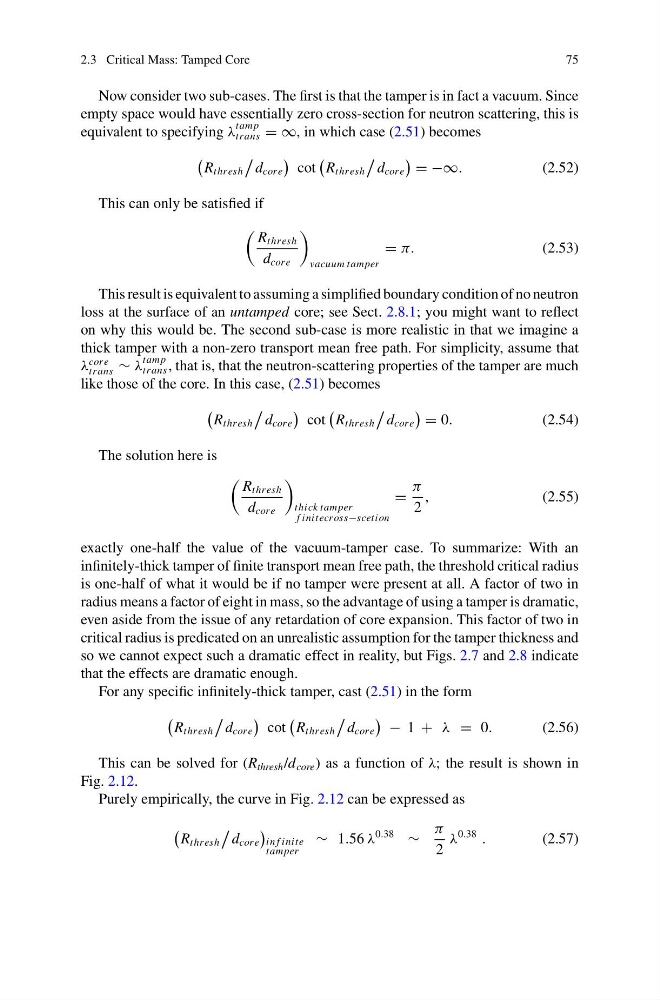
Now consider two sub-cases. The first is that the tamper is in fact a vacuum. Since
empty space would have essentially zero cross-section for neutron scattering, this is
equivalent to specifying λ
tamp
trans = ∞, in which case (2.51) becomes
R thresh
d core
cot
R thresh
d core
= −∞.
(2.52)
This can only be satisfied if
R thresh
d core
vacuum tamper
= π.
(2.53)
This result is equivalent to assuming a simplified boundary condition of no neutron
loss at the surface of an untamped core; see Sect. 2.8.1; you might want to reflect
on why this would be. The second sub-case is more realistic in that we imagine a
thick tamper with a non-zero transport mean free path. For simplicity, assume that
λ
core
trans ∼ λ
tamp
trans , that is, that the neutron-scattering properties of the tamper are much
like those of the core. In this case, (2.51) becomes
R thresh
d core
cot
R thresh
d core
= 0.
(2.54)
The solution here is
R thresh
d core
thick tamper
f initecross−scetion
=
π
2
,
(2.55)
exactly one-half the value of the vacuum-tamper case. To summarize: With an
infinitely-thick tamper of finite transport mean free path, the threshold critical radius
is one-half of what it would be if no tamper were present at all. A factor of two in
radius means a factor of eight in mass, so the advantage of using a tamper is dramatic,
even aside from the issue of any retardation of core expansion. This factor of two in
critical radius is predicated on an unrealistic assumption for the tamper thickness and
so we cannot expect such a dramatic effect in reality, but Figs. 2.7 and 2.8 indicate
that the effects are dramatic enough.
For any specific infinitely-thick tamper, cast (2.51) in the form
R thresh
d core
cot
R thresh
d core
− 1 + λ = 0.
(2.56)
This can be solved for (R thresh /d core ) as a function of λ; the result is shown in
Fig. 2.12.
Purely empirically, the curve in Fig. 2.12 can be expressed as
R thresh
d core
in f inite
tamper
∼ 1.56 λ
0.38
∼
π
2
λ
0.38
.
(2.57)
75
Now consider two sub-cases. The first is that the tamper is in fact a vacuum. Since
empty space would have essentially zero cross-section for neutron scattering, this is
equivalent to specifying λ
tamp
trans = ∞, in which case (2.51) becomes
R thresh
d core
cot
R thresh
d core
= −∞.
(2.52)
This can only be satisfied if
R thresh
d core
vacuum tamper
= π.
(2.53)
This result is equivalent to assuming a simplified boundary condition of no neutron
loss at the surface of an untamped core; see Sect. 2.8.1; you might want to reflect
on why this would be. The second sub-case is more realistic in that we imagine a
thick tamper with a non-zero transport mean free path. For simplicity, assume that
λ
core
trans ∼ λ
tamp
trans , that is, that the neutron-scattering properties of the tamper are much
like those of the core. In this case, (2.51) becomes
R thresh
d core
cot
R thresh
d core
= 0.
(2.54)
The solution here is
R thresh
d core
thick tamper
f initecross−scetion
=
π
2
,
(2.55)
exactly one-half the value of the vacuum-tamper case. To summarize: With an
infinitely-thick tamper of finite transport mean free path, the threshold critical radius
is one-half of what it would be if no tamper were present at all. A factor of two in
radius means a factor of eight in mass, so the advantage of using a tamper is dramatic,
even aside from the issue of any retardation of core expansion. This factor of two in
critical radius is predicated on an unrealistic assumption for the tamper thickness and
so we cannot expect such a dramatic effect in reality, but Figs. 2.7 and 2.8 indicate
that the effects are dramatic enough.
For any specific infinitely-thick tamper, cast (2.51) in the form
R thresh
d core
cot
R thresh
d core
− 1 + λ = 0.
(2.56)
This can be solved for (R thresh /d core ) as a function of λ; the result is shown in
Fig. 2.12.
Purely empirically, the curve in Fig. 2.12 can be expressed as
R thresh
d core
in f inite
tamper
∼ 1.56 λ
0.38
∼
π
2
λ
0.38
.
(2.57)