

70
2 Critical Mass, Efficiency, and Yield
e
2 (xct −x t )
x c cot x c − 1 − λ (x ct − 1)
R tamp + 2λ
tamp
trans (x t − 1)
3
=
x c cot x c − 1 + λ (x ct + 1)
R tamp − 2λ
tamp
trans (x t + 1)
3
,
(2.47)
where
x ct = R core
d tamp
x c = R core
d core
x t = R tamp
d tamp
λ = λ
tamp
trans
λ
core
trans
⎫
⎪ ⎪ ⎪ ⎪ ⎬
⎪ ⎪ ⎪ ⎪ ⎭
.
(2.48)
It is also necessary to demand that α = δ, as otherwise the fact that (2.43)–(2.45)
must also hold as a function of time would be violated. Some comments on these
results follow. Comments on (2.46) will be particularly extensive.
Equation (2.46) corresponds to tamped threshold criticality, where α = δ = 0.
Once values for the d’s and λ’s are given, there are two ways to use this expression.
First, if a core mass which is bare-threshold sub-critical is specified, use its radius as
R thresh and solve (2.46) for R tamp , the tamper outer radius which will just render the
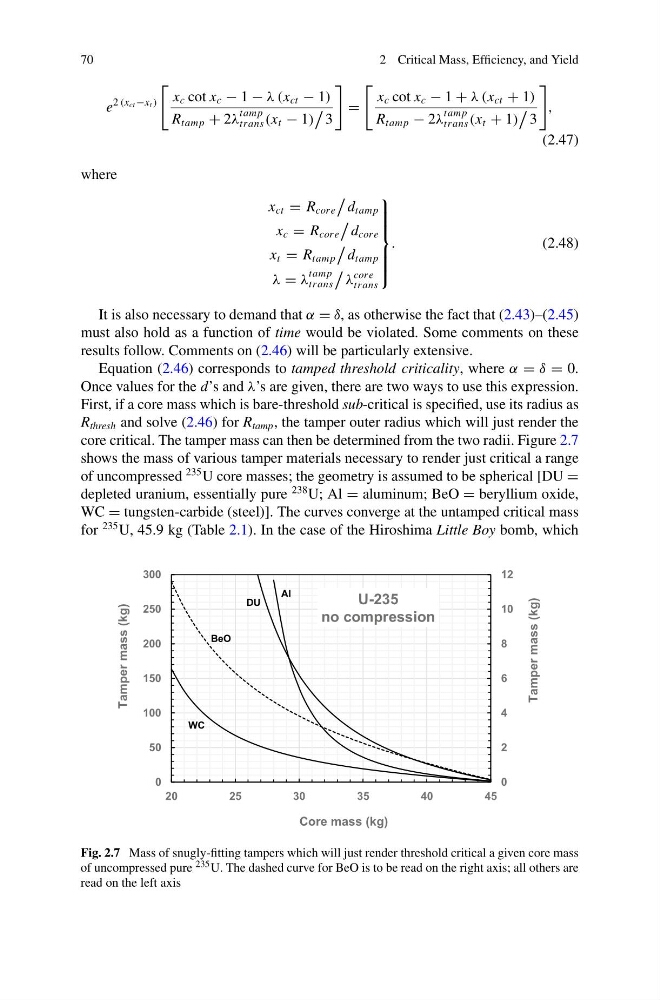
core critical. The tamper mass can then be determined from the two radii. Figure 2.7
shows the mass of various tamper materials necessary to render just critical a range
of uncompressed
235 U core masses; the geometry is assumed to be spherical [DU =
depleted uranium, essentially pure
238 U; Al = aluminum; BeO = beryllium oxide,
WC = tungsten-carbide (steel)]. The curves converge at the untamped critical mass
for
235 U, 45.9 kg (Table 2.1). In the case of the Hiroshima Little Boy bomb, which
0
2
4
6
8
10
12
0
50
100
150
200
250
300
20
25
30
35
40
45
Tamper mass (kg)
Tamper mass (kg)
Core mass (kg)
U-235
no compression
WC
BeO
DU
Al
Fig. 2.7 Mass of snugly-fitting tampers which will just render threshold critical a given core mass
of uncompressed pure 235 U. The dashed curve for BeO is to be read on the right axis; all others are
read on the left axis
2 Critical Mass, Efficiency, and Yield
e
2 (xct −x t )
x c cot x c − 1 − λ (x ct − 1)
R tamp + 2λ
tamp
trans (x t − 1)
3
=
x c cot x c − 1 + λ (x ct + 1)
R tamp − 2λ
tamp
trans (x t + 1)
3
,
(2.47)
where
x ct = R core
d tamp
x c = R core
d core
x t = R tamp
d tamp
λ = λ
tamp
trans
λ
core
trans
⎫
⎪ ⎪ ⎪ ⎪ ⎬
⎪ ⎪ ⎪ ⎪ ⎭
.
(2.48)
It is also necessary to demand that α = δ, as otherwise the fact that (2.43)–(2.45)
must also hold as a function of time would be violated. Some comments on these
results follow. Comments on (2.46) will be particularly extensive.
Equation (2.46) corresponds to tamped threshold criticality, where α = δ = 0.
Once values for the d’s and λ’s are given, there are two ways to use this expression.
First, if a core mass which is bare-threshold sub-critical is specified, use its radius as
R thresh and solve (2.46) for R tamp , the tamper outer radius which will just render the
core critical. The tamper mass can then be determined from the two radii. Figure 2.7
shows the mass of various tamper materials necessary to render just critical a range
of uncompressed
235 U core masses; the geometry is assumed to be spherical [DU =
depleted uranium, essentially pure
238 U; Al = aluminum; BeO = beryllium oxide,
WC = tungsten-carbide (steel)]. The curves converge at the untamped critical mass
for
235 U, 45.9 kg (Table 2.1). In the case of the Hiroshima Little Boy bomb, which
0
2
4
6
8
10
12
0
50
100
150
200
250
300
20
25
30
35
40
45
Tamper mass (kg)
Tamper mass (kg)
Core mass (kg)
U-235
no compression
WC
BeO
DU
Al
Fig. 2.7 Mass of snugly-fitting tampers which will just render threshold critical a given core mass
of uncompressed pure 235 U. The dashed curve for BeO is to be read on the right axis; all others are
read on the left axis