

2.3 Critical Mass: Tamped Core
69
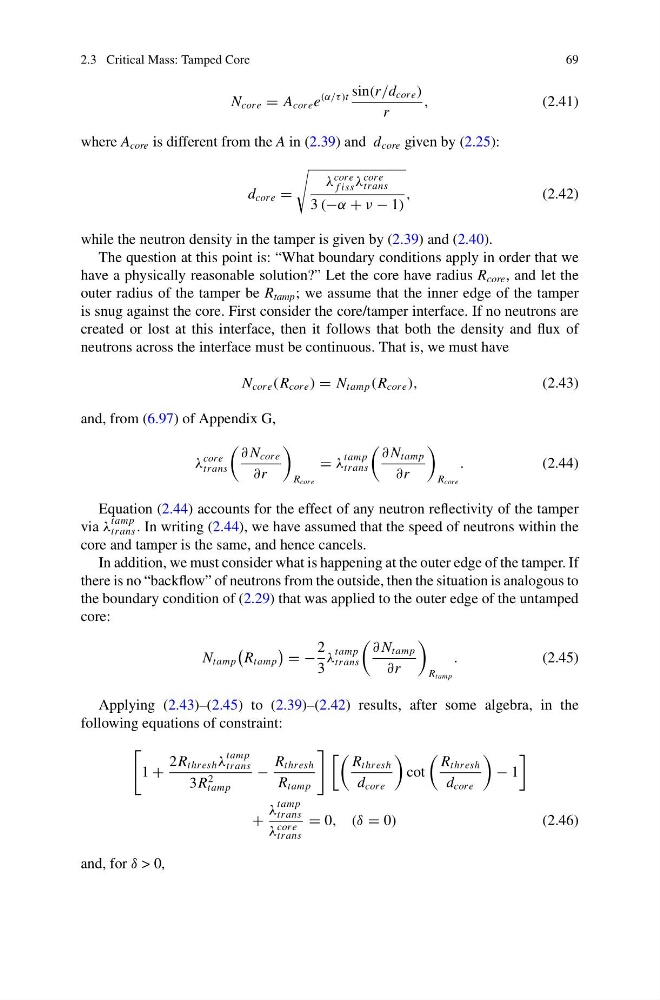
N core = A core e
(α/τ )t sin(r/d core )
r
,
(2.41)
where A core is different from the A in (2.39) and d core given by (2.25):
d core =
λ
core
f iss λ
core
trans
3 (−α + ν − 1)
,
(2.42)
while the neutron density in the tamper is given by (2.39) and (2.40).
The question at this point is: “What boundary conditions apply in order that we
have a physically reasonable solution?” Let the core have radius R core , and let the
outer radius of the tamper be R tamp ; we assume that the inner edge of the tamper
is snug against the core. First consider the core/tamper interface. If no neutrons are
created or lost at this interface, then it follows that both the density and flux of
neutrons across the interface must be continuous. That is, we must have
N core (R core ) = N tamp (R core ),
(2.43)
and, from (6.97) of Appendix G,
λ
core
trans
∂ N core
∂r
R core
= λ
tamp
trans
∂ N tamp
∂r
R core
.
(2.44)
Equation (2.44) accounts for the effect of any neutron reflectivity of the tamper
via λ
tamp
trans . In writing (2.44), we have assumed that the speed of neutrons within the
core and tamper is the same, and hence cancels.
In addition, we must consider what is happening at the outer edge of the tamper. If
there is no “backflow” of neutrons from the outside, then the situation is analogous to
the boundary condition of (2.29) that was applied to the outer edge of the untamped
core:
N tamp
R tamp
= −
2
3
λ
tamp
trans
∂ N tamp
∂r
R tamp
.
(2.45)
Applying (2.43)–(2.45) to (2.39)–(2.42) results, after some algebra, in the
following equations of constraint:
1 +
2R thresh λ
tamp
trans
3R
2
tamp
−
R thresh
R tamp
R thresh
d core
cot
R thresh
d core
− 1
+
λ
tamp
trans
λ
core
trans
= 0, (δ = 0)
(2.46)
and, for δ > 0,
69
N core = A core e
(α/τ )t sin(r/d core )
r
,
(2.41)
where A core is different from the A in (2.39) and d core given by (2.25):
d core =
λ
core
f iss λ
core
trans
3 (−α + ν − 1)
,
(2.42)
while the neutron density in the tamper is given by (2.39) and (2.40).
The question at this point is: “What boundary conditions apply in order that we
have a physically reasonable solution?” Let the core have radius R core , and let the
outer radius of the tamper be R tamp ; we assume that the inner edge of the tamper
is snug against the core. First consider the core/tamper interface. If no neutrons are
created or lost at this interface, then it follows that both the density and flux of
neutrons across the interface must be continuous. That is, we must have
N core (R core ) = N tamp (R core ),
(2.43)
and, from (6.97) of Appendix G,
λ
core
trans
∂ N core
∂r
R core
= λ
tamp
trans
∂ N tamp
∂r
R core
.
(2.44)
Equation (2.44) accounts for the effect of any neutron reflectivity of the tamper
via λ
tamp
trans . In writing (2.44), we have assumed that the speed of neutrons within the
core and tamper is the same, and hence cancels.
In addition, we must consider what is happening at the outer edge of the tamper. If
there is no “backflow” of neutrons from the outside, then the situation is analogous to
the boundary condition of (2.29) that was applied to the outer edge of the untamped
core:
N tamp
R tamp
= −
2
3
λ
tamp
trans
∂ N tamp
∂r
R tamp
.
(2.45)
Applying (2.43)–(2.45) to (2.39)–(2.42) results, after some algebra, in the
following equations of constraint:
1 +
2R thresh λ
tamp
trans
3R
2
tamp
−
R thresh
R tamp
R thresh
d core
cot
R thresh
d core
− 1
+
λ
tamp
trans
λ
core
trans
= 0, (δ = 0)
(2.46)
and, for δ > 0,