

1.11 A Numerical Model of the Fission Process
45
U S = a S A
2/3
Σ S . (MeV)
(1.112)
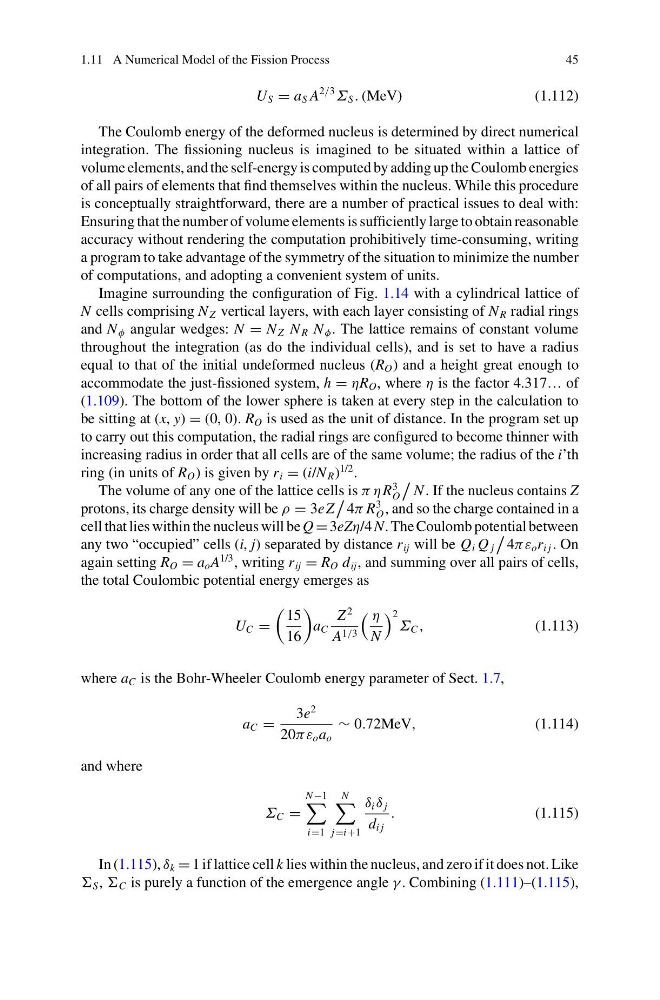
The Coulomb energy of the deformed nucleus is determined by direct numerical
integration. The fissioning nucleus is imagined to be situated within a lattice of
volume elements, and the self-energy is computed by adding up the Coulomb energies
of all pairs of elements that find themselves within the nucleus. While this procedure
is conceptually straightforward, there are a number of practical issues to deal with:
Ensuring that the number of volume elements is sufficiently large to obtain reasonable
accuracy without rendering the computation prohibitively time-consuming, writing
a program to take advantage of the symmetry of the situation to minimize the number
of computations, and adopting a convenient system of units.
Imagine surrounding the configuration of Fig. 1.14 with a cylindrical lattice of
N cells comprising N Z vertical layers, with each layer consisting of N R radial rings
and N φ angular wedges: N = N Z N R N φ . The lattice remains of constant volume
throughout the integration (as do the individual cells), and is set to have a radius
equal to that of the initial undeformed nucleus (R O ) and a height great enough to
accommodate the just-fissioned system, h = ηR O , where η is the factor 4.317… of
(1.109). The bottom of the lower sphere is taken at every step in the calculation to
be sitting at (x, y) = (0, 0). R O is used as the unit of distance. In the program set up
to carry out this computation, the radial rings are configured to become thinner with
increasing radius in order that all cells are of the same volume; the radius of the i’th
ring (in units of R O ) is given by r i = (i/N R )
1/2 .
The volume of any one of the lattice cells is π ηR
3
O
N . If the nucleus contains Z
protons, its charge density will be ρ = 3eZ
4π R
3
O , and so the charge contained in a
cell that lies within the nucleus will be Q = 3eZη/4 N. The Coulomb potential between
any two “occupied” cells (i, j) separated by distance r ij will be Q i Q j
4πε o r i j . On
again setting R O = a o A
1/3 , writing r ij = R O d ij , and summing over all pairs of cells,
the total Coulombic potential energy emerges as
U C =
15
16
a C
Z
2
A 1/3
η
N
2 Σ C ,
(1.113)
where a C is the Bohr-Wheeler Coulomb energy parameter of Sect. 1.7,
a C =
3e
2
20πε o a o
∼ 0.72MeV,
(1.114)
and where
Σ C =
N −1
i=1
N
j=i+1
δ i δ j
d i j
.
(1.115)
In (1.115), δ k = 1 if lattice cell k lies within the nucleus, and zero if it does not. Like
S , C is purely a function of the emergence angle γ . Combining (1.111)–(1.115),
45
U S = a S A
2/3
Σ S . (MeV)
(1.112)
The Coulomb energy of the deformed nucleus is determined by direct numerical
integration. The fissioning nucleus is imagined to be situated within a lattice of
volume elements, and the self-energy is computed by adding up the Coulomb energies
of all pairs of elements that find themselves within the nucleus. While this procedure
is conceptually straightforward, there are a number of practical issues to deal with:
Ensuring that the number of volume elements is sufficiently large to obtain reasonable
accuracy without rendering the computation prohibitively time-consuming, writing
a program to take advantage of the symmetry of the situation to minimize the number
of computations, and adopting a convenient system of units.
Imagine surrounding the configuration of Fig. 1.14 with a cylindrical lattice of
N cells comprising N Z vertical layers, with each layer consisting of N R radial rings
and N φ angular wedges: N = N Z N R N φ . The lattice remains of constant volume
throughout the integration (as do the individual cells), and is set to have a radius
equal to that of the initial undeformed nucleus (R O ) and a height great enough to
accommodate the just-fissioned system, h = ηR O , where η is the factor 4.317… of
(1.109). The bottom of the lower sphere is taken at every step in the calculation to
be sitting at (x, y) = (0, 0). R O is used as the unit of distance. In the program set up
to carry out this computation, the radial rings are configured to become thinner with
increasing radius in order that all cells are of the same volume; the radius of the i’th
ring (in units of R O ) is given by r i = (i/N R )
1/2 .
The volume of any one of the lattice cells is π ηR
3
O
N . If the nucleus contains Z
protons, its charge density will be ρ = 3eZ
4π R
3
O , and so the charge contained in a
cell that lies within the nucleus will be Q = 3eZη/4 N. The Coulomb potential between
any two “occupied” cells (i, j) separated by distance r ij will be Q i Q j
4πε o r i j . On
again setting R O = a o A
1/3 , writing r ij = R O d ij , and summing over all pairs of cells,
the total Coulombic potential energy emerges as
U C =
15
16
a C
Z
2
A 1/3
η
N
2 Σ C ,
(1.113)
where a C is the Bohr-Wheeler Coulomb energy parameter of Sect. 1.7,
a C =
3e
2
20πε o a o
∼ 0.72MeV,
(1.114)
and where
Σ C =
N −1
i=1
N
j=i+1
δ i δ j
d i j
.
(1.115)
In (1.115), δ k = 1 if lattice cell k lies within the nucleus, and zero if it does not. Like
S , C is purely a function of the emergence angle γ . Combining (1.111)–(1.115),