

44
1 Energy Release in Nuclear Reactions, Neutrons, Fission, and Characteristics …
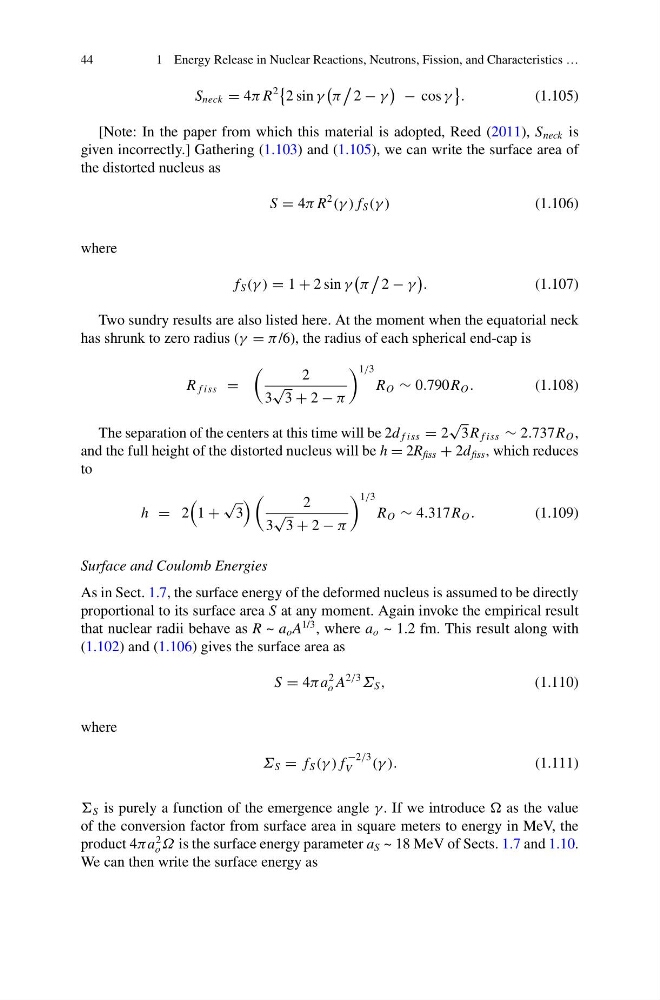
S neck = 4π R
2
2 sin γ
π
2 − γ
− cos γ
.
(1.105)
[Note: In the paper from which this material is adopted, Reed (2011), S neck is
given incorrectly.] Gathering (1.103) and (1.105), we can write the surface area of
the distorted nucleus as
S = 4π R
2
(γ ) f S (γ )
(1.106)
where
f S (γ ) = 1 + 2 sin γ
π
2 − γ
.
(1.107)
Two sundry results are also listed here. At the moment when the equatorial neck
has shrunk to zero radius (γ = π /6), the radius of each spherical end-cap is
R f iss =
2
3
√
3 + 2 − π
1/3
R O ∼ 0.790R O .
(1.108)
The separation of the centers at this time will be 2d f iss = 2
√
3R f iss ∼ 2.737R O ,
and the full height of the distorted nucleus will be h = 2R fiss + 2d fiss , which reduces
to
h = 2
1 +
√
3
2
3
√
3 + 2 − π
1/3
R O ∼ 4.317R O .
(1.109)
Surface and Coulomb Energies
As in Sect. 1.7, the surface energy of the deformed nucleus is assumed to be directly
proportional to its surface area S at any moment. Again invoke the empirical result
that nuclear radii behave as R ~ a o A
1/3 , where a o ~ 1.2 fm. This result along with
(1.102) and (1.106) gives the surface area as
S = 4πa
2
o A
2/3
Σ S ,
(1.110)
where
Σ S = f S (γ ) f
−2/3
V
(γ ).
(1.111)
S is purely a function of the emergence angle γ . If we introduce as the value
of the conversion factor from surface area in square meters to energy in MeV, the
product 4πa
2
o Ω is the surface energy parameter a S ~ 18 MeV of Sects. 1.7 and 1.10.
We can then write the surface energy as
1 Energy Release in Nuclear Reactions, Neutrons, Fission, and Characteristics …
S neck = 4π R
2
2 sin γ
π
2 − γ
− cos γ
.
(1.105)
[Note: In the paper from which this material is adopted, Reed (2011), S neck is
given incorrectly.] Gathering (1.103) and (1.105), we can write the surface area of
the distorted nucleus as
S = 4π R
2
(γ ) f S (γ )
(1.106)
where
f S (γ ) = 1 + 2 sin γ
π
2 − γ
.
(1.107)
Two sundry results are also listed here. At the moment when the equatorial neck
has shrunk to zero radius (γ = π /6), the radius of each spherical end-cap is
R f iss =
2
3
√
3 + 2 − π
1/3
R O ∼ 0.790R O .
(1.108)
The separation of the centers at this time will be 2d f iss = 2
√
3R f iss ∼ 2.737R O ,
and the full height of the distorted nucleus will be h = 2R fiss + 2d fiss , which reduces
to
h = 2
1 +
√
3
2
3
√
3 + 2 − π
1/3
R O ∼ 4.317R O .
(1.109)
Surface and Coulomb Energies
As in Sect. 1.7, the surface energy of the deformed nucleus is assumed to be directly
proportional to its surface area S at any moment. Again invoke the empirical result
that nuclear radii behave as R ~ a o A
1/3 , where a o ~ 1.2 fm. This result along with
(1.102) and (1.106) gives the surface area as
S = 4πa
2
o A
2/3
Σ S ,
(1.110)
where
Σ S = f S (γ ) f
−2/3
V
(γ ).
(1.111)
S is purely a function of the emergence angle γ . If we introduce as the value
of the conversion factor from surface area in square meters to energy in MeV, the
product 4πa
2
o Ω is the surface energy parameter a S ~ 18 MeV of Sects. 1.7 and 1.10.
We can then write the surface energy as