

34
1 Energy Release in Nuclear Reactions, Neutrons, Fission, and Characteristics …
-3
-2
-1
0
1
2
3
4
-8
-7
-6
-5
-4
-3
-2
-1
0
log (cross-section, bn)
log (energy, MeV)
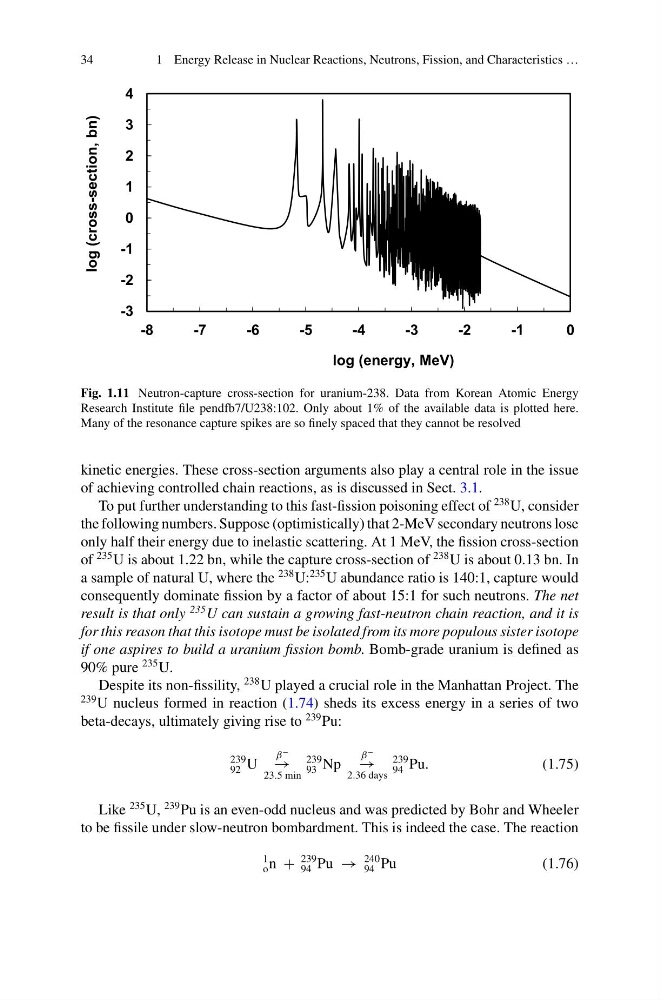
Fig. 1.11 Neutron-capture cross-section for uranium-238. Data from Korean Atomic Energy
Research Institute file pendfb7/U238:102. Only about 1% of the available data is plotted here.
Many of the resonance capture spikes are so finely spaced that they cannot be resolved
kinetic energies. These cross-section arguments also play a central role in the issue
of achieving controlled chain reactions, as is discussed in Sect. 3.1.
To put further understanding to this fast-fission poisoning effect of
238 U, consider
the following numbers. Suppose (optimistically) that 2-MeV secondary neutrons lose
only half their energy due to inelastic scattering. At 1 MeV, the fission cross-section
of
235 U is about 1.22 bn, while the capture cross-section of
238 U is about 0.13 bn. In
a sample of natural U, where the
238 U:
235 U abundance ratio is 140:1, capture would
consequently dominate fission by a factor of about 15:1 for such neutrons. The net
result is that only
235 U can sustain a growing fast-neutron chain reaction, and it is
for this reason that this isotope must be isolated from its more populous sister isotope
if one aspires to build a uranium fission bomb. Bomb-grade uranium is defined as
90% pure
235 U.
Despite its non-fissility,
238 U played a crucial role in the Manhattan Project. The
239 U nucleus formed in reaction (1.74) sheds its excess energy in a series of two
beta-decays, ultimately giving rise to
239 Pu:
239
92 U
β
−
→
23.5 min
239
93 Np
β
−
→
2.36 days
239
94 Pu.
(1.75)
Like
235 U,
239 Pu is an even-odd nucleus and was predicted by Bohr and Wheeler
to be fissile under slow-neutron bombardment. This is indeed the case. The reaction
1
o n +
239
94 Pu →
240
94 Pu
(1.76)
1 Energy Release in Nuclear Reactions, Neutrons, Fission, and Characteristics …
-3
-2
-1
0
1
2
3
4
-8
-7
-6
-5
-4
-3
-2
-1
0
log (cross-section, bn)
log (energy, MeV)
Fig. 1.11 Neutron-capture cross-section for uranium-238. Data from Korean Atomic Energy
Research Institute file pendfb7/U238:102. Only about 1% of the available data is plotted here.
Many of the resonance capture spikes are so finely spaced that they cannot be resolved
kinetic energies. These cross-section arguments also play a central role in the issue
of achieving controlled chain reactions, as is discussed in Sect. 3.1.
To put further understanding to this fast-fission poisoning effect of
238 U, consider
the following numbers. Suppose (optimistically) that 2-MeV secondary neutrons lose
only half their energy due to inelastic scattering. At 1 MeV, the fission cross-section
of
235 U is about 1.22 bn, while the capture cross-section of
238 U is about 0.13 bn. In
a sample of natural U, where the
238 U:
235 U abundance ratio is 140:1, capture would
consequently dominate fission by a factor of about 15:1 for such neutrons. The net
result is that only
235 U can sustain a growing fast-neutron chain reaction, and it is
for this reason that this isotope must be isolated from its more populous sister isotope
if one aspires to build a uranium fission bomb. Bomb-grade uranium is defined as
90% pure
235 U.
Despite its non-fissility,
238 U played a crucial role in the Manhattan Project. The
239 U nucleus formed in reaction (1.74) sheds its excess energy in a series of two
beta-decays, ultimately giving rise to
239 Pu:
239
92 U
β
−
→
23.5 min
239
93 Np
β
−
→
2.36 days
239
94 Pu.
(1.75)
Like
235 U,
239 Pu is an even-odd nucleus and was predicted by Bohr and Wheeler
to be fissile under slow-neutron bombardment. This is indeed the case. The reaction
1
o n +
239
94 Pu →
240
94 Pu
(1.76)