

1.9 Leaping the Fission Barrier
33
0
0.5
1
1.5
2
2.5
3
3.5
0
1
2
3
(bn)
Energy (MeV)
238-inelastic
239-fission
235-fission
238-fission
238-capture
σ
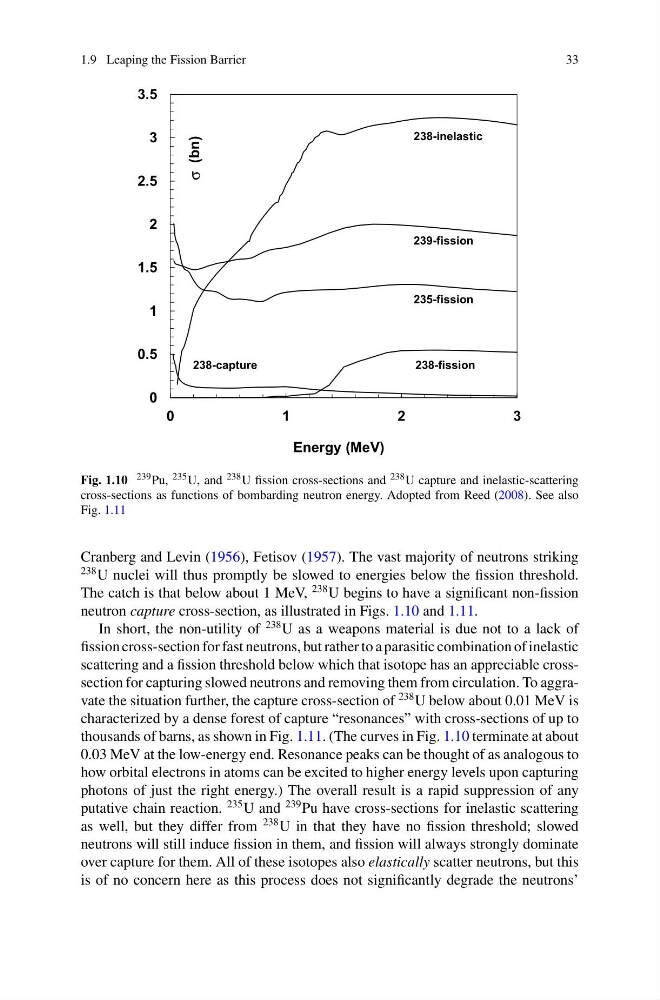
Fig. 1.10 239 Pu, 235 U, and 238 U fission cross-sections and 238 U capture and inelastic-scattering
cross-sections as functions of bombarding neutron energy. Adopted from Reed (2008). See also
Fig. 1.11
Cranberg and Levin (1956), Fetisov (1957). The vast majority of neutrons striking
238 U nuclei will thus promptly be slowed to energies below the fission threshold.
The catch is that below about 1 MeV,
238 U begins to have a significant non-fission
neutron capture cross-section, as illustrated in Figs. 1.10 and 1.11.
In short, the non-utility of
238 U as a weapons material is due not to a lack of
fission cross-section for fast neutrons, but rather to a parasitic combination of inelastic
scattering and a fission threshold below which that isotope has an appreciable crosssection for capturing slowed neutrons and removing them from circulation. To aggravate the situation further, the capture cross-section of
238 U below about 0.01 MeV is
characterized by a dense forest of capture “resonances” with cross-sections of up to
thousands of barns, as shown in Fig. 1.11. (The curves in Fig. 1.10 terminate at about
0.03 MeV at the low-energy end. Resonance peaks can be thought of as analogous to
how orbital electrons in atoms can be excited to higher energy levels upon capturing
photons of just the right energy.) The overall result is a rapid suppression of any
putative chain reaction.
235 U and
239 Pu have cross-sections for inelastic scattering
as well, but they differ from
238 U in that they have no fission threshold; slowed
neutrons will still induce fission in them, and fission will always strongly dominate
over capture for them. All of these isotopes also elastically scatter neutrons, but this
is of no concern here as this process does not significantly degrade the neutrons’
33
0
0.5
1
1.5
2
2.5
3
3.5
0
1
2
3
(bn)
Energy (MeV)
238-inelastic
239-fission
235-fission
238-fission
238-capture
σ
Fig. 1.10 239 Pu, 235 U, and 238 U fission cross-sections and 238 U capture and inelastic-scattering
cross-sections as functions of bombarding neutron energy. Adopted from Reed (2008). See also
Fig. 1.11
Cranberg and Levin (1956), Fetisov (1957). The vast majority of neutrons striking
238 U nuclei will thus promptly be slowed to energies below the fission threshold.
The catch is that below about 1 MeV,
238 U begins to have a significant non-fission
neutron capture cross-section, as illustrated in Figs. 1.10 and 1.11.
In short, the non-utility of
238 U as a weapons material is due not to a lack of
fission cross-section for fast neutrons, but rather to a parasitic combination of inelastic
scattering and a fission threshold below which that isotope has an appreciable crosssection for capturing slowed neutrons and removing them from circulation. To aggravate the situation further, the capture cross-section of
238 U below about 0.01 MeV is
characterized by a dense forest of capture “resonances” with cross-sections of up to
thousands of barns, as shown in Fig. 1.11. (The curves in Fig. 1.10 terminate at about
0.03 MeV at the low-energy end. Resonance peaks can be thought of as analogous to
how orbital electrons in atoms can be excited to higher energy levels upon capturing
photons of just the right energy.) The overall result is a rapid suppression of any
putative chain reaction.
235 U and
239 Pu have cross-sections for inelastic scattering
as well, but they differ from
238 U in that they have no fission threshold; slowed
neutrons will still induce fission in them, and fission will always strongly dominate
over capture for them. All of these isotopes also elastically scatter neutrons, but this
is of no concern here as this process does not significantly degrade the neutrons’