

1.4 Discovery of the Neutron
7
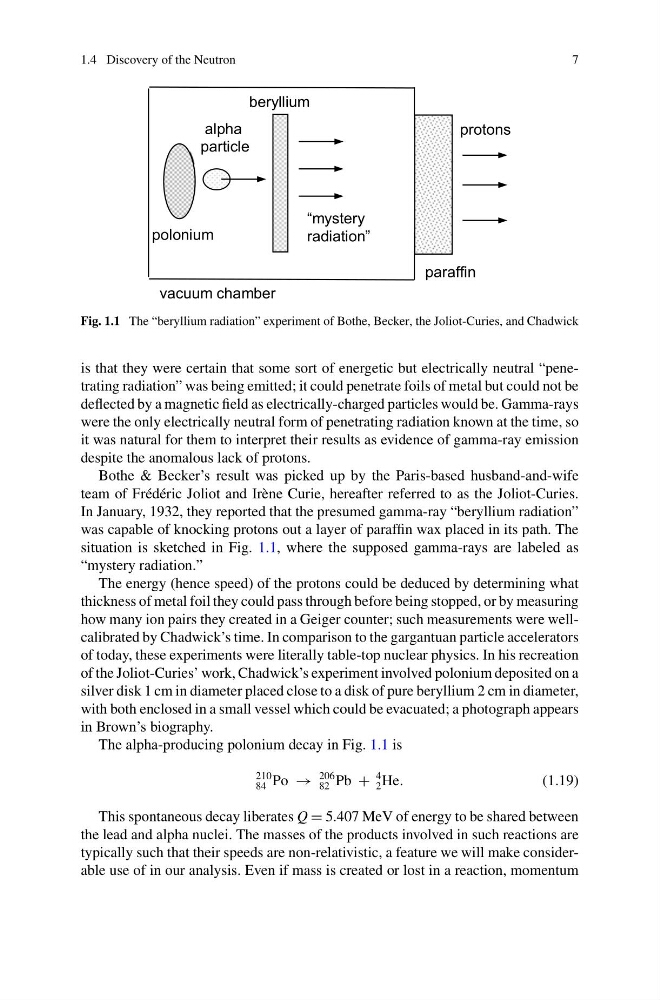
Fig. 1.1 The “beryllium radiation” experiment of Bothe, Becker, the Joliot-Curies, and Chadwick
is that they were certain that some sort of energetic but electrically neutral “penetrating radiation” was being emitted; it could penetrate foils of metal but could not be
deflected by a magnetic field as electrically-charged particles would be. Gamma-rays
were the only electrically neutral form of penetrating radiation known at the time, so
it was natural for them to interpret their results as evidence of gamma-ray emission
despite the anomalous lack of protons.
Bothe & Becker’s result was picked up by the Paris-based husband-and-wife
team of Frédéric Joliot and Irène Curie, hereafter referred to as the Joliot-Curies.
In January, 1932, they reported that the presumed gamma-ray “beryllium radiation”
was capable of knocking protons out a layer of paraffin wax placed in its path. The
situation is sketched in Fig. 1.1, where the supposed gamma-rays are labeled as
“mystery radiation.”
The energy (hence speed) of the protons could be deduced by determining what
thickness of metal foil they could pass through before being stopped, or by measuring
how many ion pairs they created in a Geiger counter; such measurements were wellcalibrated by Chadwick’s time. In comparison to the gargantuan particle accelerators
of today, these experiments were literally table-top nuclear physics. In his recreation
of the Joliot-Curies’ work, Chadwick’s experiment involved polonium deposited on a
silver disk 1 cm in diameter placed close to a disk of pure beryllium 2 cm in diameter,
with both enclosed in a small vessel which could be evacuated; a photograph appears
in Brown’s biography.
The alpha-producing polonium decay in Fig. 1.1 is
210
84 Po →
206
82 Pb +
4
2 He.
(1.19)
This spontaneous decay liberates Q = 5.407 MeV of energy to be shared between
the lead and alpha nuclei. The masses of the products involved in such reactions are
typically such that their speeds are non-relativistic, a feature we will make considerable use of in our analysis. Even if mass is created or lost in a reaction, momentum
7
Fig. 1.1 The “beryllium radiation” experiment of Bothe, Becker, the Joliot-Curies, and Chadwick
is that they were certain that some sort of energetic but electrically neutral “penetrating radiation” was being emitted; it could penetrate foils of metal but could not be
deflected by a magnetic field as electrically-charged particles would be. Gamma-rays
were the only electrically neutral form of penetrating radiation known at the time, so
it was natural for them to interpret their results as evidence of gamma-ray emission
despite the anomalous lack of protons.
Bothe & Becker’s result was picked up by the Paris-based husband-and-wife
team of Frédéric Joliot and Irène Curie, hereafter referred to as the Joliot-Curies.
In January, 1932, they reported that the presumed gamma-ray “beryllium radiation”
was capable of knocking protons out a layer of paraffin wax placed in its path. The
situation is sketched in Fig. 1.1, where the supposed gamma-rays are labeled as
“mystery radiation.”
The energy (hence speed) of the protons could be deduced by determining what
thickness of metal foil they could pass through before being stopped, or by measuring
how many ion pairs they created in a Geiger counter; such measurements were wellcalibrated by Chadwick’s time. In comparison to the gargantuan particle accelerators
of today, these experiments were literally table-top nuclear physics. In his recreation
of the Joliot-Curies’ work, Chadwick’s experiment involved polonium deposited on a
silver disk 1 cm in diameter placed close to a disk of pure beryllium 2 cm in diameter,
with both enclosed in a small vessel which could be evacuated; a photograph appears
in Brown’s biography.
The alpha-producing polonium decay in Fig. 1.1 is
210
84 Po →
206
82 Pb +
4
2 He.
(1.19)
This spontaneous decay liberates Q = 5.407 MeV of energy to be shared between
the lead and alpha nuclei. The masses of the products involved in such reactions are
typically such that their speeds are non-relativistic, a feature we will make considerable use of in our analysis. Even if mass is created or lost in a reaction, momentum