

6
1 Energy Release in Nuclear Reactions, Neutrons, Fission, and Characteristics …
nucleus and so get close enough to it to allow nuclear forces to come into play; this
is examined in Exercise 1.12 in Appendix H.
The physics of two-body collisions is put to considerable use in the following
section.
1.4 Discovery of the Neutron
Much of the material in this section is adopted from Reed (2007).
James Chadwick’s discovery of the neutron in early 1932 was a critical turning
point in the history of nuclear physics. Within two years, Enrico Fermi would generate
artificially-induced radioactivity by neutron bombardment, and less than five years
after that Otto Hahn and Fritz Strassmann would discover neutron-induced uranium
fission. The latter would lead directly to the Little Boy uranium-fission bomb, while
Fermi’s work would lead to reactors to produce plutonium for the Trinity and Fat
Man bombs.
Chadwick’s discovery was reported in two papers. The first, titled “Possible Existence of a Neutron,” is a brief report dated February 17, 1932, and published in
the February 27 edition of Nature (Chadwick 1932a). A more extensive follow-up
paper dated May 10, 1932, was published in the June 1 edition of the Proceedings
of the Royal Society of London (Chadwick 1932b). As we work through Chadwick’s
analysis, these will be referred to as Papers 1 and 2, respectively. The Nature paper
is reproduced in Andrew Brown’s excellent biography of Chadwick; see (Brown
1997). A complete description of the experimental background of the discovery of
the neutron would be quite extensive, so only a brief summary of the essentials
is given here. A more thorough discussion appears in Chap. 6 of Brown; see also
Chap. 6 of Rhodes (1986).
The experiments which lead to the discovery of the neutron were first reported
in 1930 by Walther Bothe and his student Herbert Becker, working in Germany.
Their research involved studying gamma radiation which is produced when light
elements such as magnesium and aluminum are bombarded by energetic alphaparticles emitted in the natural decay of elements such as radium or polonium. In
such reactions, the alpha particles often interact with a target nucleus to yield a
proton (hydrogen nucleus) and a gamma-ray, both of which can be detected by Geiger
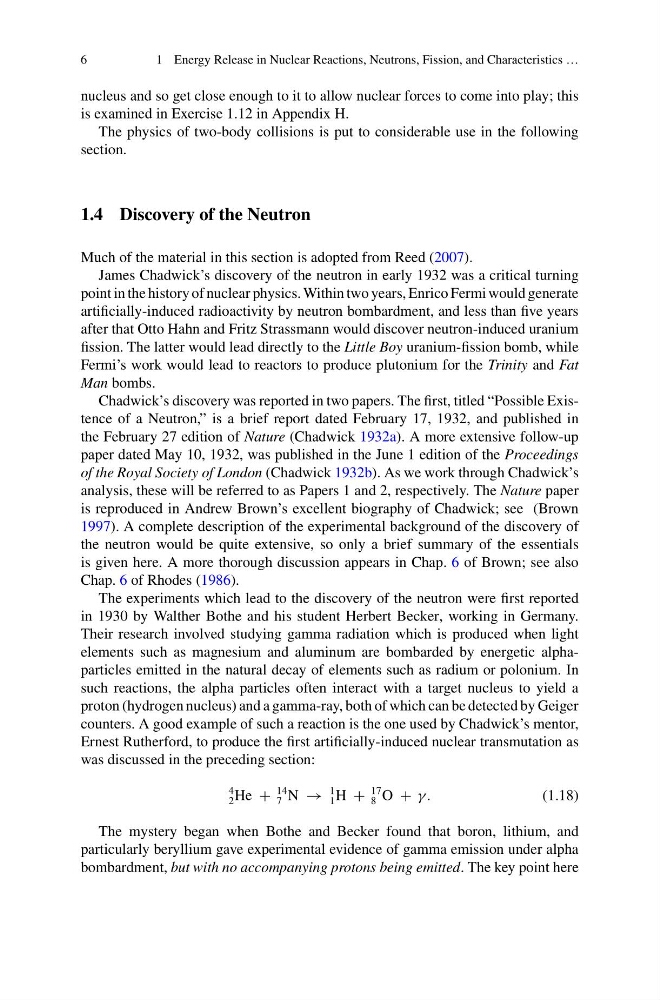
counters. A good example of such a reaction is the one used by Chadwick’s mentor,
Ernest Rutherford, to produce the first artificially-induced nuclear transmutation as
was discussed in the preceding section:
4
2 He +
14
7 N →
1
1 H +
17
8 O + γ.
(1.18)
The mystery began when Bothe and Becker found that boron, lithium, and
particularly beryllium gave experimental evidence of gamma emission under alpha
bombardment, but with no accompanying protons being emitted. The key point here
1 Energy Release in Nuclear Reactions, Neutrons, Fission, and Characteristics …
nucleus and so get close enough to it to allow nuclear forces to come into play; this
is examined in Exercise 1.12 in Appendix H.
The physics of two-body collisions is put to considerable use in the following
section.
1.4 Discovery of the Neutron
Much of the material in this section is adopted from Reed (2007).
James Chadwick’s discovery of the neutron in early 1932 was a critical turning
point in the history of nuclear physics. Within two years, Enrico Fermi would generate
artificially-induced radioactivity by neutron bombardment, and less than five years
after that Otto Hahn and Fritz Strassmann would discover neutron-induced uranium
fission. The latter would lead directly to the Little Boy uranium-fission bomb, while
Fermi’s work would lead to reactors to produce plutonium for the Trinity and Fat
Man bombs.
Chadwick’s discovery was reported in two papers. The first, titled “Possible Existence of a Neutron,” is a brief report dated February 17, 1932, and published in
the February 27 edition of Nature (Chadwick 1932a). A more extensive follow-up
paper dated May 10, 1932, was published in the June 1 edition of the Proceedings
of the Royal Society of London (Chadwick 1932b). As we work through Chadwick’s
analysis, these will be referred to as Papers 1 and 2, respectively. The Nature paper
is reproduced in Andrew Brown’s excellent biography of Chadwick; see (Brown
1997). A complete description of the experimental background of the discovery of
the neutron would be quite extensive, so only a brief summary of the essentials
is given here. A more thorough discussion appears in Chap. 6 of Brown; see also
Chap. 6 of Rhodes (1986).
The experiments which lead to the discovery of the neutron were first reported
in 1930 by Walther Bothe and his student Herbert Becker, working in Germany.
Their research involved studying gamma radiation which is produced when light
elements such as magnesium and aluminum are bombarded by energetic alphaparticles emitted in the natural decay of elements such as radium or polonium. In
such reactions, the alpha particles often interact with a target nucleus to yield a
proton (hydrogen nucleus) and a gamma-ray, both of which can be detected by Geiger
counters. A good example of such a reaction is the one used by Chadwick’s mentor,
Ernest Rutherford, to produce the first artificially-induced nuclear transmutation as
was discussed in the preceding section:
4
2 He +
14
7 N →
1
1 H +
17
8 O + γ.
(1.18)
The mystery began when Bothe and Becker found that boron, lithium, and
particularly beryllium gave experimental evidence of gamma emission under alpha
bombardment, but with no accompanying protons being emitted. The key point here