

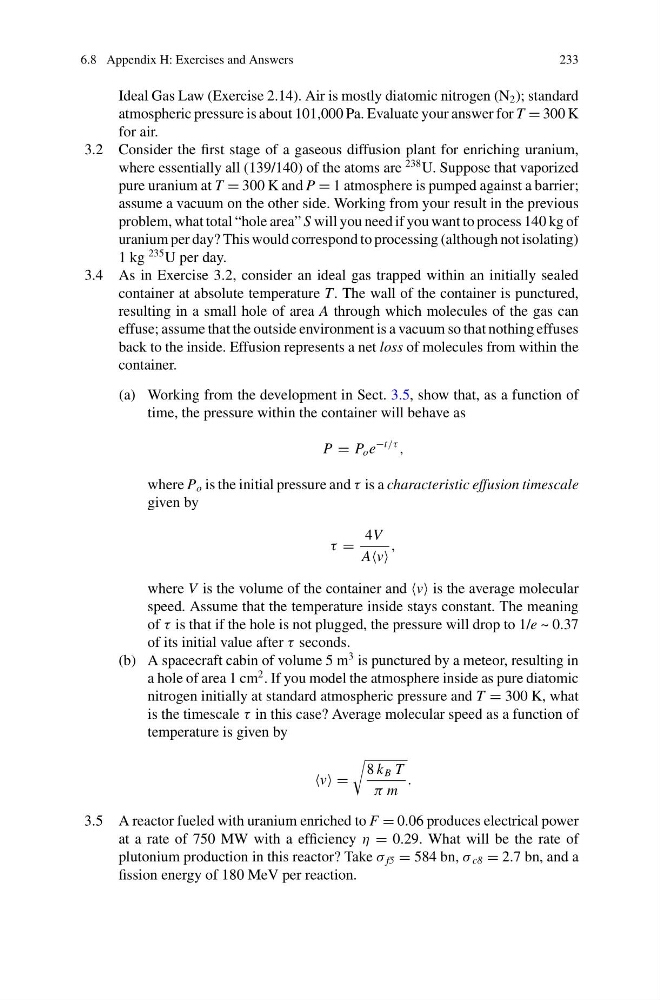
6.8 Appendix H: Exercises and Answers
233
Ideal Gas Law (Exercise 2.14). Air is mostly diatomic nitrogen (N 2 ); standard
atmospheric pressure is about 101,000 Pa. Evaluate your answer for T = 300 K
for air.
3.2 Consider the first stage of a gaseous diffusion plant for enriching uranium,
where essentially all (139/140) of the atoms are
238 U. Suppose that vaporized
pure uranium at T = 300 K and P = 1 atmosphere is pumped against a barrier;
assume a vacuum on the other side. Working from your result in the previous
problem, what total “hole area” S will you need if you want to process 140 kg of
uranium per day? This would correspond to processing (although not isolating)
1 kg
235 U per day.
3.4 As in Exercise 3.2, consider an ideal gas trapped within an initially sealed
container at absolute temperature T. The wall of the container is punctured,
resulting in a small hole of area A through which molecules of the gas can
effuse; assume that the outside environment is a vacuum so that nothing effuses
back to the inside. Effusion represents a net loss of molecules from within the
container.
(a) Working from the development in Sect. 3.5, show that, as a function of
time, the pressure within the container will behave as
P = P o e
−t/τ
,
where P o is the initial pressure and τ is a characteristic effusion timescale
given by
τ =
4V
Av
,
where V is the volume of the container and v is the average molecular
speed. Assume that the temperature inside stays constant. The meaning
of τ is that if the hole is not plugged, the pressure will drop to 1/e ~ 0.37
of its initial value after τ seconds.
(b) A spacecraft cabin of volume 5 m
3 is punctured by a meteor, resulting in
a hole of area 1 cm
2 . If you model the atmosphere inside as pure diatomic
nitrogen initially at standard atmospheric pressure and T = 300 K, what
is the timescale τ in this case? Average molecular speed as a function of
temperature is given by
v =
8 k B T
π m
.
3.5 A reactor fueled with uranium enriched to F = 0.06 produces electrical power
at a rate of 750 MW with a efficiency η = 0.29. What will be the rate of
plutonium production in this reactor? Take σ f5 = 584 bn, σ c8 = 2.7 bn, and a
fission energy of 180 MeV per reaction.
233
Ideal Gas Law (Exercise 2.14). Air is mostly diatomic nitrogen (N 2 ); standard
atmospheric pressure is about 101,000 Pa. Evaluate your answer for T = 300 K
for air.
3.2 Consider the first stage of a gaseous diffusion plant for enriching uranium,
where essentially all (139/140) of the atoms are
238 U. Suppose that vaporized
pure uranium at T = 300 K and P = 1 atmosphere is pumped against a barrier;
assume a vacuum on the other side. Working from your result in the previous
problem, what total “hole area” S will you need if you want to process 140 kg of
uranium per day? This would correspond to processing (although not isolating)
1 kg
235 U per day.
3.4 As in Exercise 3.2, consider an ideal gas trapped within an initially sealed
container at absolute temperature T. The wall of the container is punctured,
resulting in a small hole of area A through which molecules of the gas can
effuse; assume that the outside environment is a vacuum so that nothing effuses
back to the inside. Effusion represents a net loss of molecules from within the
container.
(a) Working from the development in Sect. 3.5, show that, as a function of
time, the pressure within the container will behave as
P = P o e
−t/τ
,
where P o is the initial pressure and τ is a characteristic effusion timescale
given by
τ =
4V
Av
,
where V is the volume of the container and v is the average molecular
speed. Assume that the temperature inside stays constant. The meaning
of τ is that if the hole is not plugged, the pressure will drop to 1/e ~ 0.37
of its initial value after τ seconds.
(b) A spacecraft cabin of volume 5 m
3 is punctured by a meteor, resulting in
a hole of area 1 cm
2 . If you model the atmosphere inside as pure diatomic
nitrogen initially at standard atmospheric pressure and T = 300 K, what
is the timescale τ in this case? Average molecular speed as a function of
temperature is given by
v =
8 k B T
π m
.
3.5 A reactor fueled with uranium enriched to F = 0.06 produces electrical power
at a rate of 750 MW with a efficiency η = 0.29. What will be the rate of
plutonium production in this reactor? Take σ f5 = 584 bn, σ c8 = 2.7 bn, and a
fission energy of 180 MeV per reaction.