

232
6 Appendices
m A
m n
K n
θ
φ
K A
m A
m n
K n
/
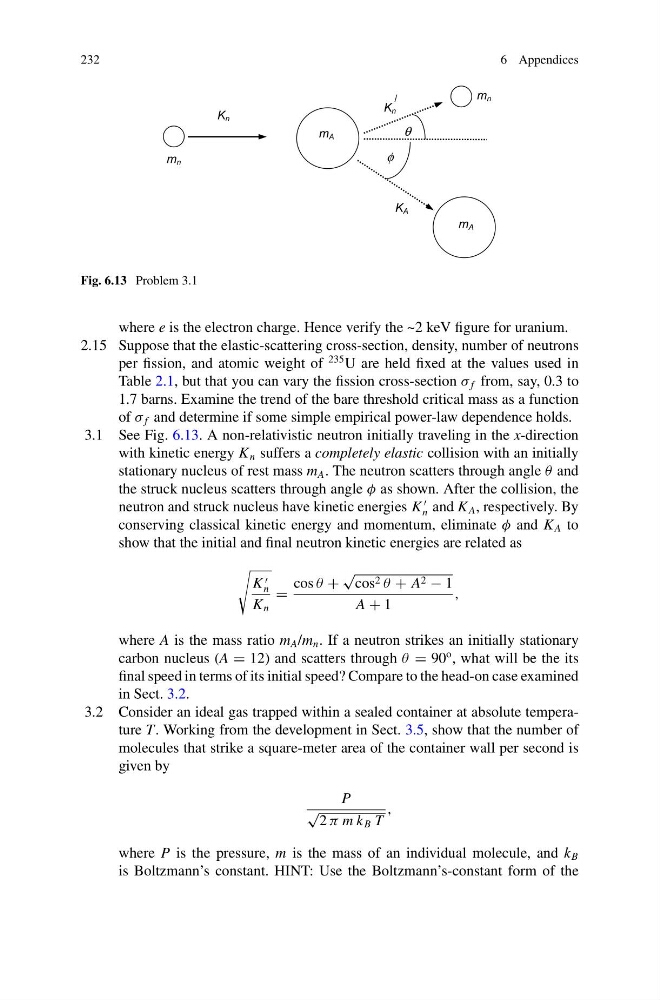
Fig. 6.13 Problem 3.1
where e is the electron charge. Hence verify the ~2 keV figure for uranium.
2.15 Suppose that the elastic-scattering cross-section, density, number of neutrons
per fission, and atomic weight of
235 U are held fixed at the values used in
Table 2.1, but that you can vary the fission cross-section σ f from, say, 0.3 to
1.7 barns. Examine the trend of the bare threshold critical mass as a function
of σ f and determine if some simple empirical power-law dependence holds.
3.1 See Fig. 6.13. A non-relativistic neutron initially traveling in the x-direction
with kinetic energy K n suffers a completely elastic collision with an initially
stationary nucleus of rest mass m A . The neutron scatters through angle θ and
the struck nucleus scatters through angle φ as shown. After the collision, the
neutron and struck nucleus have kinetic energies K
n and K A , respectively. By
conserving classical kinetic energy and momentum, eliminate φ and K A to
show that the initial and final neutron kinetic energies are related as
K
n
K n
=
cos θ +
√
cos 2 θ + A 2 − 1
A + 1
,
where A is the mass ratio m A /m n . If a neutron strikes an initially stationary
carbon nucleus (A = 12) and scatters through θ = 90
o , what will be the its
final speed in terms of its initial speed? Compare to the head-on case examined
in Sect. 3.2.
3.2 Consider an ideal gas trapped within a sealed container at absolute temperature T. Working from the development in Sect. 3.5, show that the number of
molecules that strike a square-meter area of the container wall per second is
given by
P
√
2 π m k B T
,
where P is the pressure, m is the mass of an individual molecule, and k B
is Boltzmann’s constant. HINT: Use the Boltzmann’s-constant form of the
6 Appendices
m A
m n
K n
θ
φ
K A
m A
m n
K n
/
Fig. 6.13 Problem 3.1
where e is the electron charge. Hence verify the ~2 keV figure for uranium.
2.15 Suppose that the elastic-scattering cross-section, density, number of neutrons
per fission, and atomic weight of
235 U are held fixed at the values used in
Table 2.1, but that you can vary the fission cross-section σ f from, say, 0.3 to
1.7 barns. Examine the trend of the bare threshold critical mass as a function
of σ f and determine if some simple empirical power-law dependence holds.
3.1 See Fig. 6.13. A non-relativistic neutron initially traveling in the x-direction
with kinetic energy K n suffers a completely elastic collision with an initially
stationary nucleus of rest mass m A . The neutron scatters through angle θ and
the struck nucleus scatters through angle φ as shown. After the collision, the
neutron and struck nucleus have kinetic energies K
n and K A , respectively. By
conserving classical kinetic energy and momentum, eliminate φ and K A to
show that the initial and final neutron kinetic energies are related as
K
n
K n
=
cos θ +
√
cos 2 θ + A 2 − 1
A + 1
,
where A is the mass ratio m A /m n . If a neutron strikes an initially stationary
carbon nucleus (A = 12) and scatters through θ = 90
o , what will be the its
final speed in terms of its initial speed? Compare to the head-on case examined
in Sect. 3.2.
3.2 Consider an ideal gas trapped within a sealed container at absolute temperature T. Working from the development in Sect. 3.5, show that the number of
molecules that strike a square-meter area of the container wall per second is
given by
P
√
2 π m k B T
,
where P is the pressure, m is the mass of an individual molecule, and k B
is Boltzmann’s constant. HINT: Use the Boltzmann’s-constant form of the