

228
6 Appendices
Z 1
Z 2 , A
E (MeV)
R
d
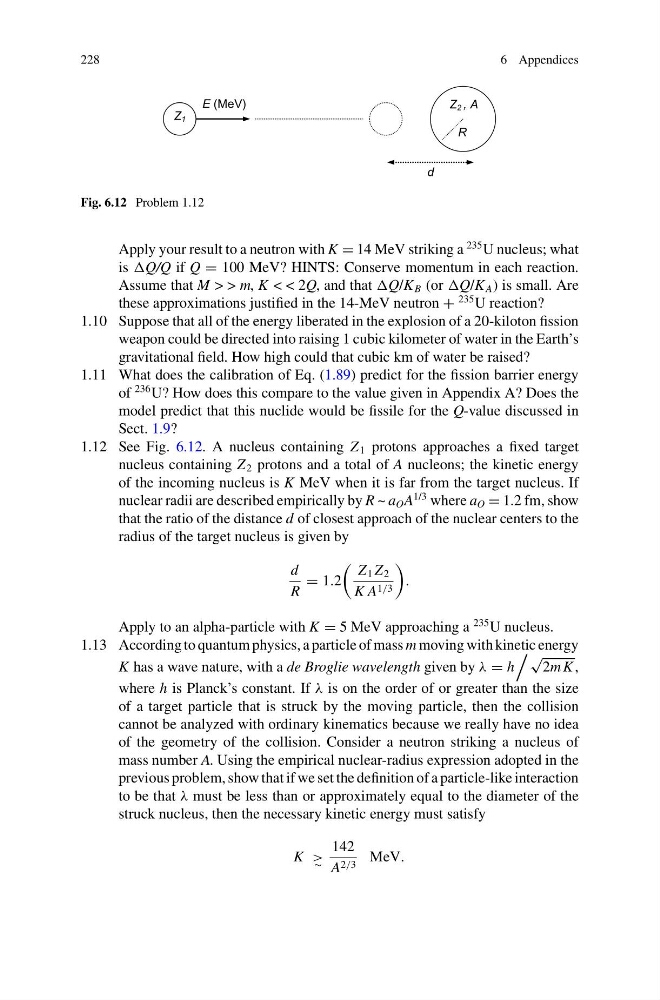
Fig. 6.12 Problem 1.12
Apply your result to a neutron with K = 14 MeV striking a
235 U nucleus; what
is if Q = 100 MeV? HINTS: Conserve momentum in each reaction.
Assume that M > > m, K < < 2Q, and that B (or A ) is small. Are
these approximations justified in the 14-MeV neutron +
235 U reaction?
1.10 Suppose that all of the energy liberated in the explosion of a 20-kiloton fission
weapon could be directed into raising 1 cubic kilometer of water in the Earth’s
gravitational field. How high could that cubic km of water be raised?
1.11 What does the calibration of Eq. (1.89) predict for the fission barrier energy
of
236 U? How does this compare to the value given in Appendix A? Does the
model predict that this nuclide would be fissile for the Q-value discussed in
Sect. 1.9?
1.12 See Fig. 6.12. A nucleus containing Z 1 protons approaches a fixed target
nucleus containing Z 2 protons and a total of A nucleons; the kinetic energy
of the incoming nucleus is K MeV when it is far from the target nucleus. If
nuclear radii are described empirically by R ~ a O A
1/3 where a O = 1.2 fm, show
that the ratio of the distance d of closest approach of the nuclear centers to the
radius of the target nucleus is given by
d
R
= 1.2
Z 1 Z 2
K A 1/3
.
Apply to an alpha-particle with K = 5 MeV approaching a
235 U nucleus.
1.13 According to quantum physics, a particle of mass m moving with kinetic energy
K has a wave nature, with a de Broglie wavelength given by λ = h
√
2m K ,
where h is Planck’s constant. If λ is on the order of or greater than the size
of a target particle that is struck by the moving particle, then the collision
cannot be analyzed with ordinary kinematics because we really have no idea
of the geometry of the collision. Consider a neutron striking a nucleus of
mass number A. Using the empirical nuclear-radius expression adopted in the
previous problem, show that if we set the definition of a particle-like interaction
to be that λ must be less than or approximately equal to the diameter of the
struck nucleus, then the necessary kinetic energy must satisfy
K > ∼
142
A 2/3 MeV.
6 Appendices
Z 1
Z 2 , A
E (MeV)
R
d
Fig. 6.12 Problem 1.12
Apply your result to a neutron with K = 14 MeV striking a
235 U nucleus; what
is if Q = 100 MeV? HINTS: Conserve momentum in each reaction.
Assume that M > > m, K < < 2Q, and that B (or A ) is small. Are
these approximations justified in the 14-MeV neutron +
235 U reaction?
1.10 Suppose that all of the energy liberated in the explosion of a 20-kiloton fission
weapon could be directed into raising 1 cubic kilometer of water in the Earth’s
gravitational field. How high could that cubic km of water be raised?
1.11 What does the calibration of Eq. (1.89) predict for the fission barrier energy
of
236 U? How does this compare to the value given in Appendix A? Does the
model predict that this nuclide would be fissile for the Q-value discussed in
Sect. 1.9?
1.12 See Fig. 6.12. A nucleus containing Z 1 protons approaches a fixed target
nucleus containing Z 2 protons and a total of A nucleons; the kinetic energy
of the incoming nucleus is K MeV when it is far from the target nucleus. If
nuclear radii are described empirically by R ~ a O A
1/3 where a O = 1.2 fm, show
that the ratio of the distance d of closest approach of the nuclear centers to the
radius of the target nucleus is given by
d
R
= 1.2
Z 1 Z 2
K A 1/3
.
Apply to an alpha-particle with K = 5 MeV approaching a
235 U nucleus.
1.13 According to quantum physics, a particle of mass m moving with kinetic energy
K has a wave nature, with a de Broglie wavelength given by λ = h
√
2m K ,
where h is Planck’s constant. If λ is on the order of or greater than the size
of a target particle that is struck by the moving particle, then the collision
cannot be analyzed with ordinary kinematics because we really have no idea
of the geometry of the collision. Consider a neutron striking a nucleus of
mass number A. Using the empirical nuclear-radius expression adopted in the
previous problem, show that if we set the definition of a particle-like interaction
to be that λ must be less than or approximately equal to the diameter of the
struck nucleus, then the necessary kinetic energy must satisfy
K > ∼
142
A 2/3 MeV.