

6.8 Appendix H: Exercises and Answers
227
1.6 Consider a γ -ray of energy E γ and a classical, non-relativistic particle of mass
m moving with the same amount of kinetic energy. Both strike a classical,
non-relativistic particle of mass M head on as in Sect. 1.4; assume that the
gamma recoils backwards. Show that the ratio of the kinetic energy acquired
by M when struck by the massive particle to that when struck by the γ -ray is
approximately
K
m
M
K
γ
M
∼
2E m
E γ
1 + E m
E M
2 ,
where the E’s designate mc
2 rest energies and where it has been assumed that
E γ < < E M . Apply to an α-particle being struck by a γ -ray and a proton, with
E γ = 10 MeV. HINT: Consider Eqs. (1.32) and (1.34).
1.7 Show that the kinetic energy of a nonrelativistic neutron moving with speed v
= βc is given by E ∼ 470 β
2 MeV.
1.8 In an environment of absolute temperature T, the kinetic energy of a particle
corresponds on average to 3k B T /2, where k B is Boltzmann’s constant. Show
that if a neutron is moving at a nonrelativistic speed with kinetic energy E
MeV, then the equivalent temperature is T = (7.74 × 10
9 E) Kelvin. Energies
of a couple MeV are characteristic of neutrons released in fission reactions.
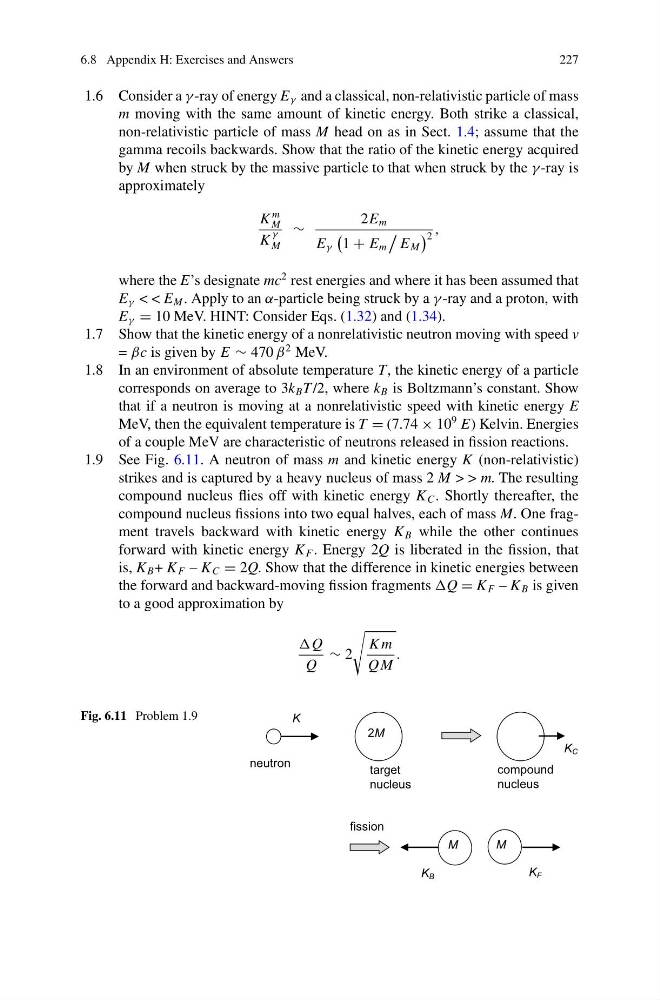
1.9 See Fig. 6.11. A neutron of mass m and kinetic energy K (non-relativistic)
strikes and is captured by a heavy nucleus of mass 2 M > > m. The resulting
compound nucleus flies off with kinetic energy K C . Shortly thereafter, the
compound nucleus fissions into two equal halves, each of mass M. One fragment travels backward with kinetic energy K B while the other continues
forward with kinetic energy K F . Energy 2Q is liberated in the fission, that
is, K B + K F – K C = 2Q. Show that the difference in kinetic energies between
the forward and backward-moving fission fragments = K F – K B is given
to a good approximation by
Q
∼ 2
K m
Q M
.
Fig. 6.11 Problem 1.9
neutron
target
nucleus
compound
nucleus
2M
K
fission
M
M
K B
K F
K C
227
1.6 Consider a γ -ray of energy E γ and a classical, non-relativistic particle of mass
m moving with the same amount of kinetic energy. Both strike a classical,
non-relativistic particle of mass M head on as in Sect. 1.4; assume that the
gamma recoils backwards. Show that the ratio of the kinetic energy acquired
by M when struck by the massive particle to that when struck by the γ -ray is
approximately
K
m
M
K
γ
M
∼
2E m
E γ
1 + E m
E M
2 ,
where the E’s designate mc
2 rest energies and where it has been assumed that
E γ < < E M . Apply to an α-particle being struck by a γ -ray and a proton, with
E γ = 10 MeV. HINT: Consider Eqs. (1.32) and (1.34).
1.7 Show that the kinetic energy of a nonrelativistic neutron moving with speed v
= βc is given by E ∼ 470 β
2 MeV.
1.8 In an environment of absolute temperature T, the kinetic energy of a particle
corresponds on average to 3k B T /2, where k B is Boltzmann’s constant. Show
that if a neutron is moving at a nonrelativistic speed with kinetic energy E
MeV, then the equivalent temperature is T = (7.74 × 10
9 E) Kelvin. Energies
of a couple MeV are characteristic of neutrons released in fission reactions.
1.9 See Fig. 6.11. A neutron of mass m and kinetic energy K (non-relativistic)
strikes and is captured by a heavy nucleus of mass 2 M > > m. The resulting
compound nucleus flies off with kinetic energy K C . Shortly thereafter, the
compound nucleus fissions into two equal halves, each of mass M. One fragment travels backward with kinetic energy K B while the other continues
forward with kinetic energy K F . Energy 2Q is liberated in the fission, that
is, K B + K F – K C = 2Q. Show that the difference in kinetic energies between
the forward and backward-moving fission fragments = K F – K B is given
to a good approximation by
Q
∼ 2
K m
Q M
.
Fig. 6.11 Problem 1.9
neutron
target
nucleus
compound
nucleus
2M
K
fission
M
M
K B
K F
K C