

6.5 Appendix E: Formal Derivation of the Bohr-Wheeler Spontaneous Fission Limit
213
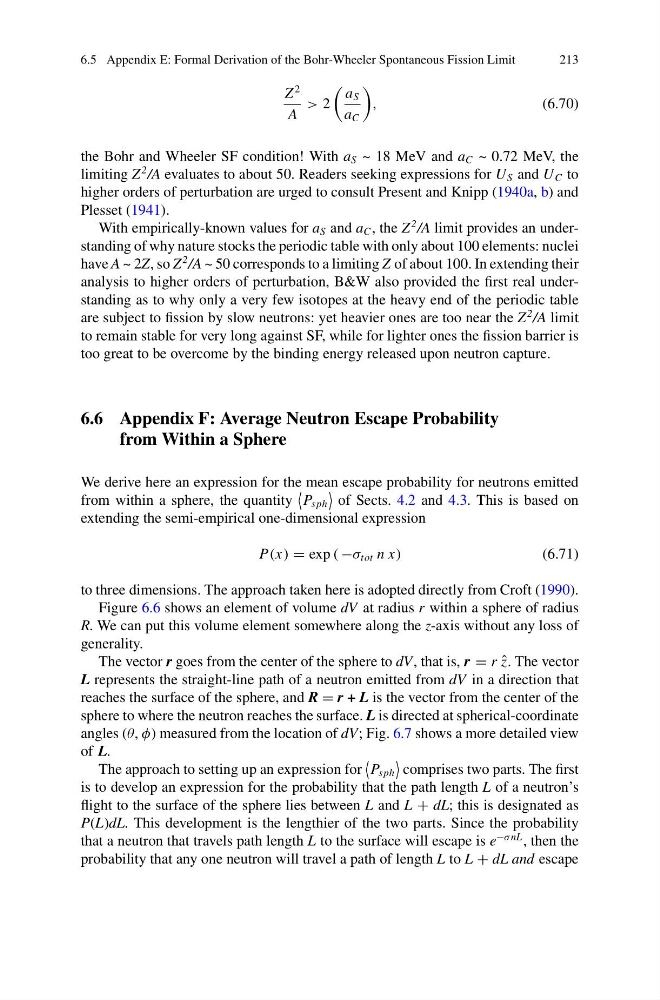
Z
2
A
> 2
a S
a C
,
(6.70)
the Bohr and Wheeler SF condition! With a S ~ 18 MeV and a C ~ 0.72 MeV, the
limiting Z
2 /A evaluates to about 50. Readers seeking expressions for U S and U C to
higher orders of perturbation are urged to consult Present and Knipp (1940a, b) and
Plesset (1941).
With empirically-known values for a S and a C , the Z
2 /A limit provides an understanding of why nature stocks the periodic table with only about 100 elements: nuclei
have A ~ 2Z, so Z
2 /A ~ 50 corresponds to a limiting Z of about 100. In extending their
analysis to higher orders of perturbation, B&W also provided the first real understanding as to why only a very few isotopes at the heavy end of the periodic table
are subject to fission by slow neutrons: yet heavier ones are too near the Z
2 /A limit
to remain stable for very long against SF, while for lighter ones the fission barrier is
too great to be overcome by the binding energy released upon neutron capture.
6.6 Appendix F: Average Neutron Escape Probability
from Within a Sphere
We derive here an expression for the mean escape probability for neutrons emitted
from within a sphere, the quantity
P sph
of Sects. 4.2 and 4.3. This is based on
extending the semi-empirical one-dimensional expression
P(x) = exp ( −σ tot n x)
(6.71)
to three dimensions. The approach taken here is adopted directly from Croft (1990).
Figure 6.6 shows an element of volume dV at radius r within a sphere of radius
R. We can put this volume element somewhere along the z-axis without any loss of
generality.
The vector r goes from the center of the sphere to dV, that is, r = r ˆ
z. The vector
L represents the straight-line path of a neutron emitted from dV in a direction that
reaches the surface of the sphere, and R = r + L is the vector from the center of the
sphere to where the neutron reaches the surface. L is directed at spherical-coordinate
angles (θ, φ) measured from the location of dV; Fig. 6.7 shows a more detailed view
of L.
The approach to setting up an expression for
P sph
comprises two parts. The first
is to develop an expression for the probability that the path length L of a neutron’s
flight to the surface of the sphere lies between L and L + dL; this is designated as
P(L)dL. This development is the lengthier of the two parts. Since the probability
that a neutron that travels path length L to the surface will escape is e
−σ nL , then the
probability that any one neutron will travel a path of length L to L + dL and escape
213
Z
2
A
> 2
a S
a C
,
(6.70)
the Bohr and Wheeler SF condition! With a S ~ 18 MeV and a C ~ 0.72 MeV, the
limiting Z
2 /A evaluates to about 50. Readers seeking expressions for U S and U C to
higher orders of perturbation are urged to consult Present and Knipp (1940a, b) and
Plesset (1941).
With empirically-known values for a S and a C , the Z
2 /A limit provides an understanding of why nature stocks the periodic table with only about 100 elements: nuclei
have A ~ 2Z, so Z
2 /A ~ 50 corresponds to a limiting Z of about 100. In extending their
analysis to higher orders of perturbation, B&W also provided the first real understanding as to why only a very few isotopes at the heavy end of the periodic table
are subject to fission by slow neutrons: yet heavier ones are too near the Z
2 /A limit
to remain stable for very long against SF, while for lighter ones the fission barrier is
too great to be overcome by the binding energy released upon neutron capture.
6.6 Appendix F: Average Neutron Escape Probability
from Within a Sphere
We derive here an expression for the mean escape probability for neutrons emitted
from within a sphere, the quantity
P sph
of Sects. 4.2 and 4.3. This is based on
extending the semi-empirical one-dimensional expression
P(x) = exp ( −σ tot n x)
(6.71)
to three dimensions. The approach taken here is adopted directly from Croft (1990).
Figure 6.6 shows an element of volume dV at radius r within a sphere of radius
R. We can put this volume element somewhere along the z-axis without any loss of
generality.
The vector r goes from the center of the sphere to dV, that is, r = r ˆ
z. The vector
L represents the straight-line path of a neutron emitted from dV in a direction that
reaches the surface of the sphere, and R = r + L is the vector from the center of the
sphere to where the neutron reaches the surface. L is directed at spherical-coordinate
angles (θ, φ) measured from the location of dV; Fig. 6.7 shows a more detailed view
of L.
The approach to setting up an expression for
P sph
comprises two parts. The first
is to develop an expression for the probability that the path length L of a neutron’s
flight to the surface of the sphere lies between L and L + dL; this is designated as
P(L)dL. This development is the lengthier of the two parts. Since the probability
that a neutron that travels path length L to the surface will escape is e
−σ nL , then the
probability that any one neutron will travel a path of length L to L + dL and escape