

212
6 Appendices
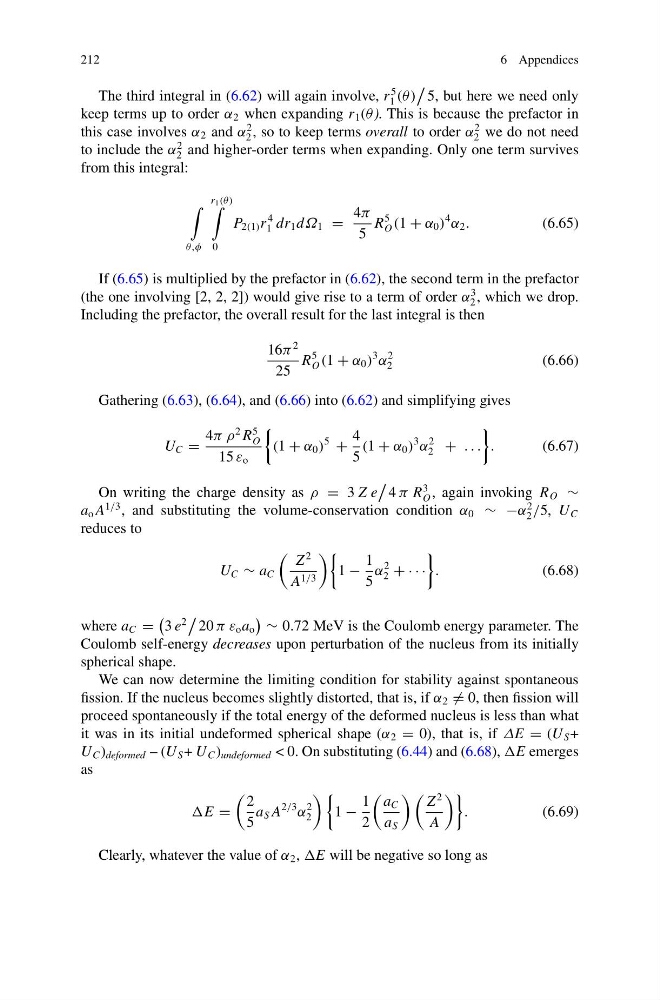
The third integral in (6.62) will again involve, r
5
1 (θ )
5, but here we need only
keep terms up to order α 2 when expanding r 1 (θ ). This is because the prefactor in
this case involves α 2 and α
2
2 , so to keep terms overall to order α
2
2 we do not need
to include the α
2
2 and higher-order terms when expanding. Only one term survives
from this integral:
θ,φ
r 1( θ)
0
P 2(1) r
4
1 dr 1 dΩ 1 =
4π
5
R
5
O (1 + α 0 )
4
α 2 .
(6.65)
If (6.65) is multiplied by the prefactor in (6.62), the second term in the prefactor
(the one involving [2, 2, 2]) would give rise to a term of order α
3
2 , which we drop.
Including the prefactor, the overall result for the last integral is then
16π
2
25
R
5
O (1 + α 0 )
3
α
2
2
(6.66)
Gathering (6.63), (6.64), and (6.66) into (6.62) and simplifying gives
U C =
4π ρ
2 R
5
O
15 ε o
(1 + α 0 )
5
+
4
5
(1 + α 0 )
3
α
2
2 + . . .
.
(6.67)
On writing the charge density as ρ = 3 Z e
4 π R
3
O , again invoking R O ∼
a o A
1/3 , and substituting the volume-conservation condition α 0 ∼ −α
2
2 /5, U C
reduces to
U C ∼ a C
Z
2
A 1/3
1 −
1
5
α
2
2 + · · ·
.
(6.68)
where a C =
3 e
2
20 π ε o a o
∼ 0.72 MeV is the Coulomb energy parameter. The
Coulomb self-energy decreases upon perturbation of the nucleus from its initially
spherical shape.
We can now determine the limiting condition for stability against spontaneous
fission. If the nucleus becomes slightly distorted, that is, if α 2 = 0, then fission will
proceed spontaneously if the total energy of the deformed nucleus is less than what
it was in its initial undeformed spherical shape (α 2 = 0), that is, if ΔE = (U S +
U C ) deformed – (U S + U C ) undeformed < 0. On substituting (6.44) and (6.68), E emerges
as
E =
2
5
a S A
2/3
α
2
2
1 −
1
2
a C
a S
Z
2
A
.
(6.69)
Clearly, whatever the value of α 2 , E will be negative so long as
6 Appendices
The third integral in (6.62) will again involve, r
5
1 (θ )
5, but here we need only
keep terms up to order α 2 when expanding r 1 (θ ). This is because the prefactor in
this case involves α 2 and α
2
2 , so to keep terms overall to order α
2
2 we do not need
to include the α
2
2 and higher-order terms when expanding. Only one term survives
from this integral:
θ,φ
r 1( θ)
0
P 2(1) r
4
1 dr 1 dΩ 1 =
4π
5
R
5
O (1 + α 0 )
4
α 2 .
(6.65)
If (6.65) is multiplied by the prefactor in (6.62), the second term in the prefactor
(the one involving [2, 2, 2]) would give rise to a term of order α
3
2 , which we drop.
Including the prefactor, the overall result for the last integral is then
16π
2
25
R
5
O (1 + α 0 )
3
α
2
2
(6.66)
Gathering (6.63), (6.64), and (6.66) into (6.62) and simplifying gives
U C =
4π ρ
2 R
5
O
15 ε o
(1 + α 0 )
5
+
4
5
(1 + α 0 )
3
α
2
2 + . . .
.
(6.67)
On writing the charge density as ρ = 3 Z e
4 π R
3
O , again invoking R O ∼
a o A
1/3 , and substituting the volume-conservation condition α 0 ∼ −α
2
2 /5, U C
reduces to
U C ∼ a C
Z
2
A 1/3
1 −
1
5
α
2
2 + · · ·
.
(6.68)
where a C =
3 e
2
20 π ε o a o
∼ 0.72 MeV is the Coulomb energy parameter. The
Coulomb self-energy decreases upon perturbation of the nucleus from its initially
spherical shape.
We can now determine the limiting condition for stability against spontaneous
fission. If the nucleus becomes slightly distorted, that is, if α 2 = 0, then fission will
proceed spontaneously if the total energy of the deformed nucleus is less than what
it was in its initial undeformed spherical shape (α 2 = 0), that is, if ΔE = (U S +
U C ) deformed – (U S + U C ) undeformed < 0. On substituting (6.44) and (6.68), E emerges
as
E =
2
5
a S A
2/3
α
2
2
1 −
1
2
a C
a S
Z
2
A
.
(6.69)
Clearly, whatever the value of α 2 , E will be negative so long as