

4.6 Estimating the Contribution of 238 U to the Trinity Yield
173
five. For more scatterings, p esc does not change drastically, approaching 0.624
as S → ∞. For estimating the
238 U yield, I adopt p esc ~ 0.55.
(iii) The fraction of fission-liberated neutrons above the fission threshold was
examined in Sect. 1.8, and estimated as f thresh ~ 0.55.
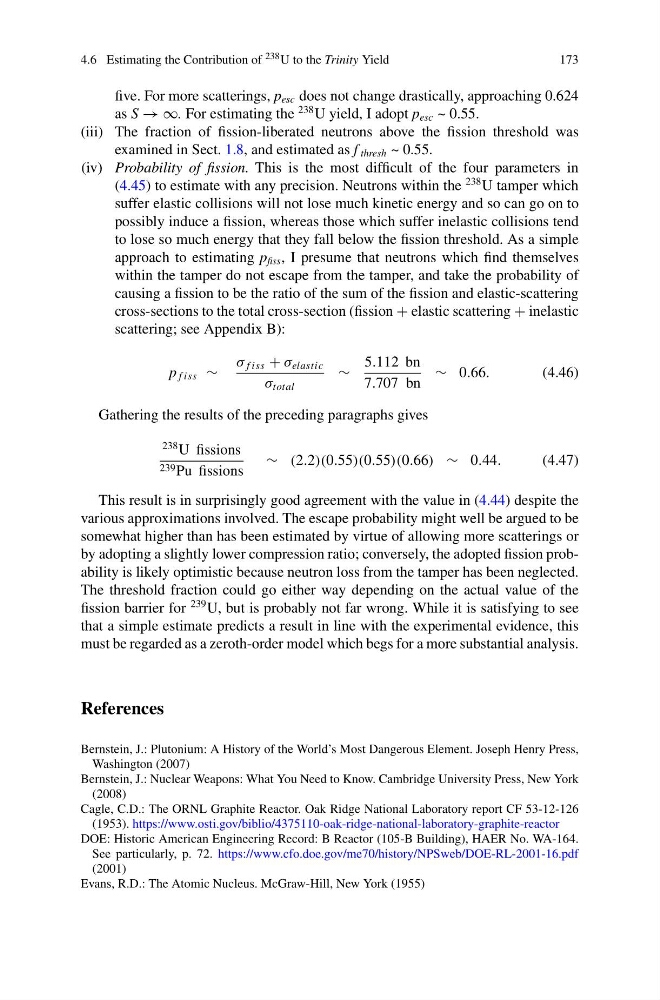
(iv) Probability of fission. This is the most difficult of the four parameters in
(4.45) to estimate with any precision. Neutrons within the
238 U tamper which
suffer elastic collisions will not lose much kinetic energy and so can go on to
possibly induce a fission, whereas those which suffer inelastic collisions tend
to lose so much energy that they fall below the fission threshold. As a simple
approach to estimating p fiss , I presume that neutrons which find themselves
within the tamper do not escape from the tamper, and take the probability of
causing a fission to be the ratio of the sum of the fission and elastic-scattering
cross-sections to the total cross-section (fission + elastic scattering + inelastic
scattering; see Appendix B):
p f iss ∼
σ f iss + σ elastic
σ total
∼
5.112 bn
7.707 bn
∼ 0.66.
(4.46)
Gathering the results of the preceding paragraphs gives
238 U fissions
239 Pu fissions
∼ (2.2)(0.55)(0.55)(0.66) ∼ 0.44.
(4.47)
This result is in surprisingly good agreement with the value in (4.44) despite the
various approximations involved. The escape probability might well be argued to be
somewhat higher than has been estimated by virtue of allowing more scatterings or
by adopting a slightly lower compression ratio; conversely, the adopted fission probability is likely optimistic because neutron loss from the tamper has been neglected.
The threshold fraction could go either way depending on the actual value of the
fission barrier for
239 U, but is probably not far wrong. While it is satisfying to see
that a simple estimate predicts a result in line with the experimental evidence, this
must be regarded as a zeroth-order model which begs for a more substantial analysis.
References
Bernstein, J.: Plutonium: A History of the World’s Most Dangerous Element. Joseph Henry Press,
Washington (2007)
Bernstein, J.: Nuclear Weapons: What You Need to Know. Cambridge University Press, New York
(2008)
Cagle, C.D.: The ORNL Graphite Reactor. Oak Ridge National Laboratory report CF 53-12-126
(1953). https://www.osti.gov/biblio/4375110-oak-ridge-national-laboratory-graphite-reactor
DOE: Historic American Engineering Record: B Reactor (105-B Building), HAER No. WA-164.
See particularly, p. 72. https://www.cfo.doe.gov/me70/history/NPSweb/DOE-RL-2001-16.pdf
(2001)
Evans, R.D.: The Atomic Nucleus. McGraw-Hill, New York (1955)
173
five. For more scatterings, p esc does not change drastically, approaching 0.624
as S → ∞. For estimating the
238 U yield, I adopt p esc ~ 0.55.
(iii) The fraction of fission-liberated neutrons above the fission threshold was
examined in Sect. 1.8, and estimated as f thresh ~ 0.55.
(iv) Probability of fission. This is the most difficult of the four parameters in
(4.45) to estimate with any precision. Neutrons within the
238 U tamper which
suffer elastic collisions will not lose much kinetic energy and so can go on to
possibly induce a fission, whereas those which suffer inelastic collisions tend
to lose so much energy that they fall below the fission threshold. As a simple
approach to estimating p fiss , I presume that neutrons which find themselves
within the tamper do not escape from the tamper, and take the probability of
causing a fission to be the ratio of the sum of the fission and elastic-scattering
cross-sections to the total cross-section (fission + elastic scattering + inelastic
scattering; see Appendix B):
p f iss ∼
σ f iss + σ elastic
σ total
∼
5.112 bn
7.707 bn
∼ 0.66.
(4.46)
Gathering the results of the preceding paragraphs gives
238 U fissions
239 Pu fissions
∼ (2.2)(0.55)(0.55)(0.66) ∼ 0.44.
(4.47)
This result is in surprisingly good agreement with the value in (4.44) despite the
various approximations involved. The escape probability might well be argued to be
somewhat higher than has been estimated by virtue of allowing more scatterings or
by adopting a slightly lower compression ratio; conversely, the adopted fission probability is likely optimistic because neutron loss from the tamper has been neglected.
The threshold fraction could go either way depending on the actual value of the
fission barrier for
239 U, but is probably not far wrong. While it is satisfying to see
that a simple estimate predicts a result in line with the experimental evidence, this
must be regarded as a zeroth-order model which begs for a more substantial analysis.
References
Bernstein, J.: Plutonium: A History of the World’s Most Dangerous Element. Joseph Henry Press,
Washington (2007)
Bernstein, J.: Nuclear Weapons: What You Need to Know. Cambridge University Press, New York
(2008)
Cagle, C.D.: The ORNL Graphite Reactor. Oak Ridge National Laboratory report CF 53-12-126
(1953). https://www.osti.gov/biblio/4375110-oak-ridge-national-laboratory-graphite-reactor
DOE: Historic American Engineering Record: B Reactor (105-B Building), HAER No. WA-164.
See particularly, p. 72. https://www.cfo.doe.gov/me70/history/NPSweb/DOE-RL-2001-16.pdf
(2001)
Evans, R.D.: The Atomic Nucleus. McGraw-Hill, New York (1955)