

4.5 Neutron Initiators
171
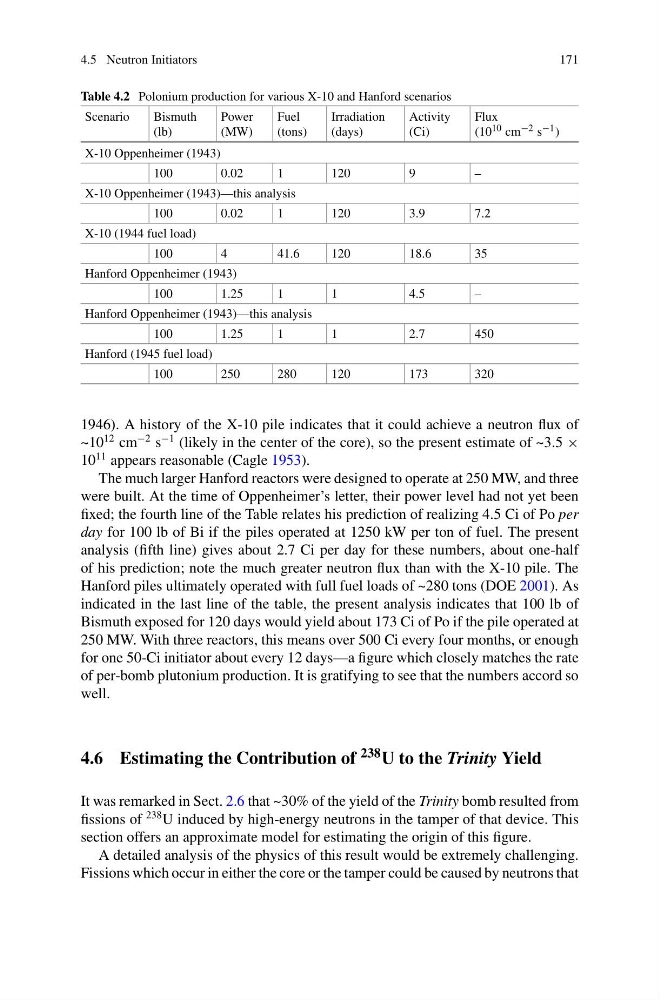
Table 4.2 Polonium production for various X-10 and Hanford scenarios
Scenario
Bismuth
(lb)
Power
(MW)
Fuel
(tons)
Irradiation
(days)
Activity
(Ci)
Flux
(10 10 cm −2 s −1 )
X-10 Oppenheimer (1943)
100
0.02
1
120
9
–
X-10 Oppenheimer (1943)—this analysis
100
0.02
1
120
3.9
7.2
X-10 (1944 fuel load)
100
4
41.6
120
18.6
35
Hanford Oppenheimer (1943)
100
1.25
1
1
4.5
–
Hanford Oppenheimer (1943)—this analysis
100
1.25
1
1
2.7
450
Hanford (1945 fuel load)
100
250
280
120
173
320
1946). A history of the X-10 pile indicates that it could achieve a neutron flux of
~10
12 cm
−2 s
−1 (likely in the center of the core), so the present estimate of ~3.5 ×
10
11 appears reasonable (Cagle 1953).
The much larger Hanford reactors were designed to operate at 250 MW, and three
were built. At the time of Oppenheimer’s letter, their power level had not yet been
fixed; the fourth line of the Table relates his prediction of realizing 4.5 Ci of Po per
day for 100 lb of Bi if the piles operated at 1250 kW per ton of fuel. The present
analysis (fifth line) gives about 2.7 Ci per day for these numbers, about one-half
of his prediction; note the much greater neutron flux than with the X-10 pile. The
Hanford piles ultimately operated with full fuel loads of ~280 tons (DOE 2001). As
indicated in the last line of the table, the present analysis indicates that 100 lb of
Bismuth exposed for 120 days would yield about 173 Ci of Po if the pile operated at
250 MW. With three reactors, this means over 500 Ci every four months, or enough
for one 50-Ci initiator about every 12 days—a figure which closely matches the rate
of per-bomb plutonium production. It is gratifying to see that the numbers accord so
well.
4.6 Estimating the Contribution of 238 U to the Trinity Yield
It was remarked in Sect. 2.6 that ~30% of the yield of the Trinity bomb resulted from
fissions of
238 U induced by high-energy neutrons in the tamper of that device. This
section offers an approximate model for estimating the origin of this figure.
A detailed analysis of the physics of this result would be extremely challenging.
Fissions which occur in either the core or the tamper could be caused by neutrons that
171
Table 4.2 Polonium production for various X-10 and Hanford scenarios
Scenario
Bismuth
(lb)
Power
(MW)
Fuel
(tons)
Irradiation
(days)
Activity
(Ci)
Flux
(10 10 cm −2 s −1 )
X-10 Oppenheimer (1943)
100
0.02
1
120
9
–
X-10 Oppenheimer (1943)—this analysis
100
0.02
1
120
3.9
7.2
X-10 (1944 fuel load)
100
4
41.6
120
18.6
35
Hanford Oppenheimer (1943)
100
1.25
1
1
4.5
–
Hanford Oppenheimer (1943)—this analysis
100
1.25
1
1
2.7
450
Hanford (1945 fuel load)
100
250
280
120
173
320
1946). A history of the X-10 pile indicates that it could achieve a neutron flux of
~10
12 cm
−2 s
−1 (likely in the center of the core), so the present estimate of ~3.5 ×
10
11 appears reasonable (Cagle 1953).
The much larger Hanford reactors were designed to operate at 250 MW, and three
were built. At the time of Oppenheimer’s letter, their power level had not yet been
fixed; the fourth line of the Table relates his prediction of realizing 4.5 Ci of Po per
day for 100 lb of Bi if the piles operated at 1250 kW per ton of fuel. The present
analysis (fifth line) gives about 2.7 Ci per day for these numbers, about one-half
of his prediction; note the much greater neutron flux than with the X-10 pile. The
Hanford piles ultimately operated with full fuel loads of ~280 tons (DOE 2001). As
indicated in the last line of the table, the present analysis indicates that 100 lb of
Bismuth exposed for 120 days would yield about 173 Ci of Po if the pile operated at
250 MW. With three reactors, this means over 500 Ci every four months, or enough
for one 50-Ci initiator about every 12 days—a figure which closely matches the rate
of per-bomb plutonium production. It is gratifying to see that the numbers accord so
well.
4.6 Estimating the Contribution of 238 U to the Trinity Yield
It was remarked in Sect. 2.6 that ~30% of the yield of the Trinity bomb resulted from
fissions of
238 U induced by high-energy neutrons in the tamper of that device. This
section offers an approximate model for estimating the origin of this figure.
A detailed analysis of the physics of this result would be extremely challenging.
Fissions which occur in either the core or the tamper could be caused by neutrons that