

170
4 Complicating Factors
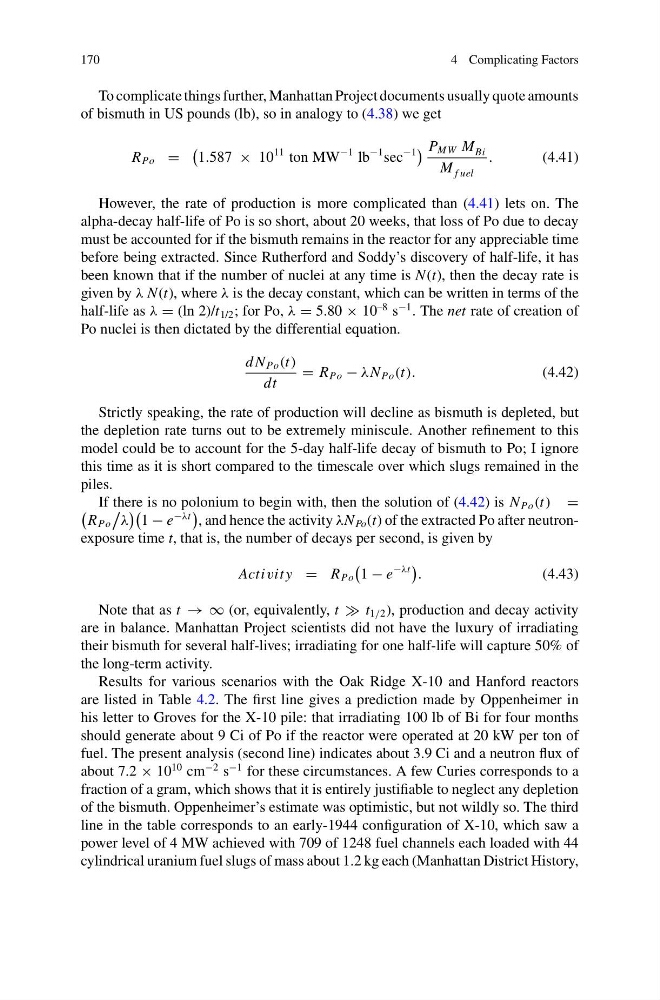
To complicate things further, Manhattan Project documents usually quote amounts
of bismuth in US pounds (lb), so in analogy to (4.38) we get
R Po =
1.587 × 10
11 ton MW
−1 lb
−1 sec
−1
P MW M Bi
M f uel
.
(4.41)
However, the rate of production is more complicated than (4.41) lets on. The
alpha-decay half-life of Po is so short, about 20 weeks, that loss of Po due to decay
must be accounted for if the bismuth remains in the reactor for any appreciable time
before being extracted. Since Rutherford and Soddy’s discovery of half-life, it has
been known that if the number of nuclei at any time is N(t), then the decay rate is
given by λ N(t), where λ is the decay constant, which can be written in terms of the
half-life as λ = (ln 2)/t 1/2 ; for Po, λ = 5.80 × 10
–8 s
−1 . The net rate of creation of
Po nuclei is then dictated by the differential equation.
d N Po (t)
dt
= R Po − λN Po (t).
(4.42)
Strictly speaking, the rate of production will decline as bismuth is depleted, but
the depletion rate turns out to be extremely miniscule. Another refinement to this
model could be to account for the 5-day half-life decay of bismuth to Po; I ignore
this time as it is short compared to the timescale over which slugs remained in the
piles.
If there is no polonium to begin with, then the solution of (4.42) is N Po (t) =
R Po
λ
1 − e
−λt
, and hence the activity λN Po (t) of the extracted Po after neutronexposure time t, that is, the number of decays per second, is given by
Activit y = R Po
1 − e
−λt
.
(4.43)
Note that as t → ∞ (or, equivalently, t t 1/2 ), production and decay activity
are in balance. Manhattan Project scientists did not have the luxury of irradiating
their bismuth for several half-lives; irradiating for one half-life will capture 50% of
the long-term activity.
Results for various scenarios with the Oak Ridge X-10 and Hanford reactors
are listed in Table 4.2. The first line gives a prediction made by Oppenheimer in
his letter to Groves for the X-10 pile: that irradiating 100 lb of Bi for four months
should generate about 9 Ci of Po if the reactor were operated at 20 kW per ton of
fuel. The present analysis (second line) indicates about 3.9 Ci and a neutron flux of
about 7.2 × 10
10 cm
−2 s
−1 for these circumstances. A few Curies corresponds to a
fraction of a gram, which shows that it is entirely justifiable to neglect any depletion
of the bismuth. Oppenheimer’s estimate was optimistic, but not wildly so. The third
line in the table corresponds to an early-1944 configuration of X-10, which saw a
power level of 4 MW achieved with 709 of 1248 fuel channels each loaded with 44
cylindrical uranium fuel slugs of mass about 1.2 kg each (Manhattan District History,
4 Complicating Factors
To complicate things further, Manhattan Project documents usually quote amounts
of bismuth in US pounds (lb), so in analogy to (4.38) we get
R Po =
1.587 × 10
11 ton MW
−1 lb
−1 sec
−1
P MW M Bi
M f uel
.
(4.41)
However, the rate of production is more complicated than (4.41) lets on. The
alpha-decay half-life of Po is so short, about 20 weeks, that loss of Po due to decay
must be accounted for if the bismuth remains in the reactor for any appreciable time
before being extracted. Since Rutherford and Soddy’s discovery of half-life, it has
been known that if the number of nuclei at any time is N(t), then the decay rate is
given by λ N(t), where λ is the decay constant, which can be written in terms of the
half-life as λ = (ln 2)/t 1/2 ; for Po, λ = 5.80 × 10
–8 s
−1 . The net rate of creation of
Po nuclei is then dictated by the differential equation.
d N Po (t)
dt
= R Po − λN Po (t).
(4.42)
Strictly speaking, the rate of production will decline as bismuth is depleted, but
the depletion rate turns out to be extremely miniscule. Another refinement to this
model could be to account for the 5-day half-life decay of bismuth to Po; I ignore
this time as it is short compared to the timescale over which slugs remained in the
piles.
If there is no polonium to begin with, then the solution of (4.42) is N Po (t) =
R Po
λ
1 − e
−λt
, and hence the activity λN Po (t) of the extracted Po after neutronexposure time t, that is, the number of decays per second, is given by
Activit y = R Po
1 − e
−λt
.
(4.43)
Note that as t → ∞ (or, equivalently, t t 1/2 ), production and decay activity
are in balance. Manhattan Project scientists did not have the luxury of irradiating
their bismuth for several half-lives; irradiating for one half-life will capture 50% of
the long-term activity.
Results for various scenarios with the Oak Ridge X-10 and Hanford reactors
are listed in Table 4.2. The first line gives a prediction made by Oppenheimer in
his letter to Groves for the X-10 pile: that irradiating 100 lb of Bi for four months
should generate about 9 Ci of Po if the reactor were operated at 20 kW per ton of
fuel. The present analysis (second line) indicates about 3.9 Ci and a neutron flux of
about 7.2 × 10
10 cm
−2 s
−1 for these circumstances. A few Curies corresponds to a
fraction of a gram, which shows that it is entirely justifiable to neglect any depletion
of the bismuth. Oppenheimer’s estimate was optimistic, but not wildly so. The third
line in the table corresponds to an early-1944 configuration of X-10, which saw a
power level of 4 MW achieved with 709 of 1248 fuel channels each loaded with 44
cylindrical uranium fuel slugs of mass about 1.2 kg each (Manhattan District History,