

3.1 Reactor Criticality
121
-1
0
1
2
3
-8
-7
-6
-5
-4
-3
-2
-1
0
log (cross-section,
bn)
log (energy, MeV)
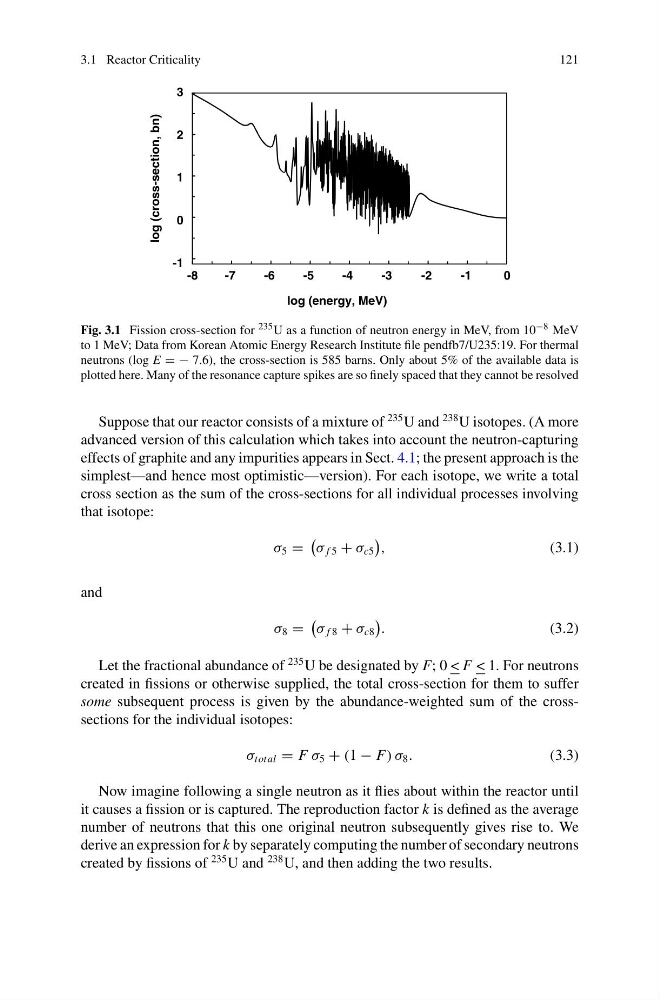
Fig. 3.1 Fission cross-section for 235 U as a function of neutron energy in MeV, from 10 −8 MeV
to 1 MeV; Data from Korean Atomic Energy Research Institute file pendfb7/U235:19. For thermal
neutrons (log E = − 7.6), the cross-section is 585 barns. Only about 5% of the available data is
plotted here. Many of the resonance capture spikes are so finely spaced that they cannot be resolved
Suppose that our reactor consists of a mixture of
235 U and
238 U isotopes. (A more
advanced version of this calculation which takes into account the neutron-capturing
effects of graphite and any impurities appears in Sect. 4.1; the present approach is the
simplest—and hence most optimistic—version). For each isotope, we write a total
cross section as the sum of the cross-sections for all individual processes involving
that isotope:
σ 5 =
σ f 5 + σ c5
,
(3.1)
and
σ 8 =
σ f 8 + σ c8
.
(3.2)
Let the fractional abundance of
235 U be designated by F; 0 < F < 1. For neutrons
created in fissions or otherwise supplied, the total cross-section for them to suffer
some subsequent process is given by the abundance-weighted sum of the crosssections for the individual isotopes:
σ total = F σ 5 + (1 − F) σ 8 .
(3.3)
Now imagine following a single neutron as it flies about within the reactor until
it causes a fission or is captured. The reproduction factor k is defined as the average
number of neutrons that this one original neutron subsequently gives rise to. We
derive an expression for k by separately computing the number of secondary neutrons
created by fissions of
235 U and
238 U, and then adding the two results.
121
-1
0
1
2
3
-8
-7
-6
-5
-4
-3
-2
-1
0
log (cross-section,
bn)
log (energy, MeV)
Fig. 3.1 Fission cross-section for 235 U as a function of neutron energy in MeV, from 10 −8 MeV
to 1 MeV; Data from Korean Atomic Energy Research Institute file pendfb7/U235:19. For thermal
neutrons (log E = − 7.6), the cross-section is 585 barns. Only about 5% of the available data is
plotted here. Many of the resonance capture spikes are so finely spaced that they cannot be resolved
Suppose that our reactor consists of a mixture of
235 U and
238 U isotopes. (A more
advanced version of this calculation which takes into account the neutron-capturing
effects of graphite and any impurities appears in Sect. 4.1; the present approach is the
simplest—and hence most optimistic—version). For each isotope, we write a total
cross section as the sum of the cross-sections for all individual processes involving
that isotope:
σ 5 =
σ f 5 + σ c5
,
(3.1)
and
σ 8 =
σ f 8 + σ c8
.
(3.2)
Let the fractional abundance of
235 U be designated by F; 0 < F < 1. For neutrons
created in fissions or otherwise supplied, the total cross-section for them to suffer
some subsequent process is given by the abundance-weighted sum of the crosssections for the individual isotopes:
σ total = F σ 5 + (1 − F) σ 8 .
(3.3)
Now imagine following a single neutron as it flies about within the reactor until
it causes a fission or is captured. The reproduction factor k is defined as the average
number of neutrons that this one original neutron subsequently gives rise to. We
derive an expression for k by separately computing the number of secondary neutrons
created by fissions of
235 U and
238 U, and then adding the two results.