

120
3 Producing Fissile Material
fissioning a
235 U nucleus, some 2.4 are on average released; these can go on to
initiate other fissions. On the other hand, the vastly more abundant
238 U nuclei tend
to capture neutrons without fissioning, removing them from circulation.
When a nucleus is struck by a neutron, one of three things will in general happen:
(i) The nucleus may fission; (ii) The nucleus may capture the neutron without
fissioning; or (iii) The neutron may scatter from the nucleus. This last process serves
only to redirect neutrons within the reactor and can be ignored if the reactor is
sufficiently large that a neutron has a good chance of being involved in a fission or
capture before being scattered through the surface of the reactor and lost. We will be
concerned with processes (i) and (ii).
The likelihood of each process is quantified by a corresponding cross-section. We
will be concerned with fission (f) and capture (c) cross-sections for
235 U and
238 U. In
self-evident notation, we write these as σ f5 , σ c5 , σ f8 , and σ c8 . Numerical values for
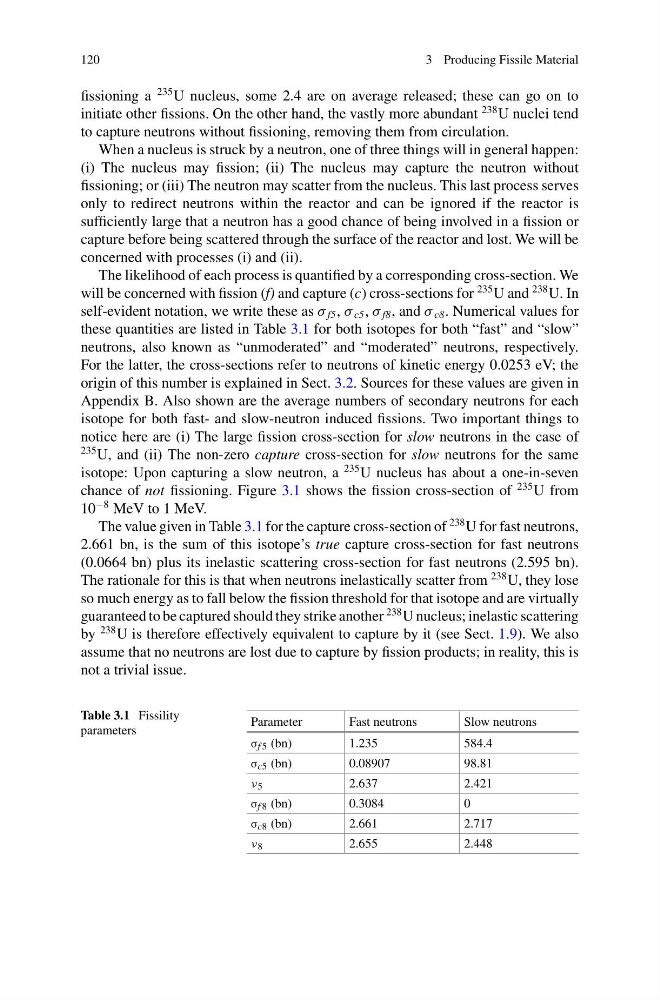
these quantities are listed in Table 3.1 for both isotopes for both “fast” and “slow”
neutrons, also known as “unmoderated” and “moderated” neutrons, respectively.
For the latter, the cross-sections refer to neutrons of kinetic energy 0.0253 eV; the
origin of this number is explained in Sect. 3.2. Sources for these values are given in
Appendix B. Also shown are the average numbers of secondary neutrons for each
isotope for both fast- and slow-neutron induced fissions. Two important things to
notice here are (i) The large fission cross-section for slow neutrons in the case of
235 U, and (ii) The non-zero capture cross-section for slow neutrons for the same
isotope: Upon capturing a slow neutron, a
235 U nucleus has about a one-in-seven
chance of not fissioning. Figure 3.1 shows the fission cross-section of
235 U from
10
−8 MeV to 1 MeV.
The value given in Table 3.1 for the capture cross-section of
238 U for fast neutrons,
2.661 bn, is the sum of this isotope’s true capture cross-section for fast neutrons
(0.0664 bn) plus its inelastic scattering cross-section for fast neutrons (2.595 bn).
The rationale for this is that when neutrons inelastically scatter from
238 U, they lose
so much energy as to fall below the fission threshold for that isotope and are virtually
guaranteed to be captured should they strike another
238 U nucleus; inelastic scattering
by
238 U is therefore effectively equivalent to capture by it (see Sect. 1.9). We also
assume that no neutrons are lost due to capture by fission products; in reality, this is
not a trivial issue.
Table 3.1 Fissility
parameters
Parameter
Fast neutrons
Slow neutrons
σ f 5 (bn)
1.235
584.4
σ c5 (bn)
0.08907
98.81
ν 5
2.637
2.421
σ f 8 (bn)
0.3084
0
σ c8 (bn)
2.661
2.717
ν 8
2.655
2.448
3 Producing Fissile Material
fissioning a
235 U nucleus, some 2.4 are on average released; these can go on to
initiate other fissions. On the other hand, the vastly more abundant
238 U nuclei tend
to capture neutrons without fissioning, removing them from circulation.
When a nucleus is struck by a neutron, one of three things will in general happen:
(i) The nucleus may fission; (ii) The nucleus may capture the neutron without
fissioning; or (iii) The neutron may scatter from the nucleus. This last process serves
only to redirect neutrons within the reactor and can be ignored if the reactor is
sufficiently large that a neutron has a good chance of being involved in a fission or
capture before being scattered through the surface of the reactor and lost. We will be
concerned with processes (i) and (ii).
The likelihood of each process is quantified by a corresponding cross-section. We
will be concerned with fission (f) and capture (c) cross-sections for
235 U and
238 U. In
self-evident notation, we write these as σ f5 , σ c5 , σ f8 , and σ c8 . Numerical values for
these quantities are listed in Table 3.1 for both isotopes for both “fast” and “slow”
neutrons, also known as “unmoderated” and “moderated” neutrons, respectively.
For the latter, the cross-sections refer to neutrons of kinetic energy 0.0253 eV; the
origin of this number is explained in Sect. 3.2. Sources for these values are given in
Appendix B. Also shown are the average numbers of secondary neutrons for each
isotope for both fast- and slow-neutron induced fissions. Two important things to
notice here are (i) The large fission cross-section for slow neutrons in the case of
235 U, and (ii) The non-zero capture cross-section for slow neutrons for the same
isotope: Upon capturing a slow neutron, a
235 U nucleus has about a one-in-seven
chance of not fissioning. Figure 3.1 shows the fission cross-section of
235 U from
10
−8 MeV to 1 MeV.
The value given in Table 3.1 for the capture cross-section of
238 U for fast neutrons,
2.661 bn, is the sum of this isotope’s true capture cross-section for fast neutrons
(0.0664 bn) plus its inelastic scattering cross-section for fast neutrons (2.595 bn).
The rationale for this is that when neutrons inelastically scatter from
238 U, they lose
so much energy as to fall below the fission threshold for that isotope and are virtually
guaranteed to be captured should they strike another
238 U nucleus; inelastic scattering
by
238 U is therefore effectively equivalent to capture by it (see Sect. 1.9). We also
assume that no neutrons are lost due to capture by fission products; in reality, this is
not a trivial issue.
Table 3.1 Fissility
parameters
Parameter
Fast neutrons
Slow neutrons
σ f 5 (bn)
1.235
584.4
σ c5 (bn)
0.08907
98.81
ν 5
2.637
2.421
σ f 8 (bn)
0.3084
0
σ c8 (bn)
2.661
2.717
ν 8
2.655
2.448