

2.6 Estimating Yield—Numerical
97
The yield as estimated by this simulation is in reasonable agreement with
published estimates. A 1952 Los Alamos report on the Hiroshima bombing, http://
www.fas.org/sgp/othergov/doe/lanl/la-1398.pdf, estimated 18.5 + 5 kt. A later analysis published by Penney et al. (1970) estimated ~12 kt, and a 1985 Los Alamos
reassessment indicated ~15 kt (Malik 1985). The simulation assumes a spherical
core, not a cylindrical one, which is likely to be less efficient; however, a 53 kg core
at a density of 18.71 gr cm
−3 would have a diameter of ~6.9 inches, very close to
the 7- inch true length of the Little Boy cylinder, which was almost as wide as it was
long: see Fig. P.3 in the Preamble. The simulation takes no account of any fissioning
of
238 U by high-energy neutrons, and so in this sense is likely to return an underestimate. A moral here is that nuclear explosions are notoriously difficult to model
accurately. At a fission yield of 17.6 kt per kg of pure
235 U (180 MeV/fission), the
simulation estimate represents an efficiency of about 1.3% for the 53-kg core.
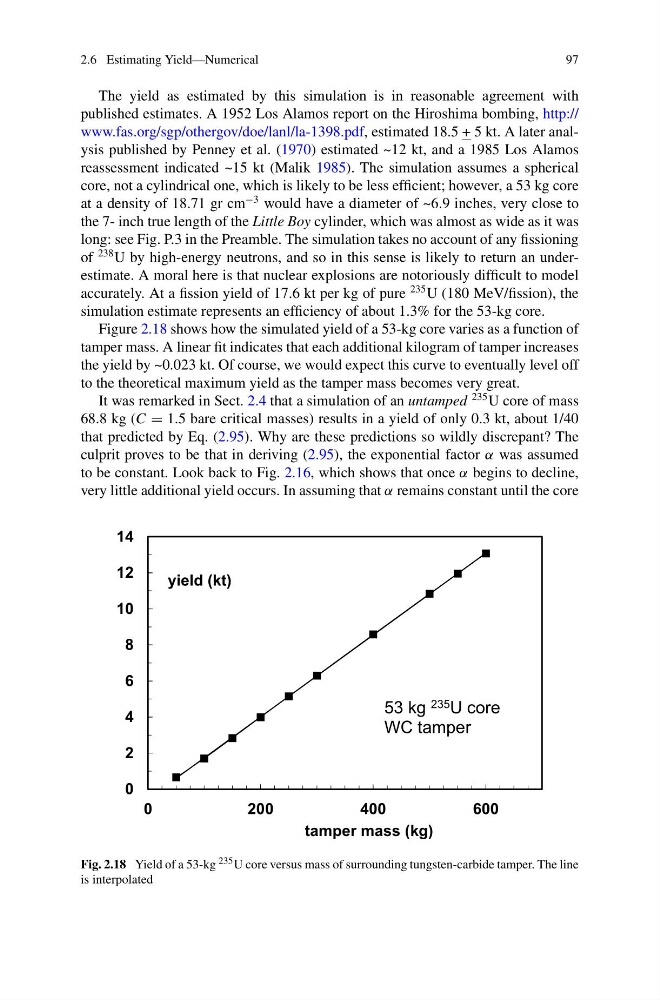
Figure 2.18 shows how the simulated yield of a 53-kg core varies as a function of
tamper mass. A linear fit indicates that each additional kilogram of tamper increases
the yield by ~0.023 kt. Of course, we would expect this curve to eventually level off
to the theoretical maximum yield as the tamper mass becomes very great.
It was remarked in Sect. 2.4 that a simulation of an untamped
235 U core of mass
68.8 kg (C = 1.5 bare critical masses) results in a yield of only 0.3 kt, about 1/40
that predicted by Eq. (2.95). Why are these predictions so wildly discrepant? The
culprit proves to be that in deriving (2.95), the exponential factor α was assumed
to be constant. Look back to Fig. 2.16, which shows that once α begins to decline,
very little additional yield occurs. In assuming that α remains constant until the core
0
2
4
6
8
10
12
14
0
200
400
600
yield (kt)
tamper mass (kg)
53 kg 235 U core
WC tamper
Fig. 2.18 Yield of a 53-kg 235 U core versus mass of surrounding tungsten-carbide tamper. The line
is interpolated
97
The yield as estimated by this simulation is in reasonable agreement with
published estimates. A 1952 Los Alamos report on the Hiroshima bombing, http://
www.fas.org/sgp/othergov/doe/lanl/la-1398.pdf, estimated 18.5 + 5 kt. A later analysis published by Penney et al. (1970) estimated ~12 kt, and a 1985 Los Alamos
reassessment indicated ~15 kt (Malik 1985). The simulation assumes a spherical
core, not a cylindrical one, which is likely to be less efficient; however, a 53 kg core
at a density of 18.71 gr cm
−3 would have a diameter of ~6.9 inches, very close to
the 7- inch true length of the Little Boy cylinder, which was almost as wide as it was
long: see Fig. P.3 in the Preamble. The simulation takes no account of any fissioning
of
238 U by high-energy neutrons, and so in this sense is likely to return an underestimate. A moral here is that nuclear explosions are notoriously difficult to model
accurately. At a fission yield of 17.6 kt per kg of pure
235 U (180 MeV/fission), the
simulation estimate represents an efficiency of about 1.3% for the 53-kg core.
Figure 2.18 shows how the simulated yield of a 53-kg core varies as a function of
tamper mass. A linear fit indicates that each additional kilogram of tamper increases
the yield by ~0.023 kt. Of course, we would expect this curve to eventually level off
to the theoretical maximum yield as the tamper mass becomes very great.
It was remarked in Sect. 2.4 that a simulation of an untamped
235 U core of mass
68.8 kg (C = 1.5 bare critical masses) results in a yield of only 0.3 kt, about 1/40
that predicted by Eq. (2.95). Why are these predictions so wildly discrepant? The
culprit proves to be that in deriving (2.95), the exponential factor α was assumed
to be constant. Look back to Fig. 2.16, which shows that once α begins to decline,
very little additional yield occurs. In assuming that α remains constant until the core
0
2
4
6
8
10
12
14
0
200
400
600
yield (kt)
tamper mass (kg)
53 kg 235 U core
WC tamper
Fig. 2.18 Yield of a 53-kg 235 U core versus mass of surrounding tungsten-carbide tamper. The line
is interpolated