

2.5 Estimating Yield—Analytic
87
Recall the earlier comments regarding how assuming constant values for α and τ
will lead to overestimating the yield; this should be clear by examining (2.96): 1/τ
2
will be proportional to the square of the density.
To help determine what value of γ to use, we can compute the total energy liberated
to time t crit as in (2.94), and then compute the average energy per particle by dividing
by the number of nuclei in the core, nV. The result is
energy per nucleus
at time t crit
= (e f f iciency)E f .
(2.97)
Even if the efficiency is very low, say 0.1%, then for E f = 180 MeV the energy per
nucleus would be 180 keV, much higher than the ~2 keV per-particle energy where
radiation pressure dominates over gas pressure. It would thus seem reasonable to
take γ = 1/3 in most cases, although γ = 2/3 would be more appropriate early in
the explosion process before much energy has been liberated.
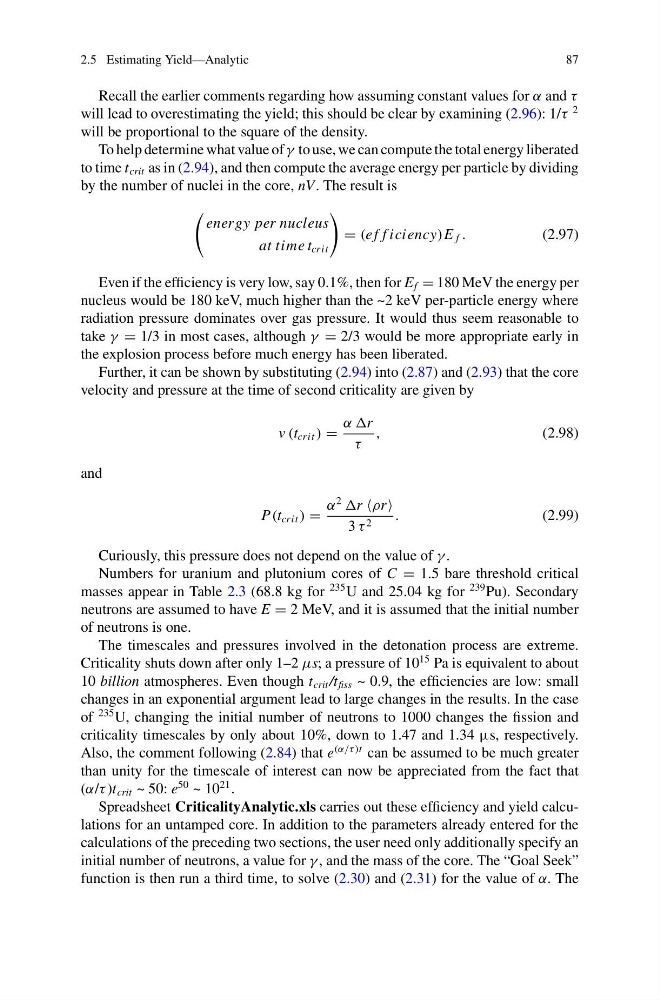
Further, it can be shown by substituting (2.94) into (2.87) and (2.93) that the core
velocity and pressure at the time of second criticality are given by
v (t crit ) =
α αr
τ
,
(2.98)
and
P(t crit ) =
α
2
r ρr
3 τ 2
.
(2.99)
Curiously, this pressure does not depend on the value of γ .
Numbers for uranium and plutonium cores of C = 1.5 bare threshold critical
masses appear in Table 2.3 (68.8 kg for
235 U and 25.04 kg for
239 Pu). Secondary
neutrons are assumed to have E = 2 MeV, and it is assumed that the initial number
of neutrons is one.
The timescales and pressures involved in the detonation process are extreme.
Criticality shuts down after only 1–2 μs; a pressure of 10
15 Pa is equivalent to about
10 billion atmospheres. Even though t crit /t fiss ~ 0.9, the efficiencies are low: small
changes in an exponential argument lead to large changes in the results. In the case
of
235 U, changing the initial number of neutrons to 1000 changes the fission and
criticality timescales by only about 10%, down to 1.47 and 1.34 µs, respectively.
Also, the comment following (2.84) that e
(α/τ )t can be assumed to be much greater
than unity for the timescale of interest can now be appreciated from the fact that
(α/τ )t crit ~ 50: e
50 ~ 10
21 .
Spreadsheet CriticalityAnalytic.xls carries out these efficiency and yield calculations for an untamped core. In addition to the parameters already entered for the
calculations of the preceding two sections, the user need only additionally specify an
initial number of neutrons, a value for γ , and the mass of the core. The “Goal Seek”
function is then run a third time, to solve (2.30) and (2.31) for the value of α. The
87
Recall the earlier comments regarding how assuming constant values for α and τ
will lead to overestimating the yield; this should be clear by examining (2.96): 1/τ
2
will be proportional to the square of the density.
To help determine what value of γ to use, we can compute the total energy liberated
to time t crit as in (2.94), and then compute the average energy per particle by dividing
by the number of nuclei in the core, nV. The result is
energy per nucleus
at time t crit
= (e f f iciency)E f .
(2.97)
Even if the efficiency is very low, say 0.1%, then for E f = 180 MeV the energy per
nucleus would be 180 keV, much higher than the ~2 keV per-particle energy where
radiation pressure dominates over gas pressure. It would thus seem reasonable to
take γ = 1/3 in most cases, although γ = 2/3 would be more appropriate early in
the explosion process before much energy has been liberated.
Further, it can be shown by substituting (2.94) into (2.87) and (2.93) that the core
velocity and pressure at the time of second criticality are given by
v (t crit ) =
α αr
τ
,
(2.98)
and
P(t crit ) =
α
2
r ρr
3 τ 2
.
(2.99)
Curiously, this pressure does not depend on the value of γ .
Numbers for uranium and plutonium cores of C = 1.5 bare threshold critical
masses appear in Table 2.3 (68.8 kg for
235 U and 25.04 kg for
239 Pu). Secondary
neutrons are assumed to have E = 2 MeV, and it is assumed that the initial number
of neutrons is one.
The timescales and pressures involved in the detonation process are extreme.
Criticality shuts down after only 1–2 μs; a pressure of 10
15 Pa is equivalent to about
10 billion atmospheres. Even though t crit /t fiss ~ 0.9, the efficiencies are low: small
changes in an exponential argument lead to large changes in the results. In the case
of
235 U, changing the initial number of neutrons to 1000 changes the fission and
criticality timescales by only about 10%, down to 1.47 and 1.34 µs, respectively.
Also, the comment following (2.84) that e
(α/τ )t can be assumed to be much greater
than unity for the timescale of interest can now be appreciated from the fact that
(α/τ )t crit ~ 50: e
50 ~ 10
21 .
Spreadsheet CriticalityAnalytic.xls carries out these efficiency and yield calculations for an untamped core. In addition to the parameters already entered for the
calculations of the preceding two sections, the user need only additionally specify an
initial number of neutrons, a value for γ , and the mass of the core. The “Goal Seek”
function is then run a third time, to solve (2.30) and (2.31) for the value of α. The