

86
2 Critical Mass, Efficiency, and Yield
r = r second
criticlit y
− r initial =
C
1/2
− C
1/3
R o ,
(2.91)
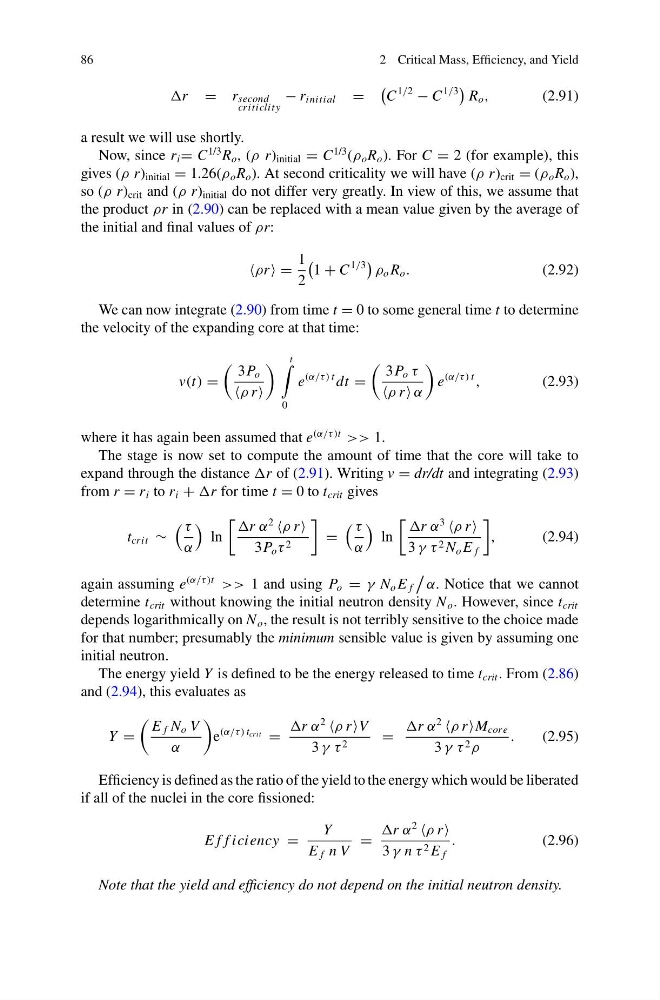
a result we will use shortly.
Now, since r i = C
1/3 R o , (ρ r) initial = C
1/3 (ρ o R o ). For C = 2 (for example), this
gives (ρ r) initial = 1.26(ρ o R o ). At second criticality we will have (ρ r) crit = (ρ o R o ),
so (ρ r) crit and (ρ r) initial do not differ very greatly. In view of this, we assume that
the product ρr in (2.90) can be replaced with a mean value given by the average of
the initial and final values of ρr:
ρr =
1
2
1 + C
1/3
ρ o R o .
(2.92)
We can now integrate (2.90) from time t = 0 to some general time t to determine
the velocity of the expanding core at that time:
v(t) =
3P o
ρ r
t
0
e
(α/τ ) t dt =
3P o τ
ρ r α
e
(α/τ ) t
,
(2.93)
where it has again been assumed that e
(α/τ )t
>> 1.
The stage is now set to compute the amount of time that the core will take to
expand through the distance r of (2.91). Writing v = dr/dt and integrating (2.93)
from r = r i to r i + r for time t = 0 to t crit gives
t crit ∼
τ
α
ln
r α
2
ρ r
3P o τ 2
=
τ
α
ln
r α
3
ρ r
3 γ τ 2 N o E f
,
(2.94)
again assuming e
(α/τ )t
>> 1 and using P o = γ N o E f
α. Notice that we cannot
determine t crit without knowing the initial neutron density N o . However, since t crit
depends logarithmically on N o , the result is not terribly sensitive to the choice made
for that number; presumably the minimum sensible value is given by assuming one
initial neutron.
The energy yield Y is defined to be the energy released to time t crit . From (2.86)
and (2.94), this evaluates as
Y =
E f N o V
α
e
(α/τ ) t crit =
r α
2
ρ r V
3 γ τ 2
=
r α
2
ρ r M core
3 γ τ 2 ρ
.
(2.95)
Efficiency is defined as the ratio of the yield to the energy which would be liberated
if all of the nuclei in the core fissioned:
E f f iciency =
Y
E f n V
=
r α
2
ρ r
3 γ n τ 2 E f
.
(2.96)
Note that the yield and efficiency do not depend on the initial neutron density.
2 Critical Mass, Efficiency, and Yield
r = r second
criticlit y
− r initial =
C
1/2
− C
1/3
R o ,
(2.91)
a result we will use shortly.
Now, since r i = C
1/3 R o , (ρ r) initial = C
1/3 (ρ o R o ). For C = 2 (for example), this
gives (ρ r) initial = 1.26(ρ o R o ). At second criticality we will have (ρ r) crit = (ρ o R o ),
so (ρ r) crit and (ρ r) initial do not differ very greatly. In view of this, we assume that
the product ρr in (2.90) can be replaced with a mean value given by the average of
the initial and final values of ρr:
ρr =
1
2
1 + C
1/3
ρ o R o .
(2.92)
We can now integrate (2.90) from time t = 0 to some general time t to determine
the velocity of the expanding core at that time:
v(t) =
3P o
ρ r
t
0
e
(α/τ ) t dt =
3P o τ
ρ r α
e
(α/τ ) t
,
(2.93)
where it has again been assumed that e
(α/τ )t
>> 1.
The stage is now set to compute the amount of time that the core will take to
expand through the distance r of (2.91). Writing v = dr/dt and integrating (2.93)
from r = r i to r i + r for time t = 0 to t crit gives
t crit ∼
τ
α
ln
r α
2
ρ r
3P o τ 2
=
τ
α
ln
r α
3
ρ r
3 γ τ 2 N o E f
,
(2.94)
again assuming e
(α/τ )t
>> 1 and using P o = γ N o E f
α. Notice that we cannot
determine t crit without knowing the initial neutron density N o . However, since t crit
depends logarithmically on N o , the result is not terribly sensitive to the choice made
for that number; presumably the minimum sensible value is given by assuming one
initial neutron.
The energy yield Y is defined to be the energy released to time t crit . From (2.86)
and (2.94), this evaluates as
Y =
E f N o V
α
e
(α/τ ) t crit =
r α
2
ρ r V
3 γ τ 2
=
r α
2
ρ r M core
3 γ τ 2 ρ
.
(2.95)
Efficiency is defined as the ratio of the yield to the energy which would be liberated
if all of the nuclei in the core fissioned:
E f f iciency =
Y
E f n V
=
r α
2
ρ r
3 γ n τ 2 E f
.
(2.96)
Note that the yield and efficiency do not depend on the initial neutron density.