

type of water, Williamson has introduced the notion of valence. For him the
structural type of water is bivalent. Analogously, the types of hydrogen-chloride,
ammonia, and ammonium are monovalent, trivalent, and tetravalent. Valence is in
such a way defined as a ratio of units, atoms or Berzelius radicals, which are
exchanged between each other in substitution reactions. But, we have to be careful:
this concept is still not the explanation of chemical bond and its nature, it is merely
a measure of quantitative relationship between substances.
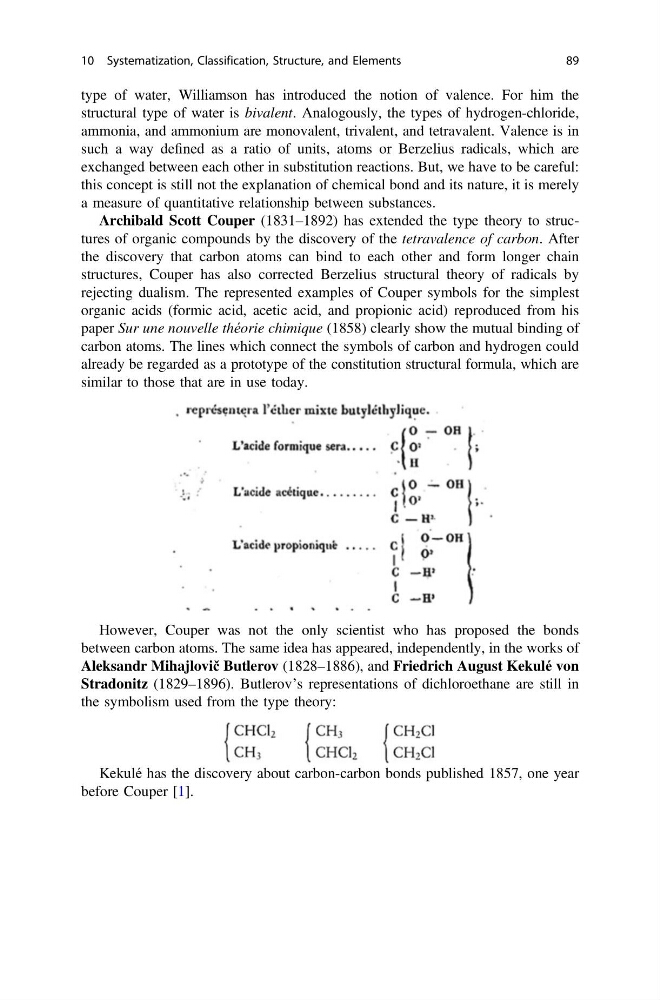
Archibald Scott Couper (1831–1892) has extended the type theory to structures of organic compounds by the discovery of the tetravalence of carbon. After
the discovery that carbon atoms can bind to each other and form longer chain
structures, Couper has also corrected Berzelius structural theory of radicals by
rejecting dualism. The represented examples of Couper symbols for the simplest
organic acids (formic acid, acetic acid, and propionic acid) reproduced from his
paper Sur une nouvelle théorie chimique (1858) clearly show the mutual binding of
carbon atoms. The lines which connect the symbols of carbon and hydrogen could
already be regarded as a prototype of the constitution structural formula, which are
similar to those that are in use today.
However, Couper was not the only scientist who has proposed the bonds
between carbon atoms. The same idea has appeared, independently, in the works of
Aleksandr Mihajlovič Butlerov (1828–1886), and Friedrich August Kekulé von
Stradonitz (1829–1896). Butlerov’s representations of dichloroethane are still in
the symbolism used from the type theory:
Kekulé has the discovery about carbon-carbon bonds published 1857, one year
before Couper [1].
10 Systematization, Classification, Structure, and Elements
89
structural type of water is bivalent. Analogously, the types of hydrogen-chloride,
ammonia, and ammonium are monovalent, trivalent, and tetravalent. Valence is in
such a way defined as a ratio of units, atoms or Berzelius radicals, which are
exchanged between each other in substitution reactions. But, we have to be careful:
this concept is still not the explanation of chemical bond and its nature, it is merely
a measure of quantitative relationship between substances.
Archibald Scott Couper (1831–1892) has extended the type theory to structures of organic compounds by the discovery of the tetravalence of carbon. After
the discovery that carbon atoms can bind to each other and form longer chain
structures, Couper has also corrected Berzelius structural theory of radicals by
rejecting dualism. The represented examples of Couper symbols for the simplest
organic acids (formic acid, acetic acid, and propionic acid) reproduced from his
paper Sur une nouvelle théorie chimique (1858) clearly show the mutual binding of
carbon atoms. The lines which connect the symbols of carbon and hydrogen could
already be regarded as a prototype of the constitution structural formula, which are
similar to those that are in use today.
However, Couper was not the only scientist who has proposed the bonds
between carbon atoms. The same idea has appeared, independently, in the works of
Aleksandr Mihajlovič Butlerov (1828–1886), and Friedrich August Kekulé von
Stradonitz (1829–1896). Butlerov’s representations of dichloroethane are still in
the symbolism used from the type theory:
Kekulé has the discovery about carbon-carbon bonds published 1857, one year
before Couper [1].
10 Systematization, Classification, Structure, and Elements
89