

This first structural theoretical concept has as a consequence the extension of our
information about chemical compounds. The substance is now represented not only
with its composition, i.e. the number of atoms of particular element, but also with its
constitution, i.e. the manner how atoms are mutually interconnected. From constitution we have also an additional information, namely, how the structure can be
decomposed in smaller fragments.
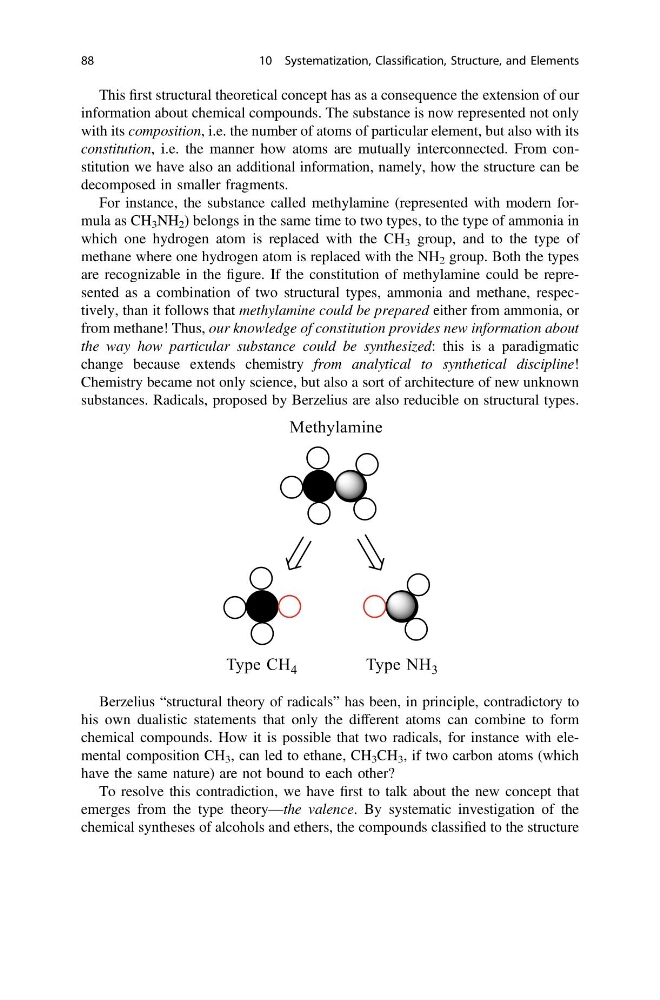
For instance, the substance called methylamine (represented with modern formula as CH 3 NH 2 ) belongs in the same time to two types, to the type of ammonia in
which one hydrogen atom is replaced with the CH 3 group, and to the type of
methane where one hydrogen atom is replaced with the NH 2 group. Both the types
are recognizable in the figure. If the constitution of methylamine could be represented as a combination of two structural types, ammonia and methane, respectively, than it follows that methylamine could be prepared either from ammonia, or
from methane! Thus, our knowledge of constitution provides new information about
the way how particular substance could be synthesized: this is a paradigmatic
change because extends chemistry from analytical to synthetical discipline!
Chemistry became not only science, but also a sort of architecture of new unknown
substances. Radicals, proposed by Berzelius are also reducible on structural types.
Berzelius “structural theory of radicals” has been, in principle, contradictory to
his own dualistic statements that only the different atoms can combine to form
chemical compounds. How it is possible that two radicals, for instance with elemental composition CH 3 , can led to ethane, CH 3 CH 3 , if two carbon atoms (which
have the same nature) are not bound to each other?
To resolve this contradiction, we have first to talk about the new concept that
emerges from the type theory—the valence. By systematic investigation of the
chemical syntheses of alcohols and ethers, the compounds classified to the structure
88
10 Systematization, Classification, Structure, and Elements
information about chemical compounds. The substance is now represented not only
with its composition, i.e. the number of atoms of particular element, but also with its
constitution, i.e. the manner how atoms are mutually interconnected. From constitution we have also an additional information, namely, how the structure can be
decomposed in smaller fragments.
For instance, the substance called methylamine (represented with modern formula as CH 3 NH 2 ) belongs in the same time to two types, to the type of ammonia in
which one hydrogen atom is replaced with the CH 3 group, and to the type of
methane where one hydrogen atom is replaced with the NH 2 group. Both the types
are recognizable in the figure. If the constitution of methylamine could be represented as a combination of two structural types, ammonia and methane, respectively, than it follows that methylamine could be prepared either from ammonia, or
from methane! Thus, our knowledge of constitution provides new information about
the way how particular substance could be synthesized: this is a paradigmatic
change because extends chemistry from analytical to synthetical discipline!
Chemistry became not only science, but also a sort of architecture of new unknown
substances. Radicals, proposed by Berzelius are also reducible on structural types.
Berzelius “structural theory of radicals” has been, in principle, contradictory to
his own dualistic statements that only the different atoms can combine to form
chemical compounds. How it is possible that two radicals, for instance with elemental composition CH 3 , can led to ethane, CH 3 CH 3 , if two carbon atoms (which
have the same nature) are not bound to each other?
To resolve this contradiction, we have first to talk about the new concept that
emerges from the type theory—the valence. By systematic investigation of the
chemical syntheses of alcohols and ethers, the compounds classified to the structure
88
10 Systematization, Classification, Structure, and Elements