

for analogy? Important step in the solution of this question has happened within the
research group of Swedish chemist Jöns Jacob Berzelius (1779–1848). His collaborators Friedrich Wöhler (1800–1882) and Eilhard Mitscherlich (1794 1863)
have represented both the concepts, analogy, and structure, respectively, in the new
light. During his investigations of the morphology of crystals, particularly the
crystals of phosphates and arsenates, Mitscherlich has discovered that the substances different in elemental composition can form the crystals with the same form
and symmetry. Mitscherlich has called it isomorphy. Thus, the structure, which is,
in this case, observed as a morphology of crystal, is independent on the composition
of the substance. Structure is an autonomous phenomenon that could be used as
possible criterion for analogy. Thus, the substances are analogous if they form the
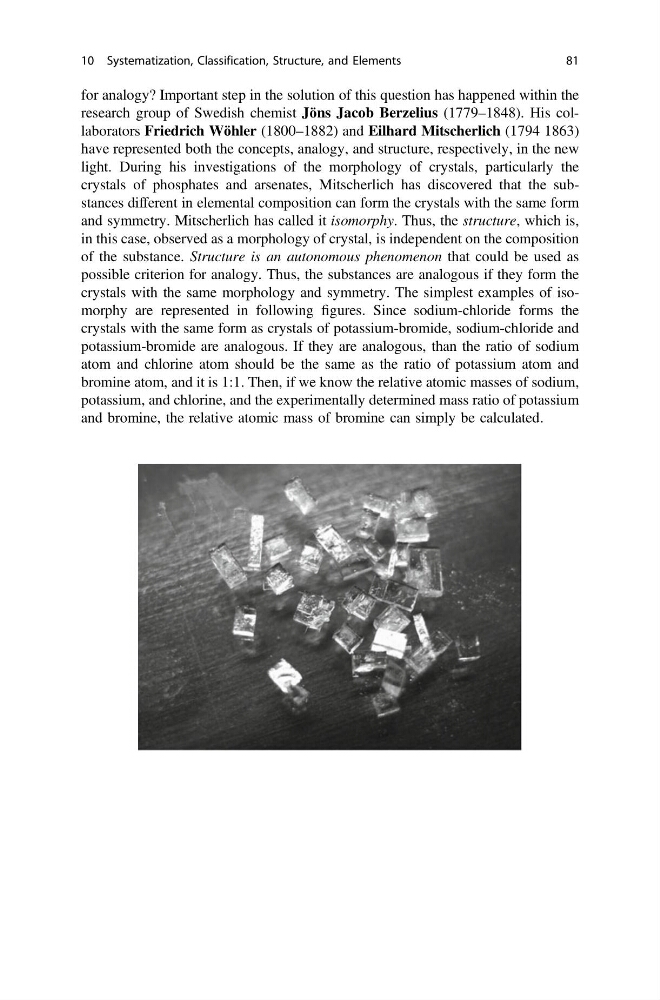
crystals with the same morphology and symmetry. The simplest examples of isomorphy are represented in following figures. Since sodium-chloride forms the
crystals with the same form as crystals of potassium-bromide, sodium-chloride and
potassium-bromide are analogous. If they are analogous, than the ratio of sodium
atom and chlorine atom should be the same as the ratio of potassium atom and
bromine atom, and it is 1:1. Then, if we know the relative atomic masses of sodium,
potassium, and chlorine, and the experimentally determined mass ratio of potassium
and bromine, the relative atomic mass of bromine can simply be calculated.
Crystals of potassium bromide KBr (the figure is copied from the public internet pages)
10 Systematization, Classification, Structure, and Elements
81
research group of Swedish chemist Jöns Jacob Berzelius (1779–1848). His collaborators Friedrich Wöhler (1800–1882) and Eilhard Mitscherlich (1794 1863)
have represented both the concepts, analogy, and structure, respectively, in the new
light. During his investigations of the morphology of crystals, particularly the
crystals of phosphates and arsenates, Mitscherlich has discovered that the substances different in elemental composition can form the crystals with the same form
and symmetry. Mitscherlich has called it isomorphy. Thus, the structure, which is,
in this case, observed as a morphology of crystal, is independent on the composition
of the substance. Structure is an autonomous phenomenon that could be used as
possible criterion for analogy. Thus, the substances are analogous if they form the
crystals with the same morphology and symmetry. The simplest examples of isomorphy are represented in following figures. Since sodium-chloride forms the
crystals with the same form as crystals of potassium-bromide, sodium-chloride and
potassium-bromide are analogous. If they are analogous, than the ratio of sodium
atom and chlorine atom should be the same as the ratio of potassium atom and
bromine atom, and it is 1:1. Then, if we know the relative atomic masses of sodium,
potassium, and chlorine, and the experimentally determined mass ratio of potassium
and bromine, the relative atomic mass of bromine can simply be calculated.
Crystals of potassium bromide KBr (the figure is copied from the public internet pages)
10 Systematization, Classification, Structure, and Elements
81