

form chemical compound, can be measured, and since the ratio of atoms of elements
on microscale is unknown, the calculation of atomic mass can be contradictory. For
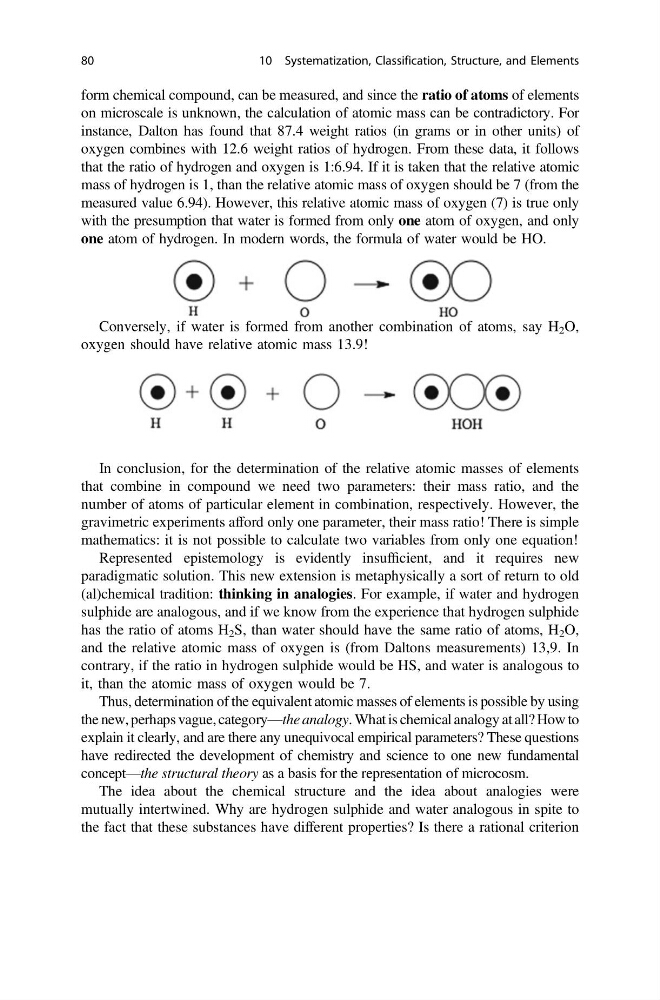
instance, Dalton has found that 87.4 weight ratios (in grams or in other units) of
oxygen combines with 12.6 weight ratios of hydrogen. From these data, it follows
that the ratio of hydrogen and oxygen is 1:6.94. If it is taken that the relative atomic
mass of hydrogen is 1, than the relative atomic mass of oxygen should be 7 (from the
measured value 6.94). However, this relative atomic mass of oxygen (7) is true only
with the presumption that water is formed from only one atom of oxygen, and only
one atom of hydrogen. In modern words, the formula of water would be HO.
Conversely, if water is formed from another combination of atoms, say H 2 O,
oxygen should have relative atomic mass 13.9!
In conclusion, for the determination of the relative atomic masses of elements
that combine in compound we need two parameters: their mass ratio, and the
number of atoms of particular element in combination, respectively. However, the
gravimetric experiments afford only one parameter, their mass ratio! There is simple
mathematics: it is not possible to calculate two variables from only one equation!
Represented epistemology is evidently insufficient, and it requires new
paradigmatic solution. This new extension is metaphysically a sort of return to old
(al)chemical tradition: thinking in analogies. For example, if water and hydrogen
sulphide are analogous, and if we know from the experience that hydrogen sulphide
has the ratio of atoms H 2 S, than water should have the same ratio of atoms, H 2 O,
and the relative atomic mass of oxygen is (from Daltons measurements) 13,9. In
contrary, if the ratio in hydrogen sulphide would be HS, and water is analogous to
it, than the atomic mass of oxygen would be 7.
Thus, determination of the equivalent atomic masses of elements is possible by using
the new, perhaps vague, category—the analogy. What is chemical analogy at all? How to
explain it clearly, and are there any unequivocal empirical parameters? These questions
have redirected the development of chemistry and science to one new fundamental
concept—the structural theory as a basis for the representation of microcosm.
The idea about the chemical structure and the idea about analogies were
mutually intertwined. Why are hydrogen sulphide and water analogous in spite to
the fact that these substances have different properties? Is there a rational criterion
80
10 Systematization, Classification, Structure, and Elements
on microscale is unknown, the calculation of atomic mass can be contradictory. For
instance, Dalton has found that 87.4 weight ratios (in grams or in other units) of
oxygen combines with 12.6 weight ratios of hydrogen. From these data, it follows
that the ratio of hydrogen and oxygen is 1:6.94. If it is taken that the relative atomic
mass of hydrogen is 1, than the relative atomic mass of oxygen should be 7 (from the
measured value 6.94). However, this relative atomic mass of oxygen (7) is true only
with the presumption that water is formed from only one atom of oxygen, and only
one atom of hydrogen. In modern words, the formula of water would be HO.
Conversely, if water is formed from another combination of atoms, say H 2 O,
oxygen should have relative atomic mass 13.9!
In conclusion, for the determination of the relative atomic masses of elements
that combine in compound we need two parameters: their mass ratio, and the
number of atoms of particular element in combination, respectively. However, the
gravimetric experiments afford only one parameter, their mass ratio! There is simple
mathematics: it is not possible to calculate two variables from only one equation!
Represented epistemology is evidently insufficient, and it requires new
paradigmatic solution. This new extension is metaphysically a sort of return to old
(al)chemical tradition: thinking in analogies. For example, if water and hydrogen
sulphide are analogous, and if we know from the experience that hydrogen sulphide
has the ratio of atoms H 2 S, than water should have the same ratio of atoms, H 2 O,
and the relative atomic mass of oxygen is (from Daltons measurements) 13,9. In
contrary, if the ratio in hydrogen sulphide would be HS, and water is analogous to
it, than the atomic mass of oxygen would be 7.
Thus, determination of the equivalent atomic masses of elements is possible by using
the new, perhaps vague, category—the analogy. What is chemical analogy at all? How to
explain it clearly, and are there any unequivocal empirical parameters? These questions
have redirected the development of chemistry and science to one new fundamental
concept—the structural theory as a basis for the representation of microcosm.
The idea about the chemical structure and the idea about analogies were
mutually intertwined. Why are hydrogen sulphide and water analogous in spite to
the fact that these substances have different properties? Is there a rational criterion
80
10 Systematization, Classification, Structure, and Elements