

mentioned Ianus Commenius, but also the reformer of alchemy Robert Boyle
(1627–1691). The database that comprised not only scientists, but also other
practitioners in the field of humanities and economy, all from the civilised circle of
that time, has started to grow. Hartlib has stimulated collaboration between scientists by joining them and informing them about actual topics of research, opinions, and discoveries. The established network has been transformed by gradual
formation of the principles of scientific universality.
This social objectification has mirrored in already mentioned methodological
objectification. Scientific true was not more a matter of individuals, or a matter of
particular closed circles, but rather it was oppened to the community. In such a way,
criticism and openness in scientific activity begun to play the key role; science
became step by step non-personal. This social influence on the science, as well as
already mentioned universalization of education have as a result the objectification
of science, and, finally it led to the scientific revolution.
The focus of scientific investigations has been shifted to a quantitative experiment. Traditional alchemy of Empedoclean principles did not more match in this
new scientific-methodological scheme. Within these frames the idea
element-principle was out of sense.
As we have mentioned, van Helmont has clearly rejected the concept about four
elements. For him, only water is acceptable as a sort of elementary substance. All
things, those measurable and variable are only a specific form of water. Water is not
more a sort of Thalesian element.
The term element makes sense only as a real empirical and mechanical substance
that we can measure, and with which we can manipulate! Empiricism as an
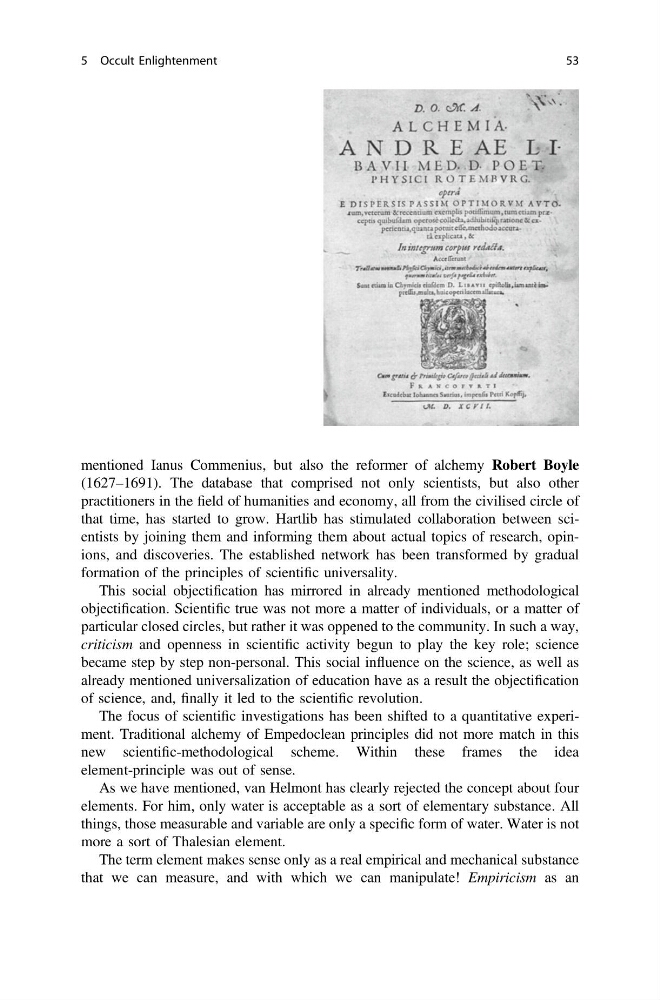
Facsimile of the cover of
the first textbook of
alchemy written by
Andreas Libavius from
1597
5 Occult Enlightenment
53
(1627–1691). The database that comprised not only scientists, but also other
practitioners in the field of humanities and economy, all from the civilised circle of
that time, has started to grow. Hartlib has stimulated collaboration between scientists by joining them and informing them about actual topics of research, opinions, and discoveries. The established network has been transformed by gradual
formation of the principles of scientific universality.
This social objectification has mirrored in already mentioned methodological
objectification. Scientific true was not more a matter of individuals, or a matter of
particular closed circles, but rather it was oppened to the community. In such a way,
criticism and openness in scientific activity begun to play the key role; science
became step by step non-personal. This social influence on the science, as well as
already mentioned universalization of education have as a result the objectification
of science, and, finally it led to the scientific revolution.
The focus of scientific investigations has been shifted to a quantitative experiment. Traditional alchemy of Empedoclean principles did not more match in this
new scientific-methodological scheme. Within these frames the idea
element-principle was out of sense.
As we have mentioned, van Helmont has clearly rejected the concept about four
elements. For him, only water is acceptable as a sort of elementary substance. All
things, those measurable and variable are only a specific form of water. Water is not
more a sort of Thalesian element.
The term element makes sense only as a real empirical and mechanical substance
that we can measure, and with which we can manipulate! Empiricism as an
Facsimile of the cover of
the first textbook of
alchemy written by
Andreas Libavius from
1597
5 Occult Enlightenment
53