

Such a way, the triangle appears as an ultimate elemental unit, a sort of
proto-element, or proto-atom. If any of the elements, i.e. its geometrical representation, can be decomposed in triangles, then from these basic units it is possible
to reconstruct any other element. Consequently, the elements can transmutate to
each other! By this mental experiment Plato intend to demonstrate that the transmutation of elements appears first on the abstract level in the world of ideas, and the
transmutation of real substances appears only as an emanation of these ideas.
Elements have their own properties, those that we recognize by our senses such
as colour, moisture, taste, heat etc. By Aristotle, there are four basic properties of
elements: dry, wet, warm, and cold. Every element is characterized by the combination of two properties, which are bound in pairs by opposites: the pair of
moisture, dry-wet, and the pair of warmness, warm-cold. Such a way, fire takes dry
from the first pair, and warm from the second, and air takes warm from the first pair
and wet from the second.
These pairs of properties, which by their combination form particular elements,
correspond to the different and independent types of senses: the sense of heat, and
the sense of moisture. As it was already mentioned, none of these two types can be
quantitatively analysed and interpreted by mathematics, or at least this was not able
in the early history of science. In contrast, other two senses, senses of space and
time, can be easily represented by mathematical methods. Movements of the
heavenly bodies, for instance, could be calculated and represented as a combination
of space and time coordinates.
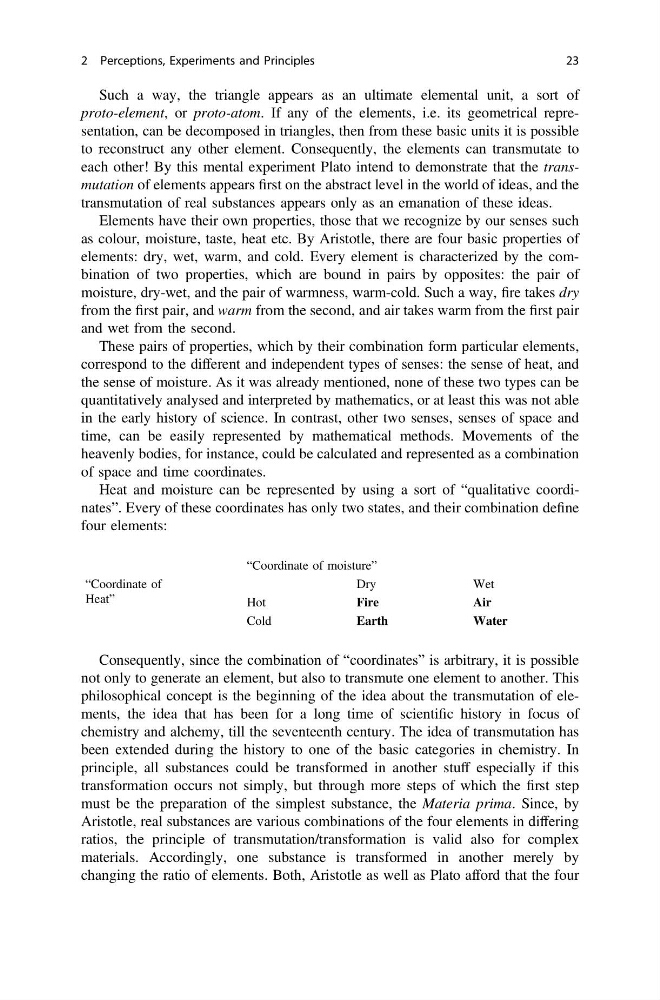
Heat and moisture can be represented by using a sort of “qualitative coordinates”. Every of these coordinates has only two states, and their combination define
four elements:
Consequently, since the combination of “coordinates” is arbitrary, it is possible
not only to generate an element, but also to transmute one element to another. This
philosophical concept is the beginning of the idea about the transmutation of elements, the idea that has been for a long time of scientific history in focus of
chemistry and alchemy, till the seventeenth century. The idea of transmutation has
been extended during the history to one of the basic categories in chemistry. In
principle, all substances could be transformed in another stuff especially if this
transformation occurs not simply, but through more steps of which the first step
must be the preparation of the simplest substance, the Materia prima. Since, by
Aristotle, real substances are various combinations of the four elements in differing
ratios, the principle of transmutation/transformation is valid also for complex
materials. Accordingly, one substance is transformed in another merely by
changing the ratio of elements. Both, Aristotle as well as Plato afford that the four
“Coordinate of moisture”
“Coordinate of
Heat”
Dry
Wet
Hot
Fire
Air
Cold
Earth
Water
2 Perceptions, Experiments and Principles
23
proto-element, or proto-atom. If any of the elements, i.e. its geometrical representation, can be decomposed in triangles, then from these basic units it is possible
to reconstruct any other element. Consequently, the elements can transmutate to
each other! By this mental experiment Plato intend to demonstrate that the transmutation of elements appears first on the abstract level in the world of ideas, and the
transmutation of real substances appears only as an emanation of these ideas.
Elements have their own properties, those that we recognize by our senses such
as colour, moisture, taste, heat etc. By Aristotle, there are four basic properties of
elements: dry, wet, warm, and cold. Every element is characterized by the combination of two properties, which are bound in pairs by opposites: the pair of
moisture, dry-wet, and the pair of warmness, warm-cold. Such a way, fire takes dry
from the first pair, and warm from the second, and air takes warm from the first pair
and wet from the second.
These pairs of properties, which by their combination form particular elements,
correspond to the different and independent types of senses: the sense of heat, and
the sense of moisture. As it was already mentioned, none of these two types can be
quantitatively analysed and interpreted by mathematics, or at least this was not able
in the early history of science. In contrast, other two senses, senses of space and
time, can be easily represented by mathematical methods. Movements of the
heavenly bodies, for instance, could be calculated and represented as a combination
of space and time coordinates.
Heat and moisture can be represented by using a sort of “qualitative coordinates”. Every of these coordinates has only two states, and their combination define
four elements:
Consequently, since the combination of “coordinates” is arbitrary, it is possible
not only to generate an element, but also to transmute one element to another. This
philosophical concept is the beginning of the idea about the transmutation of elements, the idea that has been for a long time of scientific history in focus of
chemistry and alchemy, till the seventeenth century. The idea of transmutation has
been extended during the history to one of the basic categories in chemistry. In
principle, all substances could be transformed in another stuff especially if this
transformation occurs not simply, but through more steps of which the first step
must be the preparation of the simplest substance, the Materia prima. Since, by
Aristotle, real substances are various combinations of the four elements in differing
ratios, the principle of transmutation/transformation is valid also for complex
materials. Accordingly, one substance is transformed in another merely by
changing the ratio of elements. Both, Aristotle as well as Plato afford that the four
“Coordinate of moisture”
“Coordinate of
Heat”
Dry
Wet
Hot
Fire
Air
Cold
Earth
Water
2 Perceptions, Experiments and Principles
23