

discussed in the upcoming lectures. It is almost impossible to find the reasons that
have stimulated Empedocles to propose such a concept of the four elements, because
the process of the scientific and artistic invention are elusive and irrational, often they
are the consequences of the unaspectable circumstances. Though, in the Empedoclean scheme one could recognize the geocentristic representation of the Universum,
with the Earth whose mass is concentrated in its centre, and water and air which form
the outer spheres. Already in this time, fire has been traditionally positioned either in
the most distant spheres, or in the Sun that was regarded as one of its sources.
Long-standing stability of the theory about the four elements could be explained by
the fact that its main promotor was Aristotle of Stagira (384–322 B.C.) who has
constructed almost complete natural philosophy on this Empedoclean concept, and
whose authority was unquestionable in the scholastic period of the history of science.
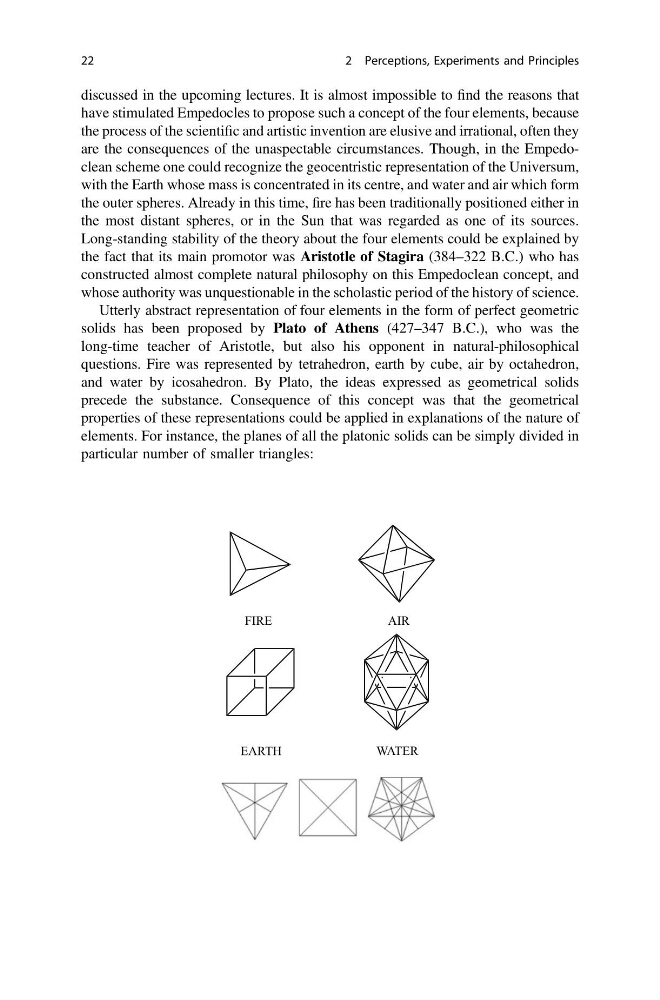
Utterly abstract representation of four elements in the form of perfect geometric
solids has been proposed by Plato of Athens (427–347 B.C.), who was the
long-time teacher of Aristotle, but also his opponent in natural-philosophical
questions. Fire was represented by tetrahedron, earth by cube, air by octahedron,
and water by icosahedron. By Plato, the ideas expressed as geometrical solids
precede the substance. Consequence of this concept was that the geometrical
properties of these representations could be applied in explanations of the nature of
elements. For instance, the planes of all the platonic solids can be simply divided in
particular number of smaller triangles:
FIRE
AIR
EARTH
WATER
Plato’s representation of four elements as four geometrical solids. The planes of all
these solids can be divided in triangles
22
2 Perceptions, Experiments and Principles
have stimulated Empedocles to propose such a concept of the four elements, because
the process of the scientific and artistic invention are elusive and irrational, often they
are the consequences of the unaspectable circumstances. Though, in the Empedoclean scheme one could recognize the geocentristic representation of the Universum,
with the Earth whose mass is concentrated in its centre, and water and air which form
the outer spheres. Already in this time, fire has been traditionally positioned either in
the most distant spheres, or in the Sun that was regarded as one of its sources.
Long-standing stability of the theory about the four elements could be explained by
the fact that its main promotor was Aristotle of Stagira (384–322 B.C.) who has
constructed almost complete natural philosophy on this Empedoclean concept, and
whose authority was unquestionable in the scholastic period of the history of science.
Utterly abstract representation of four elements in the form of perfect geometric
solids has been proposed by Plato of Athens (427–347 B.C.), who was the
long-time teacher of Aristotle, but also his opponent in natural-philosophical
questions. Fire was represented by tetrahedron, earth by cube, air by octahedron,
and water by icosahedron. By Plato, the ideas expressed as geometrical solids
precede the substance. Consequence of this concept was that the geometrical
properties of these representations could be applied in explanations of the nature of
elements. For instance, the planes of all the platonic solids can be simply divided in
particular number of smaller triangles:
FIRE
AIR
EARTH
WATER
Plato’s representation of four elements as four geometrical solids. The planes of all
these solids can be divided in triangles
22
2 Perceptions, Experiments and Principles