

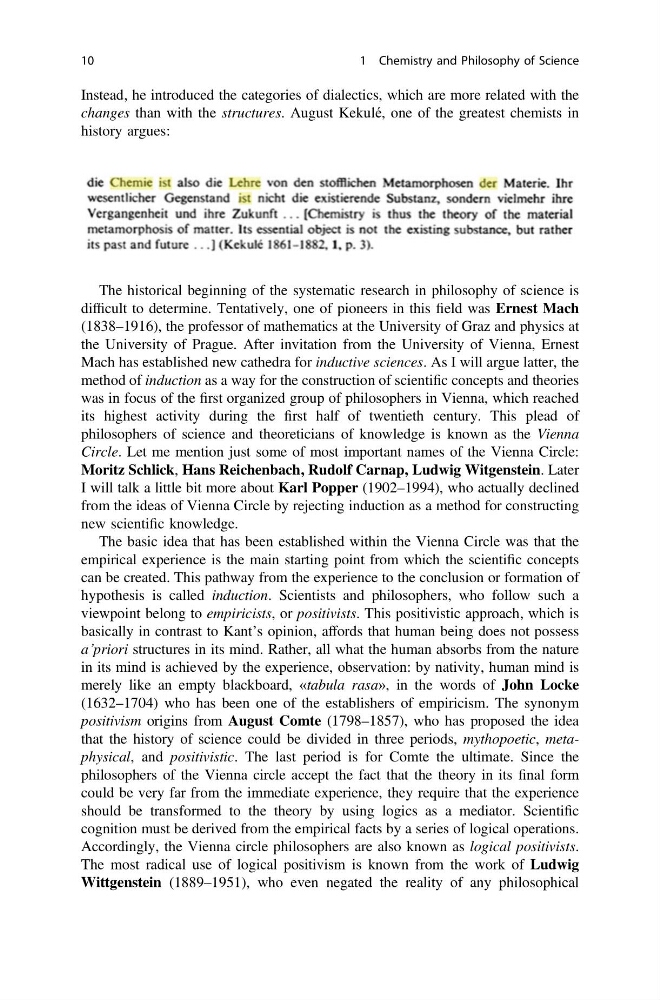
Instead, he introduced the categories of dialectics, which are more related with the
changes than with the structures. August Kekulé, one of the greatest chemists in
history argues:
The historical beginning of the systematic research in philosophy of science is
difficult to determine. Tentatively, one of pioneers in this field was Ernest Mach
(1838–1916), the professor of mathematics at the University of Graz and physics at
the University of Prague. After invitation from the University of Vienna, Ernest
Mach has established new cathedra for inductive sciences. As I will argue latter, the
method of induction as a way for the construction of scientific concepts and theories
was in focus of the first organized group of philosophers in Vienna, which reached
its highest activity during the first half of twentieth century. This plead of
philosophers of science and theoreticians of knowledge is known as the Vienna
Circle. Let me mention just some of most important names of the Vienna Circle:
Moritz Schlick, Hans Reichenbach, Rudolf Carnap, Ludwig Witgenstein. Later
I will talk a little bit more about Karl Popper (1902–1994), who actually declined
from the ideas of Vienna Circle by rejecting induction as a method for constructing
new scientific knowledge.
The basic idea that has been established within the Vienna Circle was that the
empirical experience is the main starting point from which the scientific concepts
can be created. This pathway from the experience to the conclusion or formation of
hypothesis is called induction. Scientists and philosophers, who follow such a
viewpoint belong to empiricists, or positivists. This positivistic approach, which is
basically in contrast to Kant’s opinion, affords that human being does not possess
a’priori structures in its mind. Rather, all what the human absorbs from the nature
in its mind is achieved by the experience, observation: by nativity, human mind is
merely like an empty blackboard, «tabula rasa», in the words of John Locke
(1632–1704) who has been one of the establishers of empiricism. The synonym
positivism origins from August Comte (1798–1857), who has proposed the idea
that the history of science could be divided in three periods, mythopoetic, metaphysical, and positivistic. The last period is for Comte the ultimate. Since the
philosophers of the Vienna circle accept the fact that the theory in its final form
could be very far from the immediate experience, they require that the experience
should be transformed to the theory by using logics as a mediator. Scientific
cognition must be derived from the empirical facts by a series of logical operations.
Accordingly, the Vienna circle philosophers are also known as logical positivists.
The most radical use of logical positivism is known from the work of Ludwig
Wittgenstein (1889–1951), who even negated the reality of any philosophical
10
1 Chemistry and Philosophy of Science
changes than with the structures. August Kekulé, one of the greatest chemists in
history argues:
The historical beginning of the systematic research in philosophy of science is
difficult to determine. Tentatively, one of pioneers in this field was Ernest Mach
(1838–1916), the professor of mathematics at the University of Graz and physics at
the University of Prague. After invitation from the University of Vienna, Ernest
Mach has established new cathedra for inductive sciences. As I will argue latter, the
method of induction as a way for the construction of scientific concepts and theories
was in focus of the first organized group of philosophers in Vienna, which reached
its highest activity during the first half of twentieth century. This plead of
philosophers of science and theoreticians of knowledge is known as the Vienna
Circle. Let me mention just some of most important names of the Vienna Circle:
Moritz Schlick, Hans Reichenbach, Rudolf Carnap, Ludwig Witgenstein. Later
I will talk a little bit more about Karl Popper (1902–1994), who actually declined
from the ideas of Vienna Circle by rejecting induction as a method for constructing
new scientific knowledge.
The basic idea that has been established within the Vienna Circle was that the
empirical experience is the main starting point from which the scientific concepts
can be created. This pathway from the experience to the conclusion or formation of
hypothesis is called induction. Scientists and philosophers, who follow such a
viewpoint belong to empiricists, or positivists. This positivistic approach, which is
basically in contrast to Kant’s opinion, affords that human being does not possess
a’priori structures in its mind. Rather, all what the human absorbs from the nature
in its mind is achieved by the experience, observation: by nativity, human mind is
merely like an empty blackboard, «tabula rasa», in the words of John Locke
(1632–1704) who has been one of the establishers of empiricism. The synonym
positivism origins from August Comte (1798–1857), who has proposed the idea
that the history of science could be divided in three periods, mythopoetic, metaphysical, and positivistic. The last period is for Comte the ultimate. Since the
philosophers of the Vienna circle accept the fact that the theory in its final form
could be very far from the immediate experience, they require that the experience
should be transformed to the theory by using logics as a mediator. Scientific
cognition must be derived from the empirical facts by a series of logical operations.
Accordingly, the Vienna circle philosophers are also known as logical positivists.
The most radical use of logical positivism is known from the work of Ludwig
Wittgenstein (1889–1951), who even negated the reality of any philosophical
10
1 Chemistry and Philosophy of Science