

Alchemical textual matter has been written in the secret language and idioms.
Two contents were present in the same text, the operative and the speculative
component. If we decide to follow the operative interpretation, we could probably
be able to repeat the alchemical experiment, but in this moment, the hermetic
contents will vanish. Conversely, the hermetic, speculative interpretation excludes
any information about the practical manipulation with substance. Aristotle with his
concept of deprivation, the possibility of change (rseqeri1) is already in this line,
because he supposes that by any change, for instance by melting in oven, all the
spectrum of possibilities vanishes except the particular transformation selected by
the observer—the alchemist.
From the very beginning, from Heisenberg uncertainty principle and Schrödinger equation, quantum mechanics intended to confirm its principles by explanation of chemical phenomena, especially the question about chemical bond. The
first calculation of the simplest molecule by using Schrödinger equation, which has
appeared in 1927 when Heitler and London were calculated the structure and
energy of H 2
+ , has been developed in the method known as valence bond method
(VB) [5]. Since the mathematical procedure within the VB method is too complex
for calculations of larger molecules, Friedrich Hermann Hund (1896–1997),
Robert Mulliken (1896–1986), John C. Slater (1900–1976), John
Lennard-Jones (1894–1954) and Erich Hückel (1896–1980) were developed
another method called the method of molecular orbitals (MO) . Central, and in
some sense unified theory of chemical bond has published Linus Pauling (1901–
1994) in his work The Nature of the Chemical Bond and the Structure of Molecules
and Crystals (1939).
The problem which both the methods should overcome is the infinitesimal
complexity of wave function as the representation of superposition of all the possible states. However, such wave-function could be approximated with an algebraic
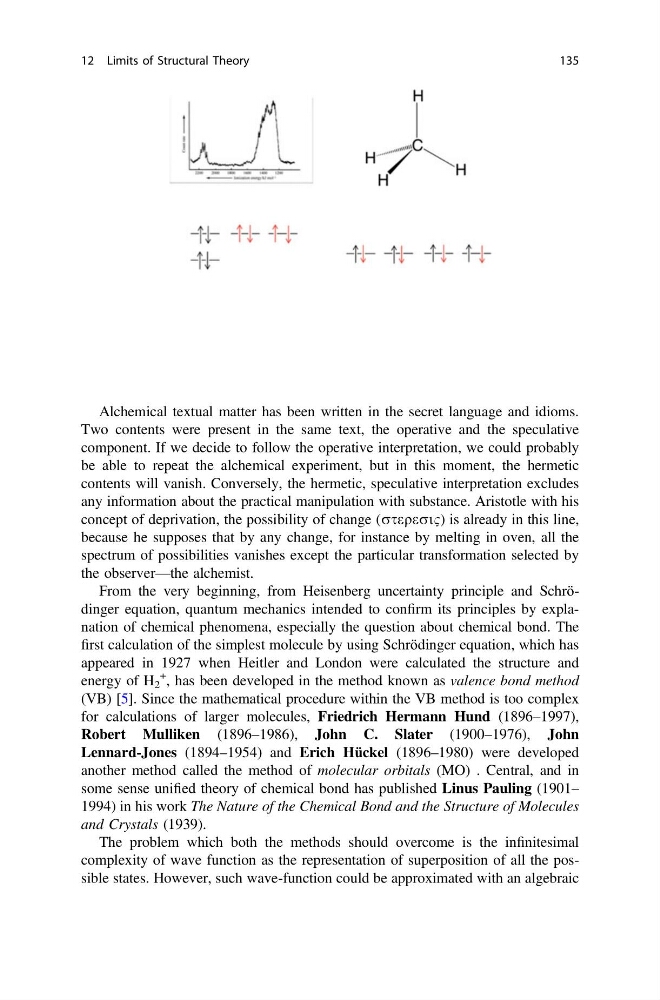
Representation of electron distribution on the left picture provides information about
the electron energies (what is also supported with the photoelectron spectrum on the
top of the figure), the information about the geometry is vanishing. Representation of
the electron distribution on the right figure is wrong, but it helps to understand the
tetrahedral geometry of the methane molecule
12 Limits of Structural Theory
135
Two contents were present in the same text, the operative and the speculative
component. If we decide to follow the operative interpretation, we could probably
be able to repeat the alchemical experiment, but in this moment, the hermetic
contents will vanish. Conversely, the hermetic, speculative interpretation excludes
any information about the practical manipulation with substance. Aristotle with his
concept of deprivation, the possibility of change (rseqeri1) is already in this line,
because he supposes that by any change, for instance by melting in oven, all the
spectrum of possibilities vanishes except the particular transformation selected by
the observer—the alchemist.
From the very beginning, from Heisenberg uncertainty principle and Schrödinger equation, quantum mechanics intended to confirm its principles by explanation of chemical phenomena, especially the question about chemical bond. The
first calculation of the simplest molecule by using Schrödinger equation, which has
appeared in 1927 when Heitler and London were calculated the structure and
energy of H 2
+ , has been developed in the method known as valence bond method
(VB) [5]. Since the mathematical procedure within the VB method is too complex
for calculations of larger molecules, Friedrich Hermann Hund (1896–1997),
Robert Mulliken (1896–1986), John C. Slater (1900–1976), John
Lennard-Jones (1894–1954) and Erich Hückel (1896–1980) were developed
another method called the method of molecular orbitals (MO) . Central, and in
some sense unified theory of chemical bond has published Linus Pauling (1901–
1994) in his work The Nature of the Chemical Bond and the Structure of Molecules
and Crystals (1939).
The problem which both the methods should overcome is the infinitesimal
complexity of wave function as the representation of superposition of all the possible states. However, such wave-function could be approximated with an algebraic
Representation of electron distribution on the left picture provides information about
the electron energies (what is also supported with the photoelectron spectrum on the
top of the figure), the information about the geometry is vanishing. Representation of
the electron distribution on the right figure is wrong, but it helps to understand the
tetrahedral geometry of the methane molecule
12 Limits of Structural Theory
135