

calculate the speed of this car. Thus, if we decide to determine the position of the
car, the information about its speed vanishes, and vice versa, if we decide to
measure the speed, the information about position vanishes. Quod erat
demonstrandum!
The dependence of the response of nature on the observer’s choice, i.e. on the
coupling of subject-object, could clearly be recognized in the choice of chemist to
observe molecules either through Lewis structures, or through quantum mechanics.
In the methane molecule, CH 4 , there are four equal chemical bonds of hydrogen
atoms with carbon. These four Lewis electron pairs is a good representation because
it informs us about the tetrahedral geometry of the molecule. However, quantum
mechanics shows that four electron pairs which have the same energy do not exist
in the methane molecule. Instead, six electrons have higher energy, and two electrons have lower energy. If we decide to use Lewis model, we can obtain the
information about the shape of the molecule, and the information about the fact that
all the carbon-hydrogen bonds are equal, but the information about electron energy
is missing. Conversely, quantum mechanics in the form of a molecular orbital
model, interprets well the electron energy, but discourages us in interpretation of
geometry starting from the concept about the four equal electron pairs in
carbon-hydrogen bonds.
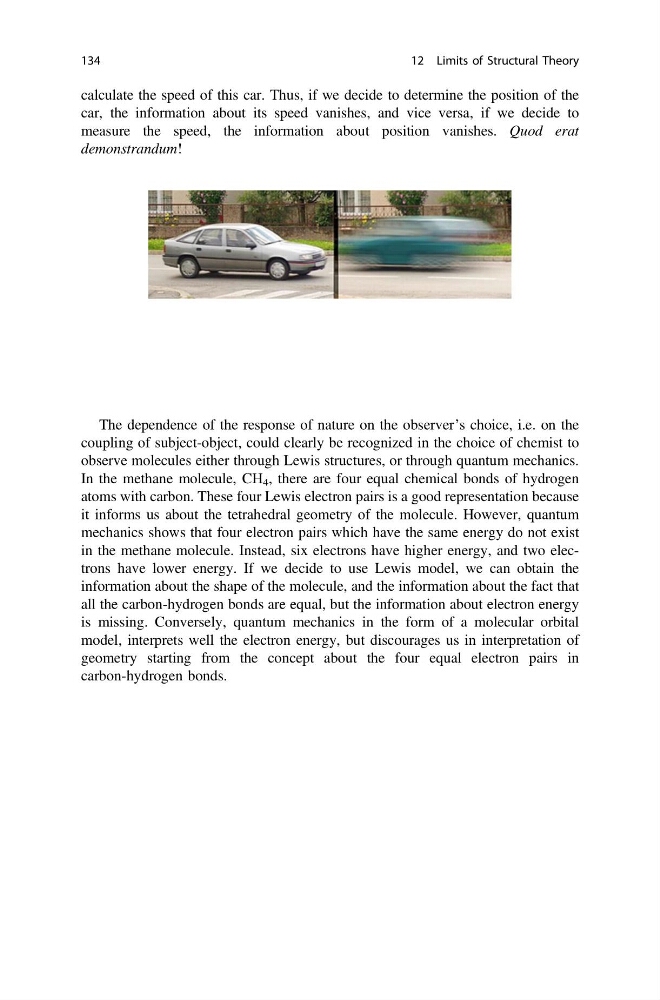
Photos that could serve as a metaphor of the idea about the uncertainty principle. For
the car on the left photo we know position, but the information about its speed is
unavailable. From the length of the smear on the right photo we can calculate the
speed, but we don’t know the position of this car
134
12 Limits of Structural Theory
car, the information about its speed vanishes, and vice versa, if we decide to
measure the speed, the information about position vanishes. Quod erat
demonstrandum!
The dependence of the response of nature on the observer’s choice, i.e. on the
coupling of subject-object, could clearly be recognized in the choice of chemist to
observe molecules either through Lewis structures, or through quantum mechanics.
In the methane molecule, CH 4 , there are four equal chemical bonds of hydrogen
atoms with carbon. These four Lewis electron pairs is a good representation because
it informs us about the tetrahedral geometry of the molecule. However, quantum
mechanics shows that four electron pairs which have the same energy do not exist
in the methane molecule. Instead, six electrons have higher energy, and two electrons have lower energy. If we decide to use Lewis model, we can obtain the
information about the shape of the molecule, and the information about the fact that
all the carbon-hydrogen bonds are equal, but the information about electron energy
is missing. Conversely, quantum mechanics in the form of a molecular orbital
model, interprets well the electron energy, but discourages us in interpretation of
geometry starting from the concept about the four equal electron pairs in
carbon-hydrogen bonds.
Photos that could serve as a metaphor of the idea about the uncertainty principle. For
the car on the left photo we know position, but the information about its speed is
unavailable. From the length of the smear on the right photo we can calculate the
speed, but we don’t know the position of this car
134
12 Limits of Structural Theory