

corresponding molecules possess electrical dipole (Thomson has called it electric
doublet). Evidently, the discovery of the polarity of molecules, as well as the
discovery of dipole moment should be attributed to Thomson.
This discussion clearly shows that subdivision of chemical affinities (chemical
bonds) in the polar, and nonpolar ones, respectively, has its origin in chemical
classification. Thus, Thomson theory has to be regarded as a consequence of the
research within the frame of chemical epistemology.
In physics, the atomic and molecular structure was analysed in the accordance
with physical epistemology, in that time based on classical mechanics and electrodynamics. In this picture, the atom is a sort of microcosmic planetary system
where the positive nucleus is surrounded by electrons in their orbits. This representation of atom is invented by Niels Bohr in his papers in Philosophical
Magazine, published during the year 1913. In his Newtonian image of atom, Bohr
has successfully calculated the electronic spectra of hydrogen atom, but nothing
more. The calculated spectra for atoms of other elements did not agree with
observations.
If, by Bohr, atom is a mechanical system with proton in the centre and the
orbiting electron, then the hydrogen molecule should also be a sort of mechanical
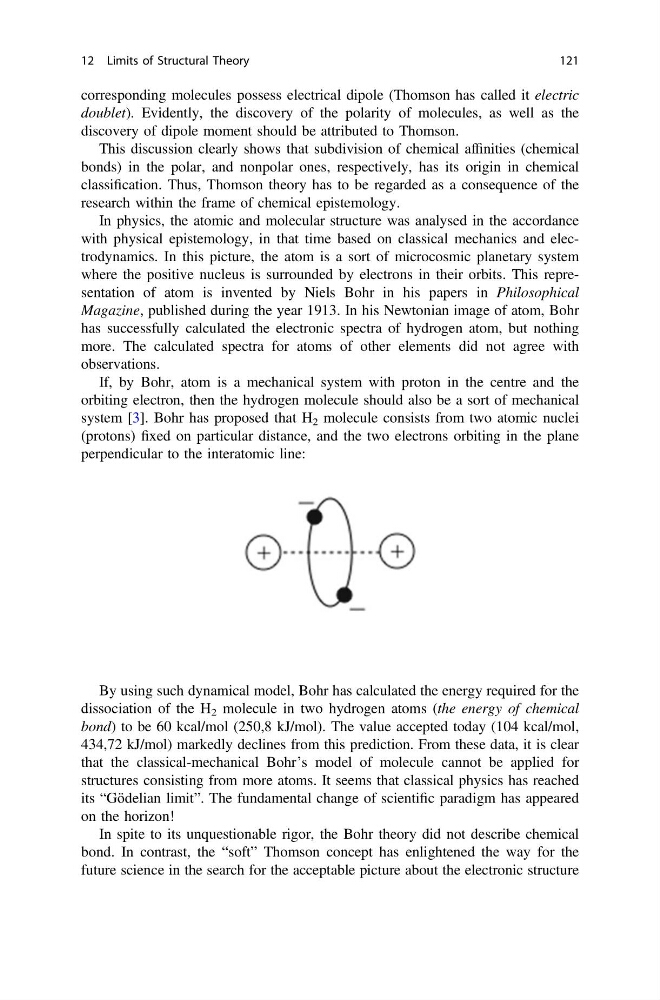
system [3]. Bohr has proposed that H 2 molecule consists from two atomic nuclei
(protons) fixed on particular distance, and the two electrons orbiting in the plane
perpendicular to the interatomic line:
By using such dynamical model, Bohr has calculated the energy required for the
dissociation of the H 2 molecule in two hydrogen atoms (the energy of chemical
bond) to be 60 kcal/mol (250,8 kJ/mol). The value accepted today (104 kcal/mol,
434,72 kJ/mol) markedly declines from this prediction. From these data, it is clear
that the classical-mechanical Bohr’s model of molecule cannot be applied for
structures consisting from more atoms. It seems that classical physics has reached
its “Gödelian limit”. The fundamental change of scientific paradigm has appeared
on the horizon!
In spite to its unquestionable rigor, the Bohr theory did not describe chemical
bond. In contrast, the “soft” Thomson concept has enlightened the way for the
future science in the search for the acceptable picture about the electronic structure
Model of the structure of hydrogen molecule proposed by Niels Bohr
12 Limits of Structural Theory
121
doublet). Evidently, the discovery of the polarity of molecules, as well as the
discovery of dipole moment should be attributed to Thomson.
This discussion clearly shows that subdivision of chemical affinities (chemical
bonds) in the polar, and nonpolar ones, respectively, has its origin in chemical
classification. Thus, Thomson theory has to be regarded as a consequence of the
research within the frame of chemical epistemology.
In physics, the atomic and molecular structure was analysed in the accordance
with physical epistemology, in that time based on classical mechanics and electrodynamics. In this picture, the atom is a sort of microcosmic planetary system
where the positive nucleus is surrounded by electrons in their orbits. This representation of atom is invented by Niels Bohr in his papers in Philosophical
Magazine, published during the year 1913. In his Newtonian image of atom, Bohr
has successfully calculated the electronic spectra of hydrogen atom, but nothing
more. The calculated spectra for atoms of other elements did not agree with
observations.
If, by Bohr, atom is a mechanical system with proton in the centre and the
orbiting electron, then the hydrogen molecule should also be a sort of mechanical
system [3]. Bohr has proposed that H 2 molecule consists from two atomic nuclei
(protons) fixed on particular distance, and the two electrons orbiting in the plane
perpendicular to the interatomic line:
By using such dynamical model, Bohr has calculated the energy required for the
dissociation of the H 2 molecule in two hydrogen atoms (the energy of chemical
bond) to be 60 kcal/mol (250,8 kJ/mol). The value accepted today (104 kcal/mol,
434,72 kJ/mol) markedly declines from this prediction. From these data, it is clear
that the classical-mechanical Bohr’s model of molecule cannot be applied for
structures consisting from more atoms. It seems that classical physics has reached
its “Gödelian limit”. The fundamental change of scientific paradigm has appeared
on the horizon!
In spite to its unquestionable rigor, the Bohr theory did not describe chemical
bond. In contrast, the “soft” Thomson concept has enlightened the way for the
future science in the search for the acceptable picture about the electronic structure
Model of the structure of hydrogen molecule proposed by Niels Bohr
12 Limits of Structural Theory
121