

are three directed electrons. This description is shown in the picture taken from the
original Thomson’s publication.
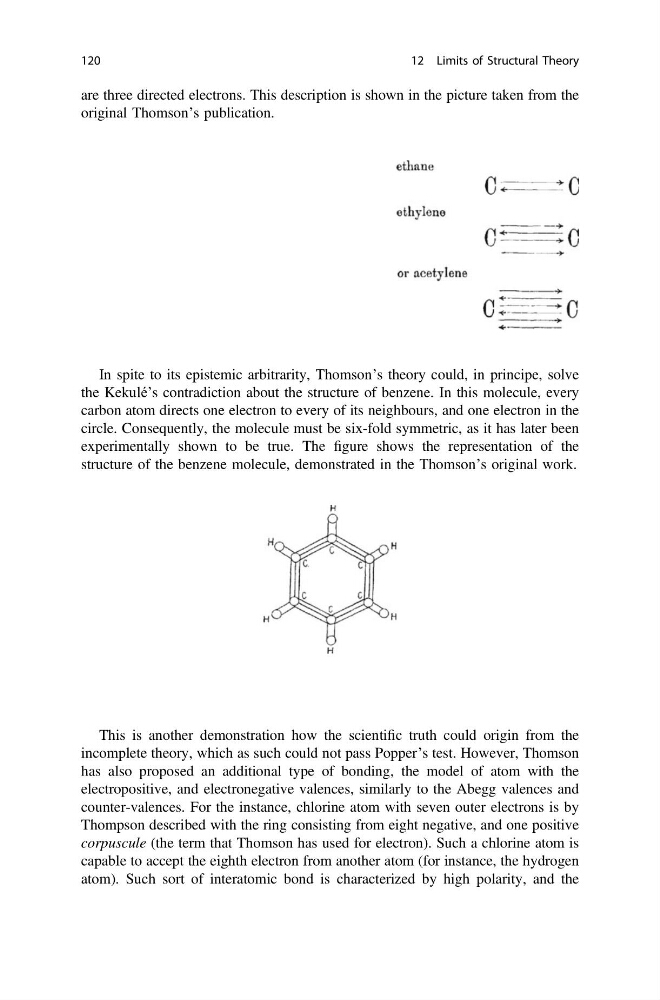
In spite to its epistemic arbitrarity, Thomson’s theory could, in principe, solve
the Kekulé’s contradiction about the structure of benzene. In this molecule, every
carbon atom directs one electron to every of its neighbours, and one electron in the
circle. Consequently, the molecule must be six-fold symmetric, as it has later been
experimentally shown to be true. The figure shows the representation of the
structure of the benzene molecule, demonstrated in the Thomson’s original work.
This is another demonstration how the scientific truth could origin from the
incomplete theory, which as such could not pass Popper’s test. However, Thomson
has also proposed an additional type of bonding, the model of atom with the
electropositive, and electronegative valences, similarly to the Abegg valences and
counter-valences. For the instance, chlorine atom with seven outer electrons is by
Thompson described with the ring consisting from eight negative, and one positive
corpuscule (the term that Thomson has used for electron). Such a chlorine atom is
capable to accept the eighth electron from another atom (for instance, the hydrogen
atom). Such sort of interatomic bond is characterized by high polarity, and the
Facsimile from the
Thomson’s paper about
the nature of chemical
bond
Facsimile from Thomson’s work about the nature of chemical bond in benzene molecule
120
12 Limits of Structural Theory
original Thomson’s publication.
In spite to its epistemic arbitrarity, Thomson’s theory could, in principe, solve
the Kekulé’s contradiction about the structure of benzene. In this molecule, every
carbon atom directs one electron to every of its neighbours, and one electron in the
circle. Consequently, the molecule must be six-fold symmetric, as it has later been
experimentally shown to be true. The figure shows the representation of the
structure of the benzene molecule, demonstrated in the Thomson’s original work.
This is another demonstration how the scientific truth could origin from the
incomplete theory, which as such could not pass Popper’s test. However, Thomson
has also proposed an additional type of bonding, the model of atom with the
electropositive, and electronegative valences, similarly to the Abegg valences and
counter-valences. For the instance, chlorine atom with seven outer electrons is by
Thompson described with the ring consisting from eight negative, and one positive
corpuscule (the term that Thomson has used for electron). Such a chlorine atom is
capable to accept the eighth electron from another atom (for instance, the hydrogen
atom). Such sort of interatomic bond is characterized by high polarity, and the
Facsimile from the
Thomson’s paper about
the nature of chemical
bond
Facsimile from Thomson’s work about the nature of chemical bond in benzene molecule
120
12 Limits of Structural Theory