

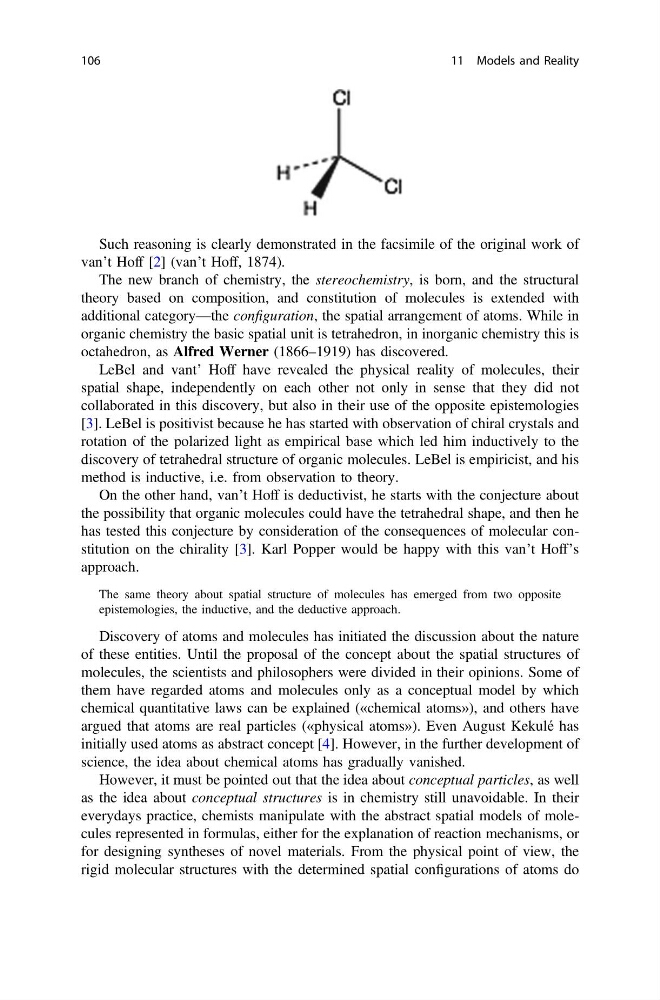
Such reasoning is clearly demonstrated in the facsimile of the original work of
van’t Hoff [2] (van’t Hoff, 1874).
The new branch of chemistry, the stereochemistry, is born, and the structural
theory based on composition, and constitution of molecules is extended with
additional category—the configuration, the spatial arrangement of atoms. While in
organic chemistry the basic spatial unit is tetrahedron, in inorganic chemistry this is
octahedron, as Alfred Werner (1866–1919) has discovered.
LeBel and vant’ Hoff have revealed the physical reality of molecules, their
spatial shape, independently on each other not only in sense that they did not
collaborated in this discovery, but also in their use of the opposite epistemologies
[3]. LeBel is positivist because he has started with observation of chiral crystals and
rotation of the polarized light as empirical base which led him inductively to the
discovery of tetrahedral structure of organic molecules. LeBel is empiricist, and his
method is inductive, i.e. from observation to theory.
On the other hand, van’t Hoff is deductivist, he starts with the conjecture about
the possibility that organic molecules could have the tetrahedral shape, and then he
has tested this conjecture by consideration of the consequences of molecular constitution on the chirality [3]. Karl Popper would be happy with this van’t Hoff’s
approach.
The same theory about spatial structure of molecules has emerged from two opposite
epistemologies, the inductive, and the deductive approach.
Discovery of atoms and molecules has initiated the discussion about the nature
of these entities. Until the proposal of the concept about the spatial structures of
molecules, the scientists and philosophers were divided in their opinions. Some of
them have regarded atoms and molecules only as a conceptual model by which
chemical quantitative laws can be explained («chemical atoms»), and others have
argued that atoms are real particles («physical atoms»). Even August Kekulé has
initially used atoms as abstract concept [4]. However, in the further development of
science, the idea about chemical atoms has gradually vanished.
However, it must be pointed out that the idea about conceptual particles, as well
as the idea about conceptual structures is in chemistry still unavoidable. In their
everydays practice, chemists manipulate with the abstract spatial models of molecules represented in formulas, either for the explanation of reaction mechanisms, or
for designing syntheses of novel materials. From the physical point of view, the
rigid molecular structures with the determined spatial configurations of atoms do
106
11 Models and Reality
van’t Hoff [2] (van’t Hoff, 1874).
The new branch of chemistry, the stereochemistry, is born, and the structural
theory based on composition, and constitution of molecules is extended with
additional category—the configuration, the spatial arrangement of atoms. While in
organic chemistry the basic spatial unit is tetrahedron, in inorganic chemistry this is
octahedron, as Alfred Werner (1866–1919) has discovered.
LeBel and vant’ Hoff have revealed the physical reality of molecules, their
spatial shape, independently on each other not only in sense that they did not
collaborated in this discovery, but also in their use of the opposite epistemologies
[3]. LeBel is positivist because he has started with observation of chiral crystals and
rotation of the polarized light as empirical base which led him inductively to the
discovery of tetrahedral structure of organic molecules. LeBel is empiricist, and his
method is inductive, i.e. from observation to theory.
On the other hand, van’t Hoff is deductivist, he starts with the conjecture about
the possibility that organic molecules could have the tetrahedral shape, and then he
has tested this conjecture by consideration of the consequences of molecular constitution on the chirality [3]. Karl Popper would be happy with this van’t Hoff’s
approach.
The same theory about spatial structure of molecules has emerged from two opposite
epistemologies, the inductive, and the deductive approach.
Discovery of atoms and molecules has initiated the discussion about the nature
of these entities. Until the proposal of the concept about the spatial structures of
molecules, the scientists and philosophers were divided in their opinions. Some of
them have regarded atoms and molecules only as a conceptual model by which
chemical quantitative laws can be explained («chemical atoms»), and others have
argued that atoms are real particles («physical atoms»). Even August Kekulé has
initially used atoms as abstract concept [4]. However, in the further development of
science, the idea about chemical atoms has gradually vanished.
However, it must be pointed out that the idea about conceptual particles, as well
as the idea about conceptual structures is in chemistry still unavoidable. In their
everydays practice, chemists manipulate with the abstract spatial models of molecules represented in formulas, either for the explanation of reaction mechanisms, or
for designing syntheses of novel materials. From the physical point of view, the
rigid molecular structures with the determined spatial configurations of atoms do
106
11 Models and Reality